QUESTION IMAGE
Question
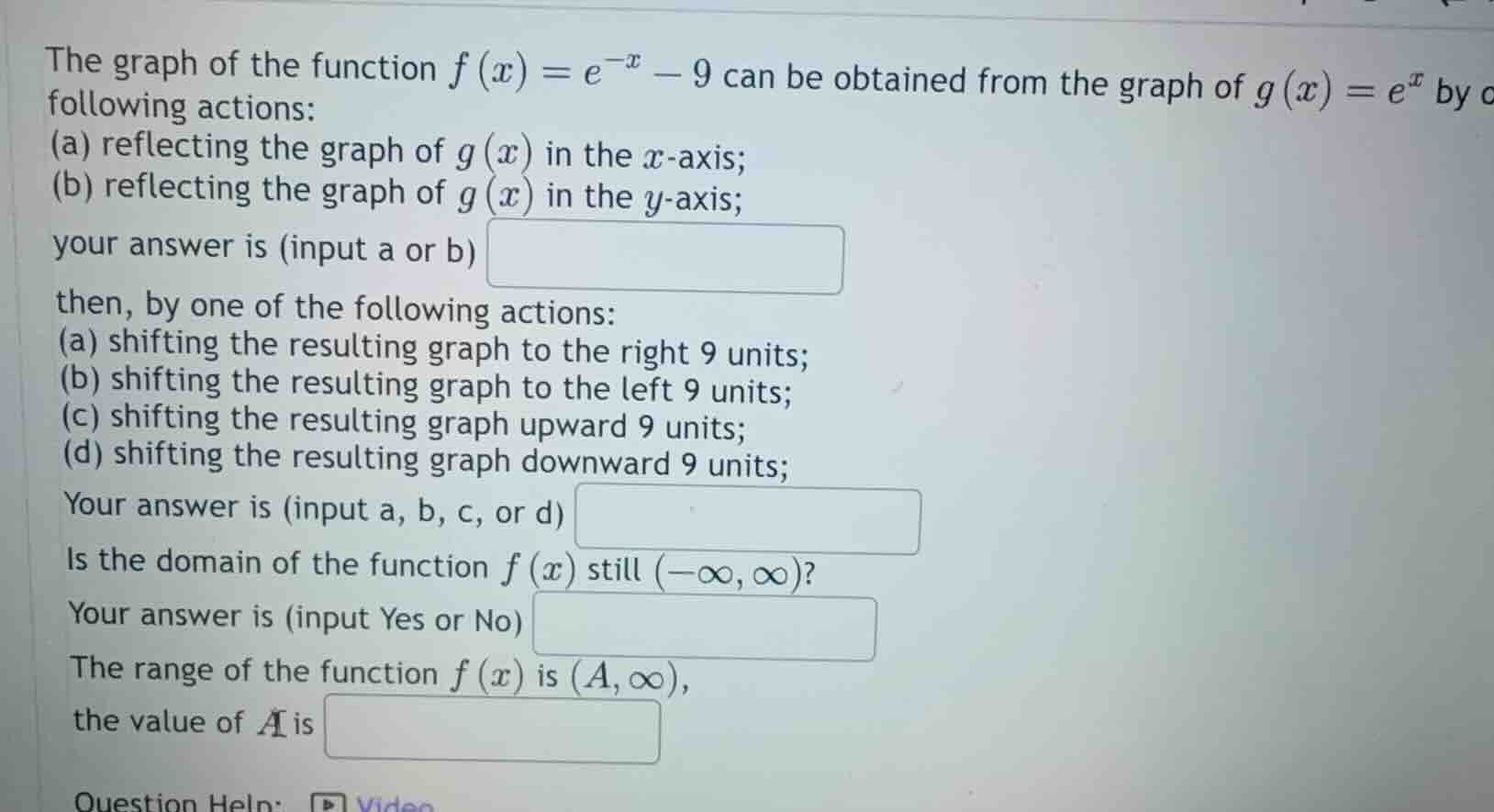
the graph of the function (f(x) = e^{-x} - 9) can be obtained from the graph of (g(x) = e^x) by one of the following actions:
(a) reflecting the graph of (g(x)) in the (x)-axis;
(b) reflecting the graph of (g(x)) in the (y)-axis;
your answer is (input a or b)
then, by one of the following actions:
(a) shifting the resulting graph to the right 9 units;
(b) shifting the resulting graph to the left 9 units;
(c) shifting the resulting graph upward 9 units;
(d) shifting the resulting graph downward 9 units;
your answer is (input a, b, c, or d)
is the domain of the function (f(x)) still ((-infty, infty))?
your answer is (input yes or no)
the range of the function (f(x)) is ((a, infty)),
the value of (a) is
🆕 New Concept Discovered: Function Transformations
How graphs shift, stretch, and reflect
Step 1: Identify the Reflection
To transform \( g(x) = e^x \) into the intermediate stage of \( f(x) = e^{-x} - 9 \), we first look at the exponent:
Replacing \( x \) with \( -x \) reflects the graph horizontally across the vertical axis.
- What this means: A horizontal flip is a reflection in the \( y \)-axis.
Therefore, the first action is b.
Step 2: Identify the Shift
Next, we look at the constant term added to the function:
Subtracting a constant from the entire function shifts the graph vertically.
- What this means: Subtracting \( 9 \) moves every point on the graph down by \( 9 \) units.
Therefore, the second action is d.
Step 3: Determine the Domain
The domain of the original exponential function \( g(x) = e^x \) is all real numbers, \( (-\infty, \infty) \).
- What this means: Reflecting a graph horizontally and shifting it vertically does not restrict the inputs you are allowed to plug into \( x \). You can still evaluate \( e^{-x} - 9 \) for any real number.
Therefore, the domain is still \( (-\infty, \infty) \). The answer is Yes.
Step 4: Determine the Range
The range of the basic exponential function \( y = e^{-x} \) is \( (0, \infty) \) because it has a horizontal asymptote at \( y = 0 \) and grows upward.
- What this means: Shifting the entire graph down by \( 9 \) units also shifts the horizontal asymptote down by \( 9 \) units, from \( y = 0 \) to \( y = -9 \).
The new range is:
Comparing this to the given interval \( (A, \infty) \), we find:

Snap & solve any problem in the app
Get step-by-step solutions on Sovi AI
Photo-based solutions with guided steps
Explore more problems and detailed explanations
- First action: b
- Second action: d
- Is the domain still \( (-\infty, \infty) \)? Yes
- The value of \( A \) is -9