QUESTION IMAGE
Question
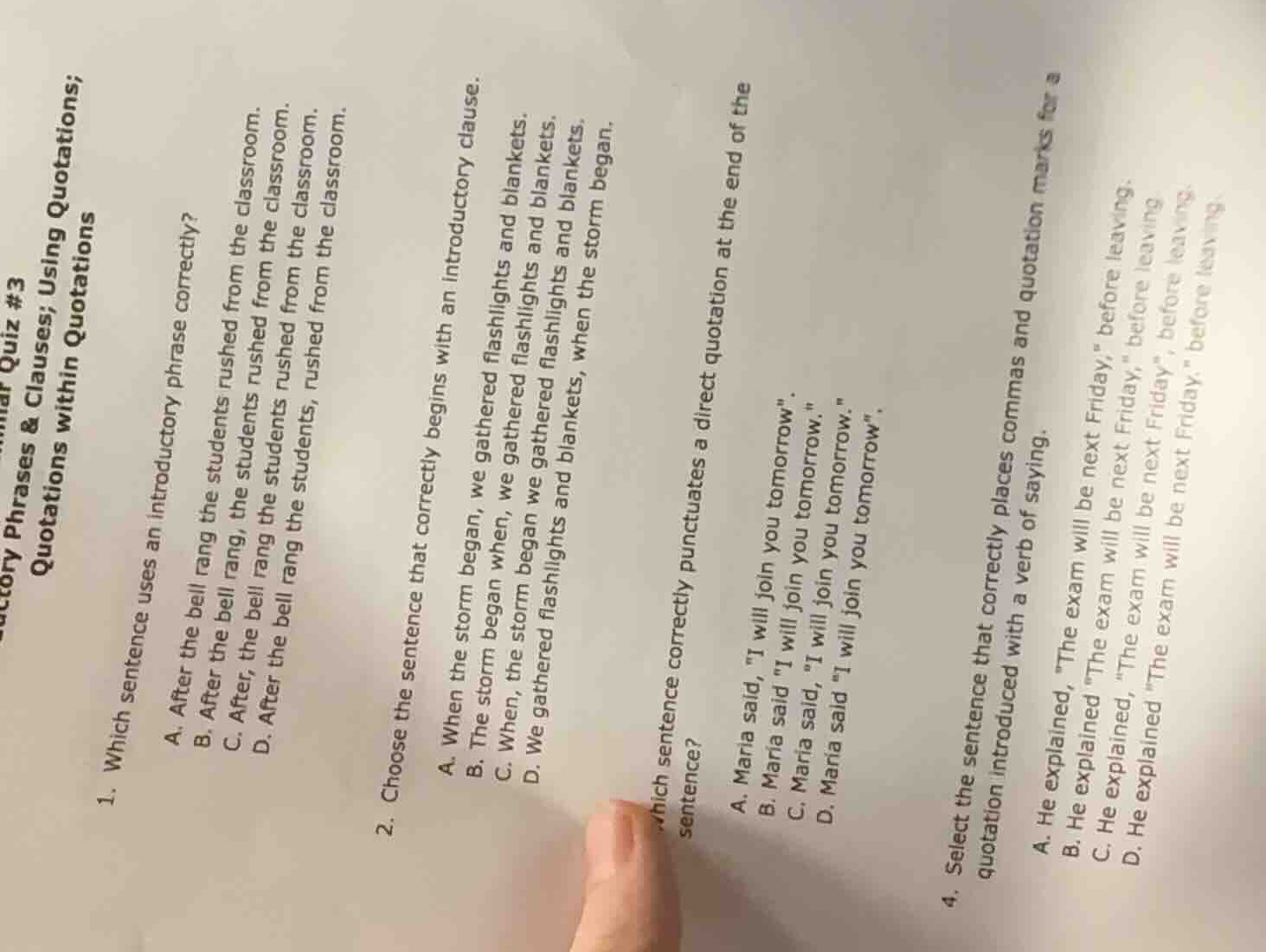
grammar quiz #3
introductory phrases & clauses; using quotations;
quotations within quotations
- which sentence uses an introductory phrase correctly?
a. after the bell rang the students rushed from the classroom.
b. after the bell rang, the students rushed from the classroom.
c. after, the bell rang the students rushed from the classroom.
d. after the bell rang the students, rushed from the classroom.
- choose the sentence that correctly begins with an introductory clause.
a. when the storm began, we gathered flashlights and blankets.
b. the storm began when, we gathered flashlights and blankets.
c. when, the storm began we gathered flashlights and blankets.
d. we gathered flashlights and blankets, when the storm began.
- which sentence correctly punctuates a direct quotation at the end of the sentence?
a. maria said, \i will join you tomorrow\.
b. maria said \i will join you tomorrow.\
c. maria said, \i will join you tomorrow.\
d. maria said \i will join you tomorrow\,
- select the sentence that correctly places commas and quotation marks for a quotation introduced with a verb of saying.
a. he explained, \the exam will be next friday,\ before leaving.
b. he explained \the exam will be next friday,\ before leaving.
c. he explained, \the exam will be next friday\, before leaving.
d. he explained \the exam will be next friday.\ before leaving.
Analyze introductory phrases
An introductory prepositional phrase or dependent clause at the start of a sentence should be followed by a comma to separate it from the main independent clause.
In Question 1, "After the bell rang" is an introductory adverbial clause. It must be followed by a comma before the main clause "the students rushed from the classroom."
- Option A lacks a comma.
- Option B correctly places a comma after "rang".
- Option C incorrectly places a comma after "After".
- Option D incorrectly places a comma after "students".
Thus, Option B is correct.
Analyze introductory clauses
An introductory adverbial clause starts with a subordinating conjunction (like "When") and must be followed by a comma when it precedes the independent clause.
In Question 2:
- Option A: "When the storm began, we gathered flashlights and blankets." This correctly starts with the subordinating clause followed by a comma.
- Option B: "The storm began when, we gathered..." is grammatically incorrect.
- Option C: "When, the storm began..." places a comma incorrectly after the subordinating conjunction.
- Option D: "We gathered flashlights and blankets, when the storm began." does not begin with an introductory clause.
Thus, Option A is correct.
Analyze direct quotation punctuation
When a direct quotation ends a sentence, the terminal punctuation (such as a period) must be placed inside the closing quotation mark.
In Question 3:
- Option A: The period is outside the quotation mark:
tomorrow". - Option B: There is a space before the period inside the quotation mark:
tomorrow ." - Option C: The period is correctly placed inside the quotation mark with no extra spaces:
tomorrow." - Option D: A comma is used instead of a period:
tomorrow",
Thus, Option C is correct.
Analyze quotation introduction punctuation
When introducing a direct quotation with a verb of saying (like "explained"), a comma should separate the introductory phrase from the quotation, and the terminal punctuation must go inside the quotation marks.
In Question 4:
- Option A: Lacks a comma after "explained" and has the comma outside the quotation mark.
- Option B: Correctly places a comma after "explained" and places the comma inside the quotation marks:
"The exam will be next Friday," before leaving. - Option C: Lacks a comma after "explained".
- Option D: Places a semicolon after "explained".
Thus, Option B is correct.

Snap & solve any problem in the app
Get step-by-step solutions on Sovi AI
Photo-based solutions with guided steps
Explore more problems and detailed explanations
Question 1
- (A) After the bell rang the students rushed from the classroom.
- (B) After the bell rang, the students rushed from the classroom. (Correct answer)
- (C) After, the bell rang the students rushed from the classroom.
- (D) After the bell rang the students, rushed from the classroom.
Question 2
- (A) When the storm began, we gathered flashlights and blankets. (Correct answer)
- (B) The storm began when, we gathered flashlights and blankets.
- (C) When, the storm began we gathered flashlights and blankets.
- (D) We gathered flashlights and blankets, when the storm began.
Question 3
- (A) Maria said, "I will join you tomorrow".
- (B) Maria said "I will join you tomorrow. "
- (C) Maria said, "I will join you tomorrow." (Correct answer)
- (D) Maria said "I will join you tomorrow",
Question 4
- (A) He explained, "The exam will be next Friday," before leaving.</mcq-correct>
- (B) He explained, "The exam will be next Friday," before leaving. (Correct answer)
<mcq-option>(C) He explained "The exam will be next Friday", before leaving.
- (D) He explained "The exam will be next Friday," before leaving.