QUESTION IMAGE
Question
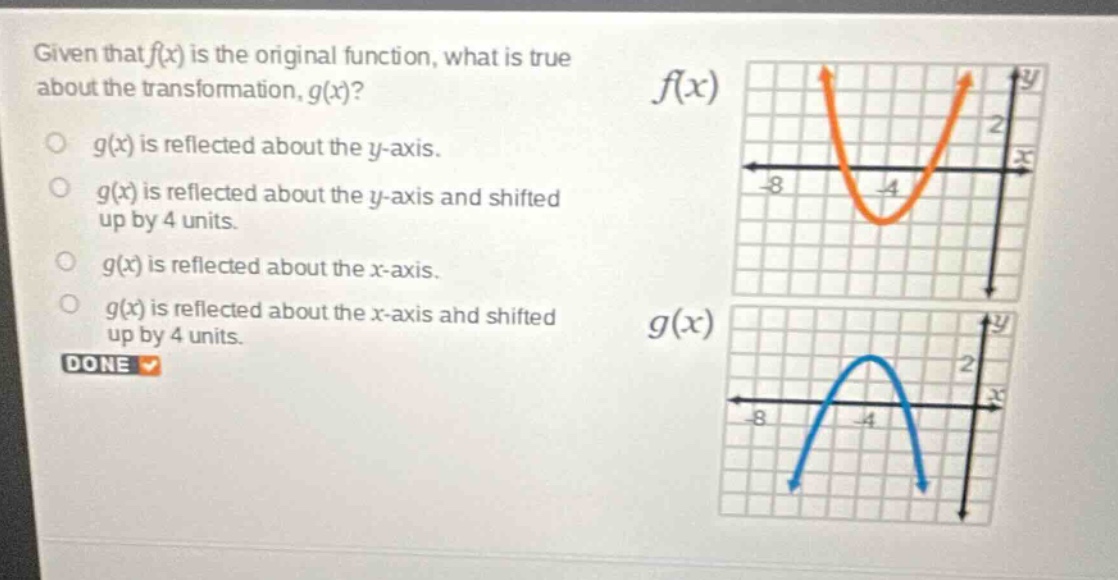
given that (f(x)) is the original function, what is true about the transformation, (g(x))?
- (g(x)) is reflected about the (y)-axis.
- (g(x)) is reflected about the (y)-axis and shifted up by 4 units.
- (g(x)) is reflected about the (x)-axis.
- (g(x)) is reflected about the (x)-axis and shifted up by 4 units.
⚡ Using what you learned: combining transformations
Step 1: Identify the vertex of the original function \( f(x) \)
Looking at the graph of \( f(x) \):
- The vertex (lowest point) of the parabola is located at \( (-4, -2) \).
- The parabola opens upwards.
Step 2: Identify the vertex of the transformed function \( g(x) \)
Looking at the graph of \( g(x) \):
- The vertex (highest point) of the parabola is located at \( (-4, 2) \).
- The parabola opens downwards.
Step 3: Analyze the transformations
- Reflection:
- The parabola changes from opening upwards to opening downwards. This indicates a reflection across the \( x \)-axis:
$$
y = -f(x)
$$
- Reflecting the original vertex \( (-4, -2) \) across the \( x \)-axis changes the sign of the \( y \)-coordinate, resulting in the point \( (-4, 2) \).
- Vertical Shift:
- Since the reflected vertex \( (-4, 2) \) matches the vertex of \( g(x) \) exactly, no vertical shift is required after the reflection.
- Therefore, the transformation is solely a reflection about the \( x \)-axis.

Snap & solve any problem in the app
Get step-by-step solutions on Sovi AI
Photo-based solutions with guided steps
Explore more problems and detailed explanations
\( g(x) \) is reflected about the \( x \)-axis.