QUESTION IMAGE
Question
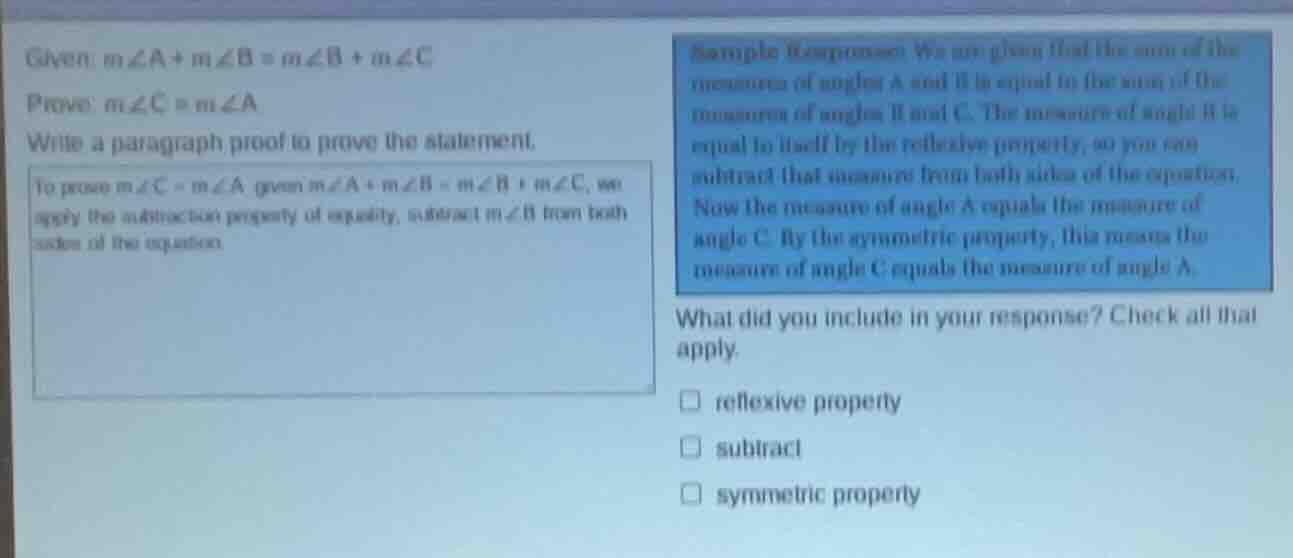
given: ( mangle a + mangle b = mangle b + mangle c )
prove: ( mangle c = mangle a )
write a paragraph proof to prove the statement.
to prove ( mangle c = mangle a ) given ( mangle a + mangle b = mangle b + mangle c ), we apply the subtraction property of equality, subtract ( mangle b ) from both sides of the equation.
sample response: we are given that the sum of the measures of angles a and b is equal to the sum of the measures of angles b and c. the measure of angle b is equal to itself by the reflexive property, so you can subtract that measure from both sides of the equation. now the measure of angle a equals the measure of angle c. by the symmetric property, this means the measure of angle c equals the measure of angle a.
what did you include in your response? check all that apply.
☐ reflexive property
☐ subtract
☐ symmetric property
- The sample response mentions the measure of angle B is equal to itself (reflexive property).
- It says to subtract the measure of angle B from both sides (subtract is included).
- It then uses the symmetric property to state \( m\angle C = m\angle A \) from \( m\angle A = m\angle C \). So all three options are included.

Snap & solve any problem in the app
Get step-by-step solutions on Sovi AI
Photo-based solutions with guided steps
Explore more problems and detailed explanations
- reflexive property
- subtract
- symmetric property