Sovi.AI - AI Math Tutor

Scan to solve math questions

QUESTION IMAGE

given: jklm is an isosceles trapezoid, \\(\\overline{kl} \\parallel \\o…

Question

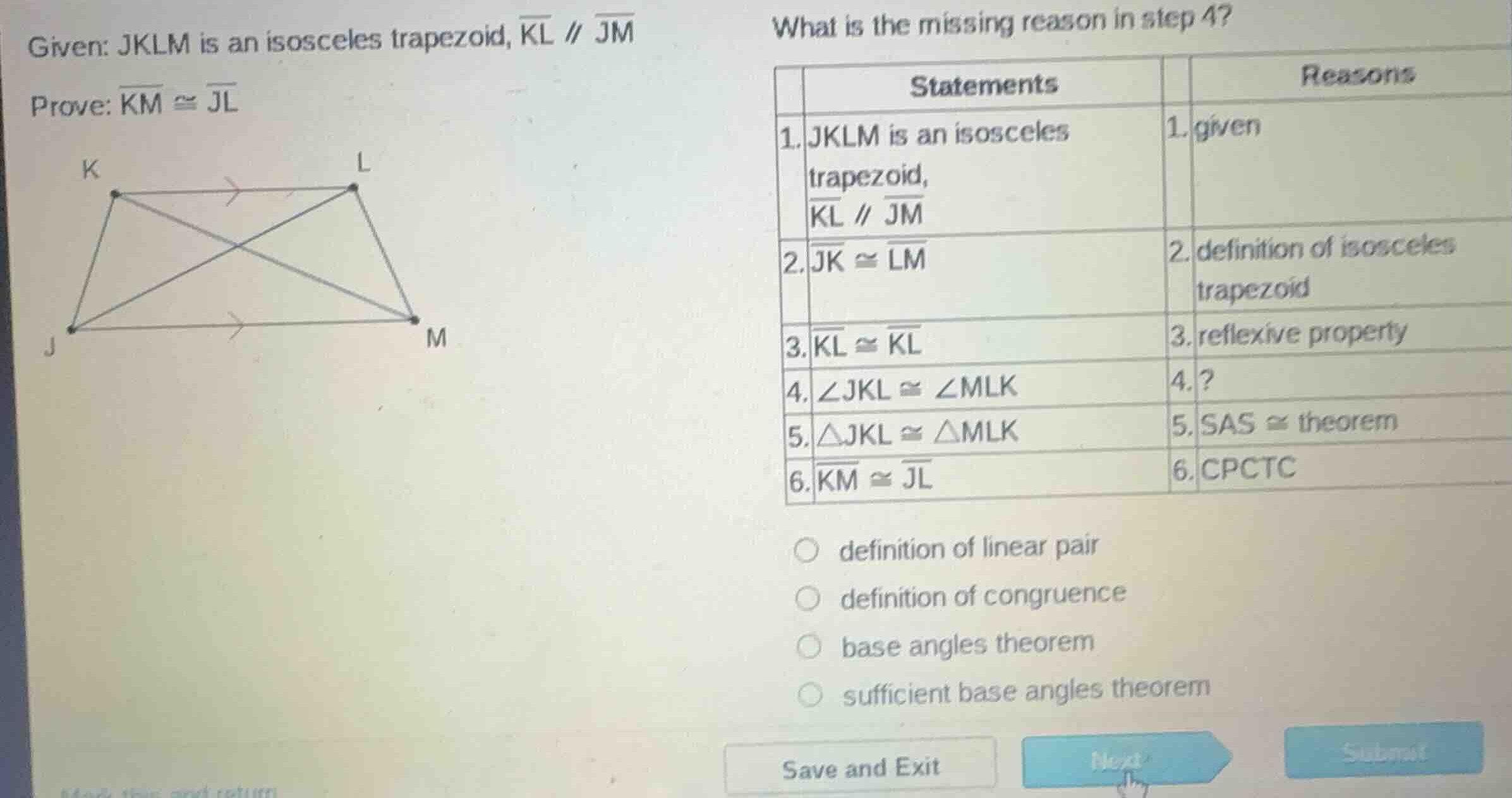
given: jklm is an isosceles trapezoid, \\(\overline{kl} \parallel \overline{jm}\\)
prove: \\(\overline{km} \cong \overline{jl}\\)

what is the missing reason in step 4?

\

$$\begin{tabular}{|l|l|} \\hline \\textbf{statements} & \\textbf{reasons} \\\\ \\hline 1. jklm is an isosceles trapezoid, \\(\\overline{kl} \\parallel \\overline{jm}\\) & 1. given \\\\ \\hline 2. \\(\\overline{jk} \\cong \\overline{lm}\\) & 2. definition of isosceles trapezoid \\\\ \\hline 3. \\(\\overline{kl} \\cong \\overline{kl}\\) & 3. reflexive property \\\\ \\hline 4. \\(\\angle jkl \\cong \\angle mlk\\) & 4. ? \\\\ \\hline 5. \\(\\triangle jkl \\cong \\triangle mlk\\) & 5. sas \\cong theorem \\\\ \\hline 6. \\(\\overline{km} \\cong \\overline{jl}\\) & 6. cpctc \\\\ \\hline \\end{tabular}$$

choices:

  • definition of linear pair
  • definition of congruence
  • base angles theorem
  • sufficient base angles theorem

Explanation:

Response

<pre_analysis>
{
"quality": "clear",
"question_count": 1,
"skills_matched": [
"direct_cot",
"multiple_choice_formatter",
"explain_then_answer",
"tutor"
],
"needs_drawing": false,
"concepts_used": [
"Trapezoid Properties"
],
"new_concepts": [
"Isosceles Trapezoid Base Angles Theorem"
],
"current_concepts": [
"Trapezoid Properties",
"Isosceles Trapezoid Base Angles Theorem"
]
}
</pre_analysis>

<reasoning>

Analyze the given geometric proof

The goal of the proof is to show that the diagonals of an isosceles trapezoid \(JKLM\) are congruent, specifically \(\overline{KM} \cong \overline{JL}\).

Let's examine the steps of the proof:

  1. Statement: \(JKLM\) is an isosceles trapezoid, \(\overline{KL} \parallel \overline{JM}\). Reason: Given.
  2. Statement: \(\overline{JK} \cong \overline{LM}\). Reason: Definition of isosceles trapezoid (non-parallel legs are congruent).
  3. Statement: \(\overline{KL} \cong \overline{KL}\). Reason: Reflexive property.
  4. Statement: \(\angle JKL \cong \angle MLK\). Reason: ?
  5. Statement: \(\Delta JKL \cong \Delta MLK\). Reason: SAS congruence theorem (using \(\overline{JK} \cong \overline{LM}\), \(\angle JKL \cong \angle MLK\), and \(\overline{KL} \cong \overline{KL}\)).
  6. Statement: \(\overline{KM} \cong \overline{JL}\). Reason: CPCTC.

Identify the missing reason for Step 4

Using the Trapezoid Properties, we know that an isosceles trapezoid has two pairs of congruent base angles.

  • One pair of base angles is along the longer base: \(\angle KJM \cong \angle LMJ\).
  • The other pair of base angles is along the shorter base: \(\angle JKL \cong \angle MLK\).

The theorem stating that the base angles of an isosceles trapezoid are congruent is called the base angles theorem (or specifically, the isosceles trapezoid base angles theorem).

Therefore, the reason that justifies \(\angle JKL \cong \angle MLK\) is the base angles theorem.
</reasoning>

<answer>
<mcq-option>definition of linear pair</mcq-option>
<mcq-option>definition of congruence</mcq-option>
<mcq-correct>base angles theorem</mcq-correct>
<mcq-option>sufficient base angles theorem</mcq-option>
</answer>

<post_analysis>
{
"subject": "Mathematics",
"question_type": "Multiple Choice",
"knowledge_point": [
"Mathematics",
"Geometry",
"Trapezoid Properties"
]
}
</post_analysis>

Answer:

<pre_analysis>
{
"quality": "clear",
"question_count": 1,
"skills_matched": [
"direct_cot",
"multiple_choice_formatter",
"explain_then_answer",
"tutor"
],
"needs_drawing": false,
"concepts_used": [
"Trapezoid Properties"
],
"new_concepts": [
"Isosceles Trapezoid Base Angles Theorem"
],
"current_concepts": [
"Trapezoid Properties",
"Isosceles Trapezoid Base Angles Theorem"
]
}
</pre_analysis>

<reasoning>

Analyze the given geometric proof

The goal of the proof is to show that the diagonals of an isosceles trapezoid \(JKLM\) are congruent, specifically \(\overline{KM} \cong \overline{JL}\).

Let's examine the steps of the proof:

  1. Statement: \(JKLM\) is an isosceles trapezoid, \(\overline{KL} \parallel \overline{JM}\). Reason: Given.
  2. Statement: \(\overline{JK} \cong \overline{LM}\). Reason: Definition of isosceles trapezoid (non-parallel legs are congruent).
  3. Statement: \(\overline{KL} \cong \overline{KL}\). Reason: Reflexive property.
  4. Statement: \(\angle JKL \cong \angle MLK\). Reason: ?
  5. Statement: \(\Delta JKL \cong \Delta MLK\). Reason: SAS congruence theorem (using \(\overline{JK} \cong \overline{LM}\), \(\angle JKL \cong \angle MLK\), and \(\overline{KL} \cong \overline{KL}\)).
  6. Statement: \(\overline{KM} \cong \overline{JL}\). Reason: CPCTC.

Identify the missing reason for Step 4

Using the Trapezoid Properties, we know that an isosceles trapezoid has two pairs of congruent base angles.

  • One pair of base angles is along the longer base: \(\angle KJM \cong \angle LMJ\).
  • The other pair of base angles is along the shorter base: \(\angle JKL \cong \angle MLK\).

The theorem stating that the base angles of an isosceles trapezoid are congruent is called the base angles theorem (or specifically, the isosceles trapezoid base angles theorem).

Therefore, the reason that justifies \(\angle JKL \cong \angle MLK\) is the base angles theorem.
</reasoning>

<answer>
<mcq-option>definition of linear pair</mcq-option>
<mcq-option>definition of congruence</mcq-option>
<mcq-correct>base angles theorem</mcq-correct>
<mcq-option>sufficient base angles theorem</mcq-option>
</answer>

<post_analysis>
{
"subject": "Mathematics",
"question_type": "Multiple Choice",
"knowledge_point": [
"Mathematics",
"Geometry",
"Trapezoid Properties"
]
}
</post_analysis>