QUESTION IMAGE
Question
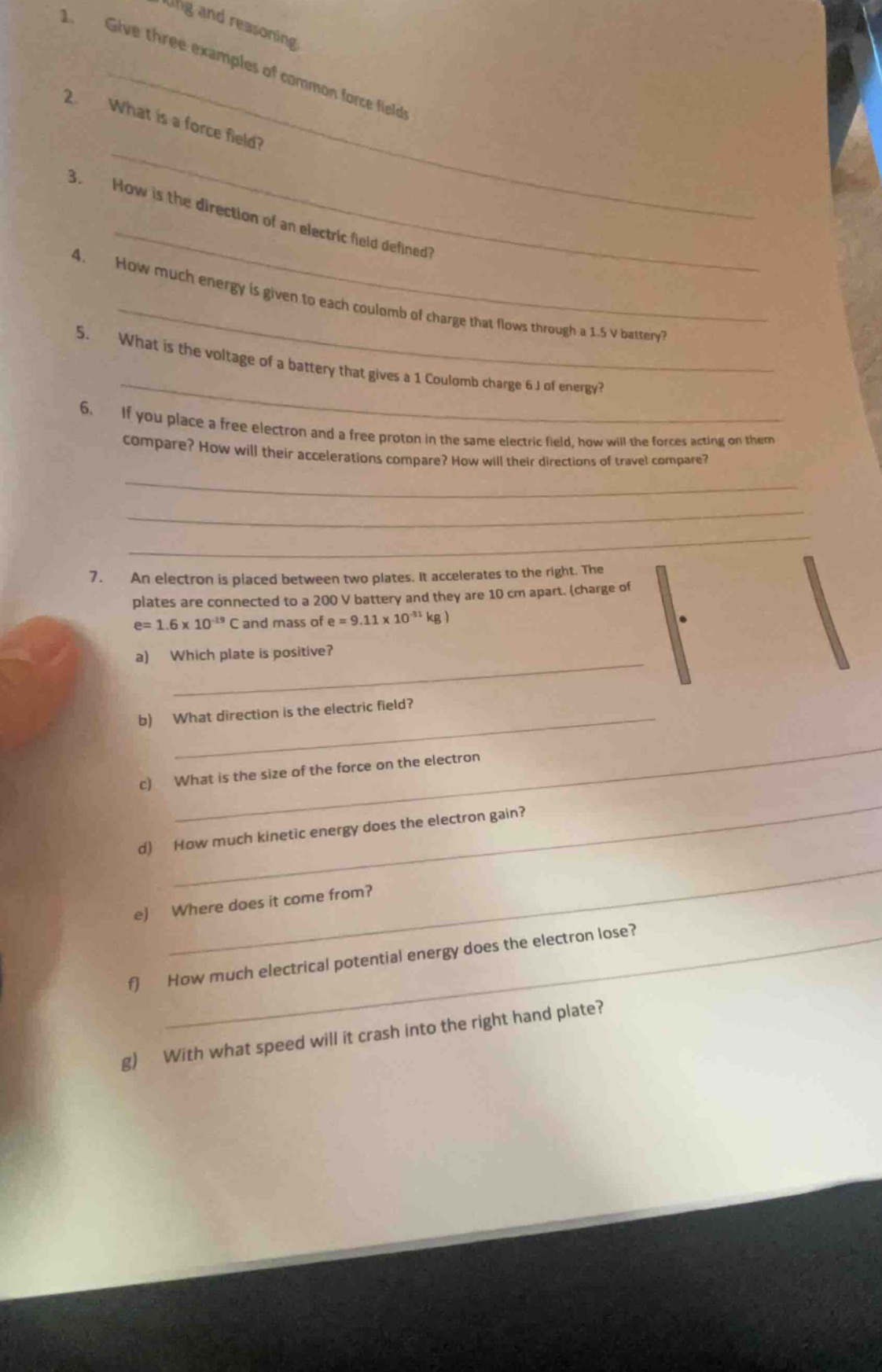
- give three examples of common force fields
- what is a force field?
- how is the direction of an electric field defined?
- how much energy is given to each coulomb of charge that flows through a 1.5 v battery?
- what is the voltage of a battery that gives a 1 coulomb charge 6 j of energy?
- if you place a free electron and a free proton in the same electric field, how will the forces acting on them compare? how will their accelerations compare? how will their directions of travel compare?
- an electron is placed between two plates. it accelerates to the right. the plates are connected to a 200 v battery and they are 10 cm apart. (charge of \\(e = 1.6 \times 10^{-19}\text{ c}\\) and mass of \\(e = 9.11 \times 10^{-31}\text{ kg}\\))
a) which plate is positive?
b) what direction is the electric field?
c) what is the size of the force on the electron
d) how much kinetic energy does the electron gain?
e) where does it come from?
f) how much electrical potential energy does the electron lose?
g) with what speed will it crash into the right hand plate?
Identify given values and core concepts
We are given a set of conceptual and quantitative physics questions regarding force fields, electric fields, electric potential, and the motion of charged particles. Let's solve each question systematically.
For Question 7, the given values are:
- Potential difference \(V = 200\text{ V}\)
- Distance between plates \(d = 10\text{ cm} = 0.1\text{ m}\)
- Charge of an electron \(q = -e = -1.6 \times 10^{-19}\text{ C}\) (magnitude \(e = 1.6 \times 10^{-19}\text{ C}\))
- Mass of an electron \(m = 9.11 \times 10^{-31}\text{ kg}\)
- The electron starts from rest and accelerates to the right.
Solve Questions 1 to 3
- Common force fields: Gravity, electric field, and magnetic field.
- Force field: A region of space in which an object experiences a non-contact force (such as gravitational, electric, or magnetic force).
- Direction of an electric field: Defined as the direction of the force that a positive test charge would experience if placed in the field.
Solve Questions 4 to 6
- Energy per Coulomb: Voltage is defined as electric potential energy per unit charge, \(V = \frac{E}{Q}\). For a \(1.5\text{ V}\) battery, the energy given to each Coulomb (\(1\text{ C}\)) is:
- Voltage of a battery: Using \(V = \frac{E}{Q}\), where \(E = 6\text{ J}\) and \(Q = 1\text{ C}\):
- Electron vs. Proton in the same electric field:
- Forces: The magnitude of the force is \(F = |q|E\). Since both have the same magnitude of charge \(e\), the magnitudes of the forces acting on them are equal.
- Accelerations: Using Newton's Second Law (\(a = \frac{F}{m}\)), since the proton is much more massive than the electron (\(m_p \approx 1836 m_e\)), the electron will have a much greater acceleration than the proton.
- Directions of travel: Since they have opposite charges, they will accelerate in opposite directions. The proton (positive) travels in the direction of the electric field, while the electron (negative) travels opposite to the electric field.
Solve Question 7 (a) to (d)
- a) Which plate is positive? Since the negatively charged electron accelerates to the right, it is attracted to the positive plate. Therefore, the right-hand plate is positive.
- b) What direction is the electric field? Electric field lines point from positive to negative. Since the right plate is positive and the left plate is negative, the electric field points to the left.
- c) What is the size of the force on the electron? First, find the electric field strength \(E\) between parallel plates:
Then, calculate the magnitude of the electric force:
- d) How much kinetic energy does the electron gain? The work done on the electron by the electric field is converted…

Snap & solve any problem in the app
Get step-by-step solutions on Sovi AI
Photo-based solutions with guided steps
Explore more problems and detailed explanations
Question 1
Give three examples of common force fields:
- Gravitational field
- Electric field
- Magnetic field
Question 2
What is a force field?
- A region of space in which an object experiences a non-contact force.
Question 3
How is the direction of an electric field defined?
- It is defined as the direction of the force that a positive test charge would experience if placed in the field.
Question 4
How much energy is given to each coulomb of charge that flows through a 1.5 V battery?
- \(1.5\text{ J}\)
Question 5
What is the voltage of a battery that gives a 1 Coulomb charge 6 J of energy?
- \(6\text{ V}\)
Question 6
If you place a free electron and a free proton in the same electric field, how will the forces acting on them compare? How will their accelerations compare? How will their directions of travel compare?
- Forces: The forces will have equal magnitudes because both particles carry the same magnitude of charge (\(e\)).
- Accelerations: The electron will have a much greater acceleration than the proton because its mass is significantly smaller.
- Directions of travel: They will travel in opposite directions because they have opposite charges.
Question 7
An electron is placed between two plates. It accelerates to the right. The plates are connected to a 200 V battery and they are 10 cm apart. (\(e = 1.6 \times 10^{-19}\text{ C}\), \(m = 9.11 \times 10^{-31}\text{ kg}\))
- a) Which plate is positive?
The right-hand plate is positive.
- b) What direction is the electric field?
To the left (from the positive right plate to the negative left plate).
- c) What is the size of the force on the electron?
\(3.2 \times 10^{-16}\text{ N}\)
- d) How much kinetic energy does the electron gain?
\(3.2 \times 10^{-17}\text{ J}\)
- e) Where does it come from?
It comes from the conversion of electrical potential energy stored in the electric field.
- f) How much electrical potential energy does the electron lose?
\(3.2 \times 10^{-17}\text{ J}\)
- g) With what speed will it crash into the right hand plate?
\(8.38 \times 10^6\text{ m/s}\)