QUESTION IMAGE
Question
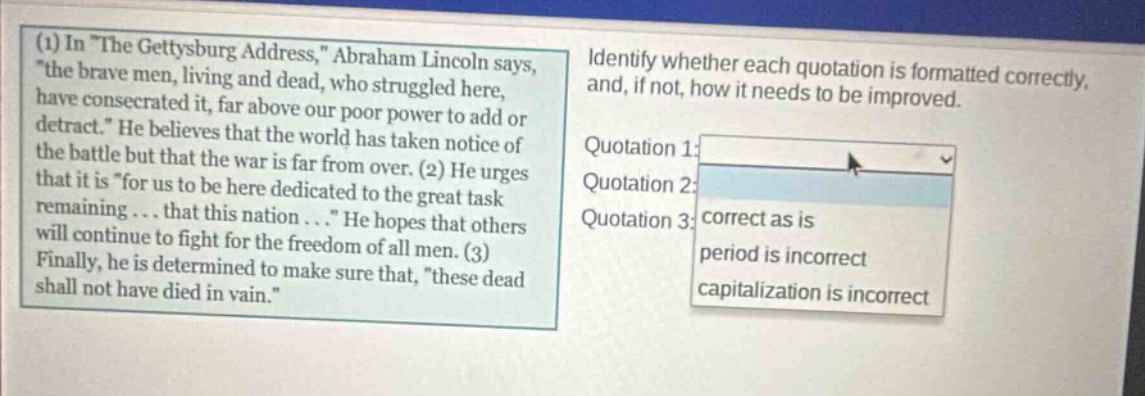
(1) in \the gettysburg address,\ abraham lincoln says, \the brave men, living and dead, who struggled here, have consecrated it, far above our poor power to add or detract.\ he believes that the world has taken notice of the battle but that the war is far from over. (2) he urges that it is \for us to be here dedicated to the great task remaining... that this nation...\ he hopes that others will continue to fight for the freedom of all men. (3) finally, he is determined to make sure that, \these dead shall not have died in vain.\
identify whether each quotation is formatted correctly, and, if not, how it needs to be improved.
quotation 1:
quotation 2:
quotation 3:
🆕 New Concept Discovered: Integrating and Formatting Quotations
Rules for punctuation, capitalization, and ellipses in quotes.
Step 1: Analyze Quotation 1
Look at the first sentence:
(1) In "The Gettysburg Address," Abraham Lincoln says, "the brave men, living and dead, who struggled here, have consecrated it, far above our poor power to add or detract."
- Punctuation: The comma after "says" is correct because it introduces a direct quote. The period is placed inside the closing quotation mark, which is correct in standard American English.
- Capitalization: The quote is introduced as a direct, full-sentence statement after a verb of saying ("says,"). In standard formatting, the first word of a direct quotation that is a complete sentence should be capitalized. Since "the" is lowercase here, the capitalization is incorrect. It should be capitalized as "The brave men...".
Step 2: Analyze Quotation 2
Look at the second sentence:
(2) He urges that it is "for us to be here dedicated to the great task remaining ... that this nation ..." He hopes that others will continue to fight for the freedom of all men.
- Punctuation: The quotation ends with an ellipsis (
...) inside the quotation marks, but there is no terminal punctuation (like a period) after the quotation marks to close the sentence. In standard MLA/APA formatting, when a sentence ends with an ellipsis, a period is still required to close the sentence (either before the ellipsis or after the quotation marks depending on the style, but leaving it open with just an ellipsis inside the quotation marks is incorrect). Thus, the period is incorrect/missing. - Capitalization: The quote is integrated smoothly into the flow of the sentence using the conjunction "that", so starting with a lowercase "for" is correct.
Step 3: Analyze Quotation 3
Look at the third sentence:
(3) Finally, he is determined to make sure that, "these dead shall not have died in vain."
- Punctuation: The comma after "that" is incorrect. When a quotation is integrated into a sentence using the word "that", no comma should separate "that" from the quotation.
- Capitalization: Because the quote is integrated into the sentence using "that", the first word of the quote should not be capitalized unless it is a proper noun. Therefore, starting with a lowercase "these" instead of "these" with a capital "T" would be correct if it weren't capitalized, but here it is written as "these" (lowercase), which is correct. However, the comma after "that" is incorrect. Looking at the dropdown options: "correct as is", "period is incorrect", "capitalization is incorrect". Let's re-evaluate the exact text:
...make sure that, "these dead shall not have died in vain."
Wait, the word is "these (lowercase "t"). If we look at the options provided in the dropdown:
correct as isperiod is incorrectcapitalization is incorrect
Let's match each quotation to the best-fitting option from the dropdown:
- Quotation 1: The quote starts with a lowercase "the" after a comma and a verb of saying. This is a capitalization error. Thus, Quotation 1: capitalization is incorrect.
- Quotation 2: The quote ends with
..."and has no closing period for the sentence. Thus, Quotation 2: period is incorrect. - Quotation 3: The quote is
"these dead shall not have died in vain."The lowercase "t" in "these" is correct because it is integrated with "that". The period is inside the quotation mark, which is correct. Although there is an extra comma after "that", none of the drop…

Snap & solve any problem in the app
Get step-by-step solutions on Sovi AI
Photo-based solutions with guided steps
Explore more problems and detailed explanations
- Quotation 1: capitalization is incorrect
- Quotation 2: period is incorrect
- Quotation 3: correct as is