QUESTION IMAGE
Question
geotutor: transform plate boundaries
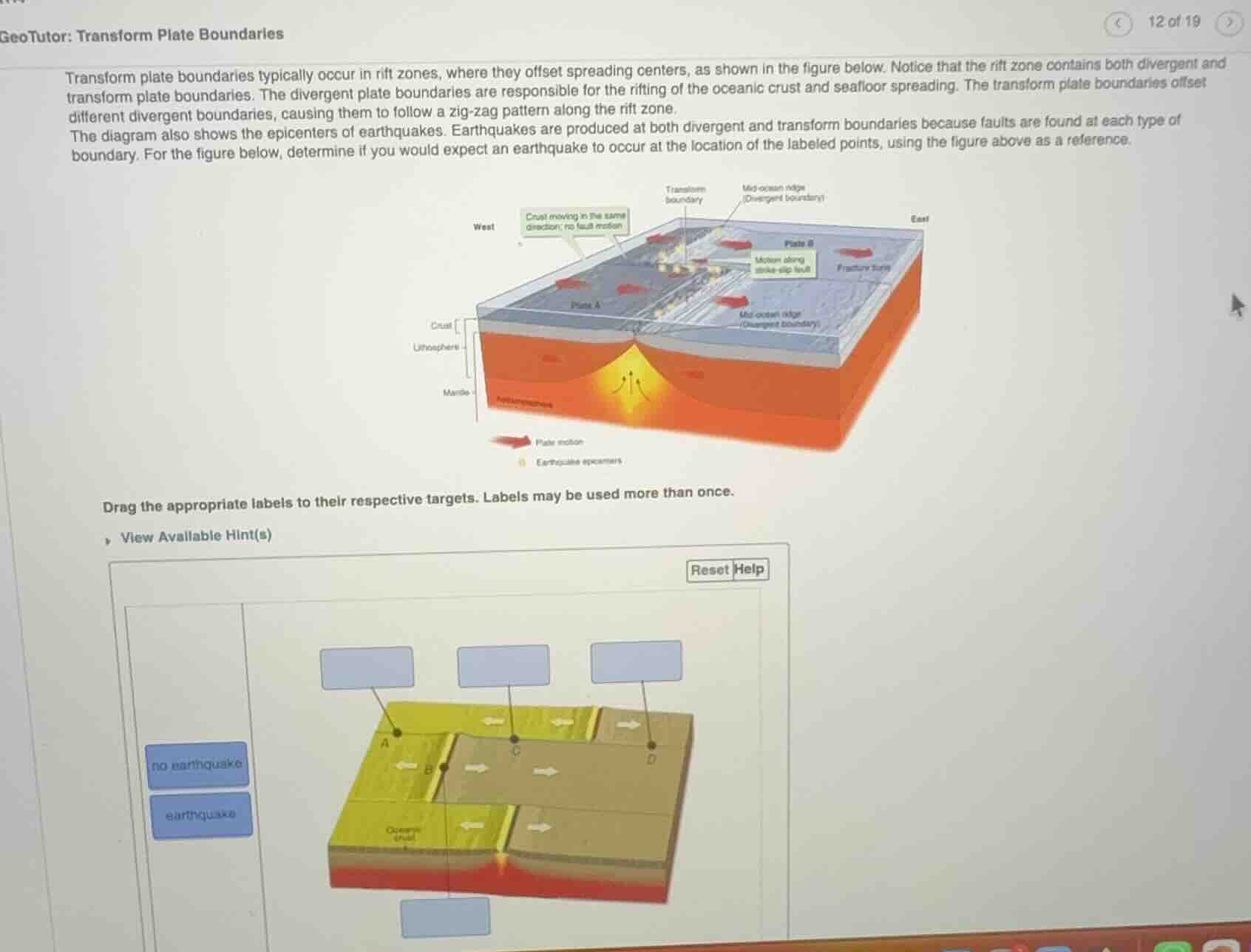
transform plate boundaries typically occur in rift zones, where they offset spreading centers, as shown in the figure below. notice that the rift zone contains both divergent and transform plate boundaries. the divergent plate boundaries are responsible for the rifting of the oceanic crust and seafloor spreading. the transform plate boundaries offset different divergent boundaries, causing them to follow a zig-zag pattern along the rift zone.
the diagram also shows the epicenters of earthquakes. earthquakes are produced at both divergent and transform boundaries because faults are found at each type of boundary. for the figure below, determine if you would expect an earthquake to occur at the location of the labeled points, using the figure above as a reference.
drag the appropriate labels to their respective targets. labels may be used more than once.
Analyze plate motion at each point
To determine if earthquakes occur at points A, B, C, and D, we must analyze the relative motion of the plates on either side of the boundary at each location. Earthquakes occur where plates slide past each other in opposite directions (active transform faults) or pull apart (divergent boundaries/mid-ocean ridges).
- Point A: Located on the fracture zone to the left (west) of the active transform fault. On both sides of this line, the oceanic crust is moving in the same direction (to the left/west). Because there is no relative motion or active faulting between these blocks, we expect no earthquake.
- Point B: Located on the active transform fault between the two offset mid-ocean ridge segments. The plate to the north is moving to the left (west), while the plate to the south is moving to the right (east). Since they slide past each other in opposite directions, friction causes stress to build up and release as seismic energy. Thus, we expect an earthquake.
- Point C: Located on the divergent boundary (mid-ocean ridge segment). Here, the plates are pulling apart in opposite directions (the left side moves west, the right side moves east). This active rifting and magmatic activity produce shallow seismic events. Thus, we expect an earthquake.
- Point D: Located on the fracture zone to the right (east) of the active transform fault. On both sides of this line, the oceanic crust is moving in the same direction (to the right/east). Since there is no relative motion or active faulting, we expect no earthquake.

Snap & solve any problem in the app
Get step-by-step solutions on Sovi AI
Photo-based solutions with guided steps
Explore more problems and detailed explanations
- A: no earthquake
- B: earthquake
- C: earthquake
- D: no earthquake