QUESTION IMAGE
Question
general biology
biol& 160
genetics problems
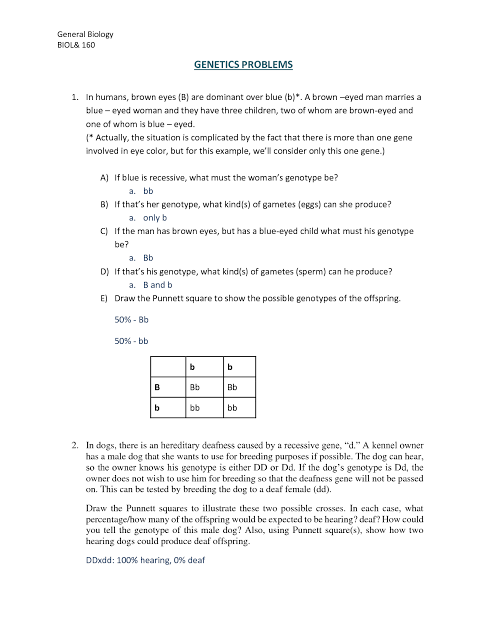
- in humans, brown eyes (b) are dominant over blue (b)*. a brown-eyed man marries a blue-eyed woman and they have three children, two of whom are brown-eyed and one of whom is blue-eyed.
(* actually, the situation is complicated by the fact that there is more than one gene involved in eye color, but for this example, well consider only this one gene.)
a) if blue is recessive, what must the womans genotype be?
a. bb
b) if thats her genotype, what kind(s) of gametes (eggs) can she produce?
a. only b
c) if the man has brown eyes, but has a blue-eyed child what must his genotype be?
a. bb
d) if thats his genotype, what kind(s) of gametes (sperm) can he produce?
a. b and b
e) draw the punnett square to show the possible genotypes of the offspring.
50% - bb
50% - bb
- in dogs, there is an hereditary deafness caused by a recessive gene, \d.\ a kennel owner has a male dog that she wants to use for breeding purposes if possible. the dog can hear, so the owner knows his genotype is either dd or dd. if the dogs genotype is dd, the owner does not wish to use him for breeding so that the deafness gene will not be passed on. this can be tested by breeding the dog to a deaf female (dd).
draw the punnett squares to illustrate these two possible crosses. in each case, what percentage/how many of the offspring would be expected to be hearing? deaf? how could you tell the genotype of this male dog? also, using punnett square(s), show how two hearing dogs could produce deaf offspring.
ddxdd: 100% hearing, 0% deaf
⚡ Using what you learned: fundamental principles of mendelian genetics
Step 1: Analyze the first test cross (DD x dd)
The male dog is homozygous dominant for hearing (\(DD\)) and is crossed with a homozygous recessive deaf female (\(dd\)).
- Male gametes: All carry the \(D\) allele.
- Female gametes: All carry the \(d\) allele.
Punnett Square:
| d | d | |
|---|---|---|
| D | Dd | Dd |
- Genotype ratio: 100% \(Dd\) (heterozygous)
- Phenotype ratio: 100% hearing, 0% deaf
---
Step 2: Analyze the second test cross (Dd x dd)
The male dog is heterozygous for hearing (\(Dd\)) and is crossed with a homozygous recessive deaf female (\(dd\)).
- Male gametes: 50% \(D\), 50% \(d\)
- Female gametes: All carry the \(d\) allele.
Punnett Square:
| d | d | |
|---|---|---|
| b | dd | dd |
- Genotype ratio: 50% \(Dd\), 50% \(dd\)
- Phenotype ratio: 50% hearing, 50% deaf
---
Step 3: Determine how to identify the male's genotype
To determine the male dog's genotype, breed him with a deaf female (\(dd\)):
- If any of the resulting offspring are deaf (\(dd\)), the male dog must have the heterozygous genotype (\(Dd\)).
- If a large number of offspring are produced and all of them can hear, the male dog is highly likely to be homozygous dominant (\(DD\)).
---
Step 4: Show how two hearing dogs can produce deaf offspring
For two hearing dogs to have a deaf puppy (\(dd\)), both parents must carry the recessive deafness allele (\(d\)) without showing the trait themselves. This means both parents must be heterozygous (\(Dd\)).
Punnett Square (Dd x Dd):
| D | d | |
|---|---|---|
| d | Dd | dd |
- Offspring Phenotypes: 75% hearing (\(DD\) or \(Dd\)), 25% deaf (\(dd\)).

Snap & solve any problem in the app
Get step-by-step solutions on Sovi AI
Photo-based solutions with guided steps
Explore more problems and detailed explanations
1. Test Crosses & Percentages
- Cross 1 (\(DD \times dd\)):
- Offspring: 100% hearing, 0% deaf.
- Cross 2 (\(Dd \times dd\)):
- Offspring: 50% hearing, 50% deaf.
2. Determining the Male's Genotype
Breed the male dog to a deaf female (\(dd\)). If even one deaf puppy is born, the male is heterozygous (\(Dd\)). If a large litter is produced and all puppies can hear, the male is homozygous dominant (\(DD\)).
3. Two Hearing Parents Producing Deaf Offspring
Both parents must be heterozygous carriers (\(Dd\)).
Punnett Square (\(Dd \times Dd\)):
- Top Parent Gametes: \(D\), \(d\)
- Side Parent Gametes: \(D\), \(d\)
- Offspring Genotypes: 25% \(DD\), 50% \(Dd\), 25% \(dd\) (deaf)