QUESTION IMAGE
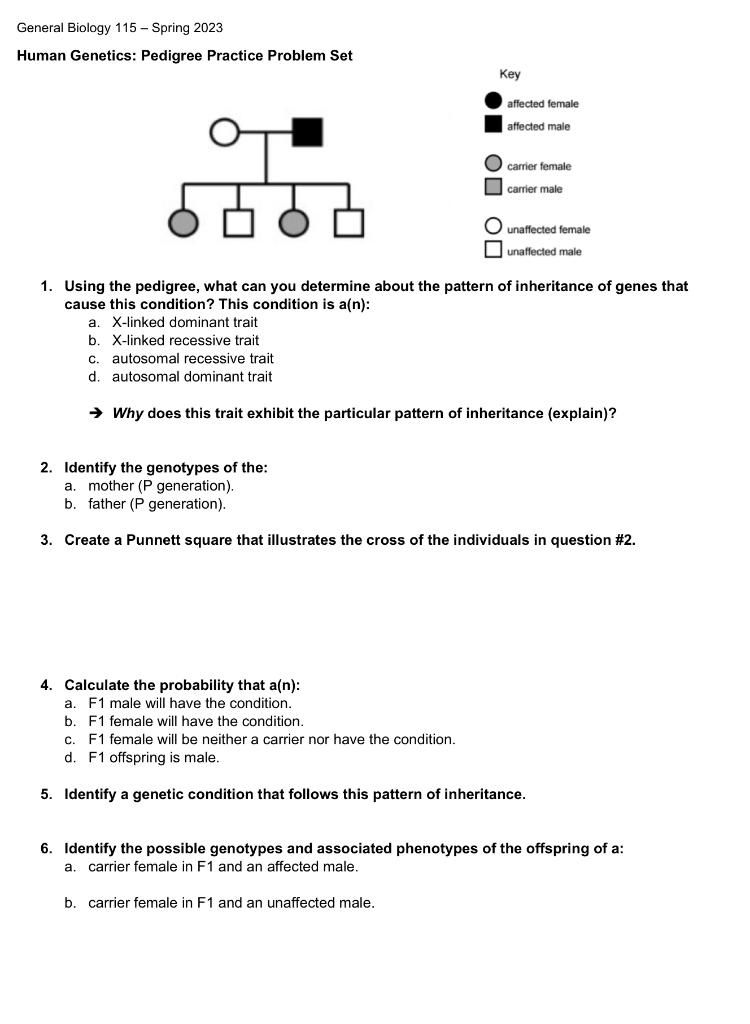
Question
general biology 115 - spring 2023
human genetics: pedigree practice problem set
- using the pedigree, what can you determine about the pattern of inheritance of genes that cause this condition? this condition is a(n):
a. x-linked dominant trait
b. x-linked recessive trait
c. autosomal recessive trait
d. autosomal dominant trait
-> why does this trait exhibit the particular pattern of inheritance (explain)?
- identify the genotypes of the:
a. mother (p generation).
b. father (p generation).
- create a punnett square that illustrates the cross of the individuals in question #2.
- calculate the probability that a(n):
a. f1 male will have the condition.
b. f1 female will have the condition.
c. f1 female will be neither a carrier nor have the condition.
d. f1 offspring is male.
- identify a genetic condition that follows this pattern of inheritance.
- identify the possible genotypes and associated phenotypes of the offspring of a:
a. carrier female in f1 and an affected male.
b. carrier female in f1 and an unaffected male.
🆕 New Concept Discovered: Pedigree Analysis and Sex-Linked Inheritance
How traits are passed down via sex chromosomes
Step 1: Determine the Pattern of Inheritance (Question 1)
To find the mode of inheritance, we look at the phenotypes of the parents and offspring in the pedigree:
- Parents (P generation): The mother is unaffected (white circle) and the father is affected (black square).
- Offspring (\(F_1\) generation): Both daughters are carriers (grey circles), and both sons are completely unaffected (white squares).
Let's evaluate the options:
- X-linked recessive: An affected father has the genotype \(X^aY\). He passes his only \(X\) chromosome (\(X^a\)) to all of his daughters, making them carriers (\(X^AX^a\)) if the mother is unaffected homozygous (\(X^AX^A\)). He passes his \(Y\) chromosome to his sons, who receive their \(X\) chromosome from their unaffected mother, making the sons completely unaffected (\(X^AY\)). This perfectly matches the pedigree.
- Autosomal recessive: If it were autosomal recessive, an affected father (\(aa\)) and an unaffected mother (\(AA\) or \(Aa\)) would have offspring who are all carriers (\(Aa\)) regardless of sex. However, in the pedigree, only the females are carriers, while the males are completely unaffected (not carriers). This sex-specific difference points directly to sex-linkage.
Therefore, the condition is an X-linked recessive trait (Option b).
Why does this trait exhibit this pattern?
Because the gene is located on the \(X\) chromosome. A father passes his \(Y\) chromosome to his sons (so they cannot inherit his affected \(X\) allele) and his \(X\) chromosome to his daughters. Since the mother is unaffected and homozygous normal, the daughters receive one normal \(X\) from the mother and one affected \(X\) from the father, making them heterozygous carriers.
---
Step 2: Identify Genotypes of the Parents (Question 2)
Let \(X^A\) represent the dominant normal allele, and \(X^a\) represent the recessive affected allele.
- a. Mother (P generation): Unaffected female who does not carry the trait:
- b. Father (P generation): Affected male:
---
Step 3: Create a Punnett Square (Question 3)
We cross the mother (\(X^AX^A\)) with the father (\(X^aY\)):
| \(X^a\) | \(Y\) | |
|---|---|---|
| \(X^A\) | \(X^AX^a\) (Carrier Female) | \(X^AY\) (Unaffected Male) |
---
Step 4: Calculate Probabilities (Question 4)
Using the Punnett square from Step 3:
- a. Probability that an \(F_1\) male will have the condition:
All males are \(X^AY\).
- b. Probability that an \(F_1\) female will have the condition:
All females are \(X^AX^a\). None are affected (\(X^aX^a\)).
- c. Probability that an \(F_1\) female will be neither a carrier nor have the condition:
All females are carriers (\(X^AX^a\)).
- d. Probability that an \(F_1\) offspring is male:
Out of all possible offspring combinations, half are male (\(X^AY\)).
---
Step 5: Identify a Genetic Condition (Question 5)
Common human genetic disorders that follow an X-linked recessive pattern of inheritance include:
- Red-green color blindness
- Hemophilia A or B
- Duchenne muscular dystrophy
---
Step 6: Offspring of Carrier Female and Affected/Unaffected Males (Question 6)
A carrier female has the genotype \(X^AX^a\).
a. Carrier female (\(X^AX^a\)) and an affec…

Snap & solve any problem in the app
Get step-by-step solutions on Sovi AI
Photo-based solutions with guided steps
Explore more problems and detailed explanations
1. Pattern of Inheritance
- Answer: b. X-linked recessive trait
- Explanation: The affected father passes his affected \(X\) chromosome to all his daughters, making them carriers, while his sons receive his \(Y\) chromosome and are completely unaffected.
2. Genotypes of Parents
- a. Mother: \(X^AX^A\)
- b. Father: \(X^aY\)
3. Punnett Square
4. Probabilities
- a. \(0\%\)
- b. \(0\%\)
- c. \(0\%\)
- d. \(50\%\) (or \(\frac{1}{2}\))
5. Example Condition
- Hemophilia (or Red-green color blindness)
6. Offspring Phenotypes and Genotypes
- a. Carrier female (\(X^AX^a\)) \(\times\) Affected male (\(X^aY\)):
- Genotypes: \(X^AX^a\), \(X^aX^a\), \(X^AY\), \(X^aY\) (ratio 1:1:1:1)
- Phenotypes: 1 carrier female, 1 affected female, 1 unaffected male, 1 affected male
- b. Carrier female (\(X^AX^a\)) \(\times\) Unaffected male (\(X^AY\)):
- Genotypes: \(X^AX^A\), \(X^AX^a\), \(X^AY\), \(X^aY\) (ratio 1:1:1:1)
- Phenotypes: 1 unaffected female, 1 carrier female, 1 unaffected male, 1 affected male