QUESTION IMAGE
Question
gather textual evidence
evaluate
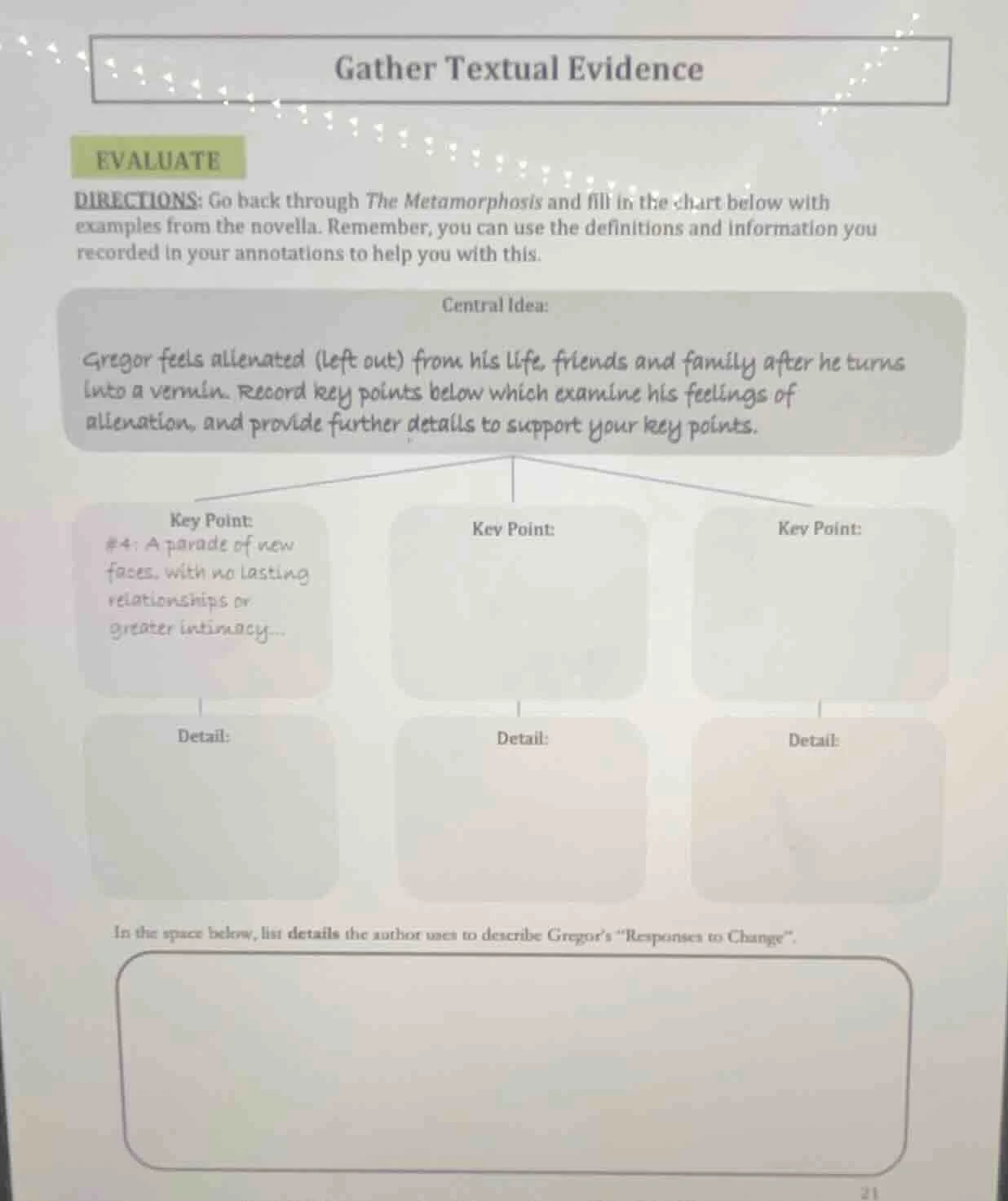
directions: go back through the metamorphosis and fill in the chart below with examples from the novella. remember, you can use the definitions and information you recorded in your annotations to help you with this.
central idea:
gregor feels alienated (left out) from his life, friends and family after he turns into a vermin. record key points below which examine his feelings of alienation, and provide further details to support your key points.
key point:
#4: a parade of new faces, with no lasting relationships or greater intimacy...
detail:
key point:
detail:
key point:
detail:
in the space below, list details the author uses to describe gregor’s “responses to change”.
All points are supported by textual evidence from Franz Kafka's The Metamorphosis, focusing on Gregor's alienation and responses to his transformation.

Snap & solve any problem in the app
Get step-by-step solutions on Sovi AI
Photo-based solutions with guided steps
Explore more problems and detailed explanations
Key Points & Details for Alienation:
- Key Point #4: A parade of new faces, with no lasting relationships or greater intimacy...
Detail: When the Samsas take in three boarders, Gregor watches them interact with his family but is completely excluded; the boarders treat him as a repulsive intruder, and his family ignores his presence to cater to the guests, leaving Gregor isolated from any new or existing close connections.
- Key Point: Rejection by his immediate family
Detail: Gregor's father throws apples at him, wounding him, and his sister eventually insists they "get rid of" him, viewing him as a burden rather than their family member.
- Key Point: Loss of his role and purpose
Detail: Gregor can no longer work as a traveling salesman to support his family, so he loses the only role that gave him a sense of belonging in his household; his family begins to see him as useless instead of their provider.
Gregor's "Responses to Change":
- Initially, he tries to ignore his transformation and focus on his work routine, attempting to get out of bed to catch his train.
- He hides under his couch whenever his family enters his room, trying to avoid their fear and rejection.
- He becomes increasingly withdrawn and stops eating, eventually letting himself die as a passive acceptance of his alienated, hopeless situation.
- He shows small acts of attachment to his old life, such as clinging to the picture of the woman in furs on his wall, as a last link to his former identity.