QUESTION IMAGE
Question
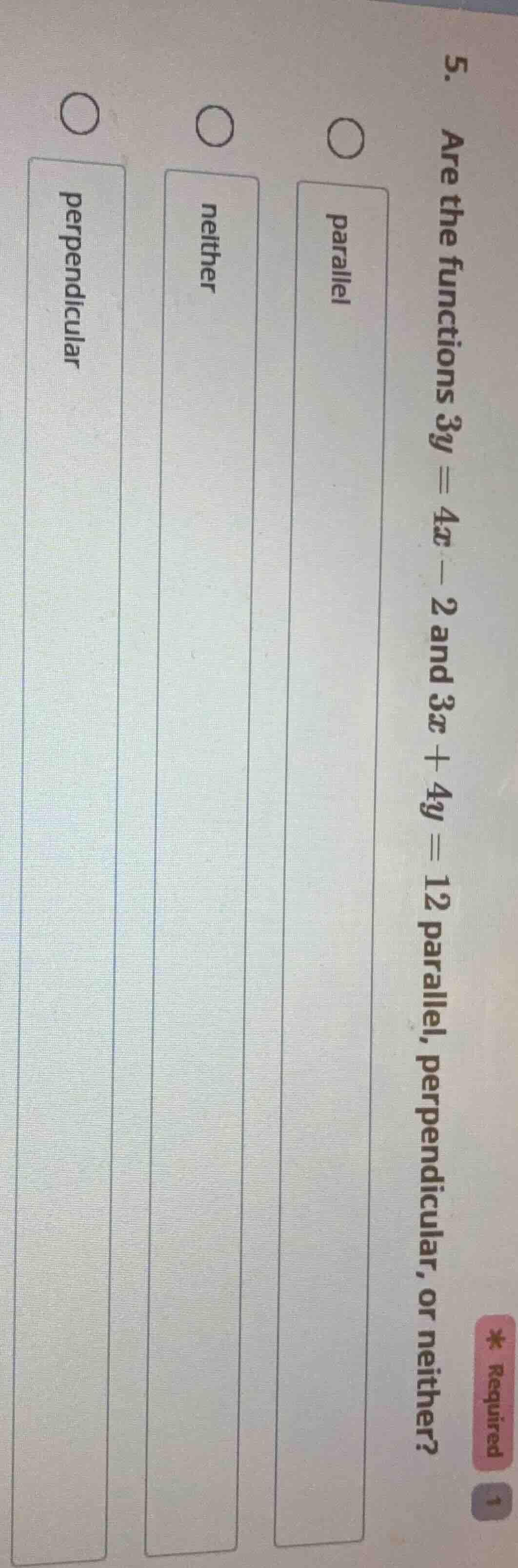
- are the functions $3y = 4x - 2$ and $3x + 4y = 12$ parallel, perpendicular, or neither?
options: parallel, neither, perpendicular
Step1: Convert to slope - intercept form ($y = mx + b$) for first equation
Given \(3y=4x - 2\), divide both sides by 3: \(y=\frac{4}{3}x-\frac{2}{3}\). So the slope \(m_1=\frac{4}{3}\).
Step2: Convert to slope - intercept form for second equation
Given \(3x + 4y=12\), solve for \(y\): \(4y=-3x + 12\), divide by 4: \(y=-\frac{3}{4}x + 3\). So the slope \(m_2=-\frac{3}{4}\).
Step3: Check if slopes are parallel or perpendicular
- For parallel lines, \(m_1=m_2\). Here \(\frac{4}{3}
eq-\frac{3}{4}\), so not parallel.
- For perpendicular lines, \(m_1\times m_2=- 1\). Calculate \(\frac{4}{3}\times(-\frac{3}{4})=-1\). So the slopes are negative reciprocals, meaning the lines are perpendicular.

Snap & solve any problem in the app
Get step-by-step solutions on Sovi AI
Photo-based solutions with guided steps
Explore more problems and detailed explanations
perpendicular