QUESTION IMAGE
Question
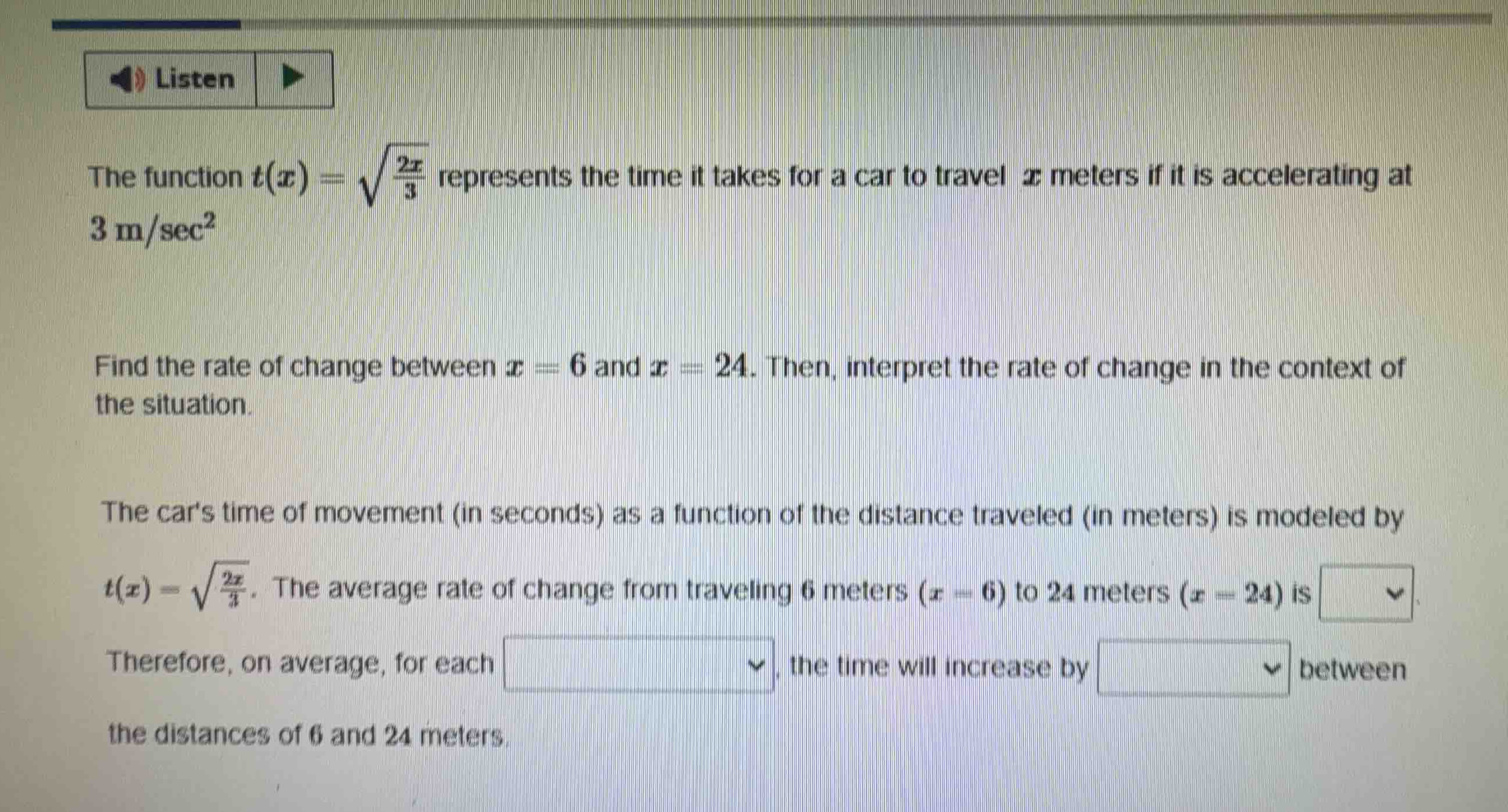
the function \\(t(x) = \sqrt{\frac{2x}{3}}\\) represents the time it takes for a car to travel \\(x\\) meters if it is accelerating at \\(3\text{ m/sec}^2\\).
find the rate of change between \\(x = 6\\) and \\(x = 24\\). then, interpret the rate of change in the context of the situation.
the cars time of movement (in seconds) as a function of the distance traveled (in meters) is modeled by \\(t(x) = \sqrt{\frac{2x}{3}}\\). the average rate of change from traveling 6 meters (\\(x = 6\\)) to 24 meters (\\(x = 24\\)) is dropdown.
therefore, on average, for each dropdown, the time will increase by dropdown between the distances of 6 and 24 meters.
Evaluate the function at the given boundaries
We evaluate the function \(t(x) = \sqrt{\frac{2x}{3}}\) at \(x = 6\) and \(x = 24\).
At \(x = 6\):
At \(x = 24\):
Calculate the average rate of change
The average rate of change of \(t(x)\) from \(x = a\) to \(x = b\) is given by:
Substituting \(a = 6\) and \(b = 24\):
Interpret the rate of change in context
The average rate of change is \(\frac{1}{9}\) seconds per meter.
This means that, on average, for each additional meter traveled, the time will increase by \(\frac{1}{9}\) second (or approximately \(0.11\) seconds) between the distances of 6 and 24 meters.

Snap & solve any problem in the app
Get step-by-step solutions on Sovi AI
Photo-based solutions with guided steps
Explore more problems and detailed explanations
The car's time of movement (in seconds) as a function of the distance traveled (in meters) is modeled by \(t(x) = \sqrt{\frac{2x}{3}}\). The average rate of change from traveling 6 meters (\(x = 6\)) to 24 meters (\(x = 24\)) is <blank>\(\frac{1}{9}\)</blank>.
Therefore, on average, for each <blank>additional meter traveled</blank>, the time will increase by <blank>\(\frac{1}{9}\) second</blank> between the distances of 6 and 24 meters.