QUESTION IMAGE
Question
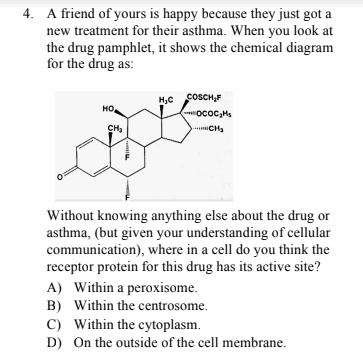
- a friend of yours is happy because they just got a new treatment for their asthma. when you look at the drug pamphlet, it shows the chemical diagram for the drug as:
without knowing anything else about the drug or asthma, (but given your understanding of cellular communication), where in a cell do you think the receptor protein for this drug has its active site?
a) within a peroxisome.
b) within the centrosome.
c) within the cytoplasm.
d) on the outside of the cell membrane.
🆕 New Concept Discovered: Steroid Hormone Signaling
Lipid-soluble signals cross membranes to meet intracellular receptors.
Step 1: Identify the chemical nature of the drug
Looking at the chemical diagram, the drug has a characteristic four-ring carbon backbone (three six-membered rings and one five-membered ring). This fused ring system is the signature structure of a steroid.
Because steroids are lipids made primarily of hydrocarbons, they are highly hydrophobic (lipophilic/nonpolar).
Step 2: Determine membrane permeability
The plasma membrane of a cell is made of a phospholipid bilayer.
- Hydrophilic (polar) molecules cannot easily cross this hydrophobic core and must bind to receptors on the cell surface (outside the cell membrane).
- Hydrophobic (nonpolar) molecules, like this steroid drug, can easily diffuse directly through the lipid bilayer into the cell.
Step 3: Locate the receptor protein
Since the steroid drug can freely cross the plasma membrane, its target receptor does not need to be on the extracellular surface. Instead, steroid receptors are intracellular proteins located inside the target cell—specifically within the cytoplasm (or the nucleus). Once the drug enters the cytoplasm, it binds to its receptor to initiate cellular communication.

Snap & solve any problem in the app
Get step-by-step solutions on Sovi AI
Photo-based solutions with guided steps
Explore more problems and detailed explanations
C) Within the cytoplasm.