QUESTION IMAGE
Question
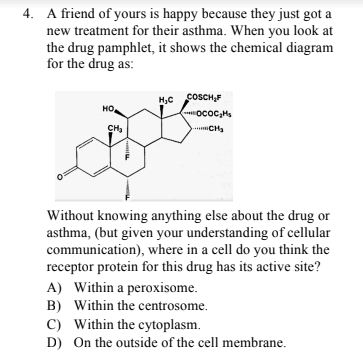
- a friend of yours is happy because they just got a new treatment for their asthma. when you look at the drug pamphlet, it shows the chemical diagram for the drug as:
without knowing anything else about the drug or asthma, (but given your understanding of cellular communication), where in a cell do you think the receptor protein for this drug has its active site?
a) within a peroxisome.
b) within the centrosome.
c) within the cytoplasm.
d) on the outside of the cell membrane.
🆕 New Concept Discovered: Cell Signaling and Receptor Localization
How chemical structure determines where a signal is received
Step 1: Analyze the chemical structure of the drug
The chemical diagram shows a molecule with a characteristic four-ring core structure (three six-membered rings and one five-membered ring). This fused ring system is the hallmark of a steroid.
Because steroids are lipids, they are highly hydrophobic (lipophilic) and nonpolar. This physical property allows them to easily diffuse directly through the hydrophobic lipid bilayer of the cell membrane.
Step 2: Determine receptor localization based on membrane permeability
In cellular communication, the location of a receptor depends on whether its ligand can cross the plasma membrane:
- Hydrophilic/polar ligands (like peptide hormones) cannot cross the lipid bilayer, so they bind to cell-surface receptors on the outside of the cell membrane.
- Hydrophobic/nonpolar ligands (like steroid hormones) easily pass through the cell membrane, meaning their receptors are located inside the cell—typically in the cytoplasm or the nucleus.
Since this drug is a steroid, it will diffuse into the cell, and its receptor's active site will be located inside the cell within the cytoplasm (or nucleus), rather than on the extracellular surface.

Snap & solve any problem in the app
Get step-by-step solutions on Sovi AI
Photo-based solutions with guided steps
Explore more problems and detailed explanations
C) Within the cytoplasm.