QUESTION IMAGE
Question
your friend is writing a short story, but she has forgotten to add speech marks.
add the missing speech marks to the text. use double marks (\) only.
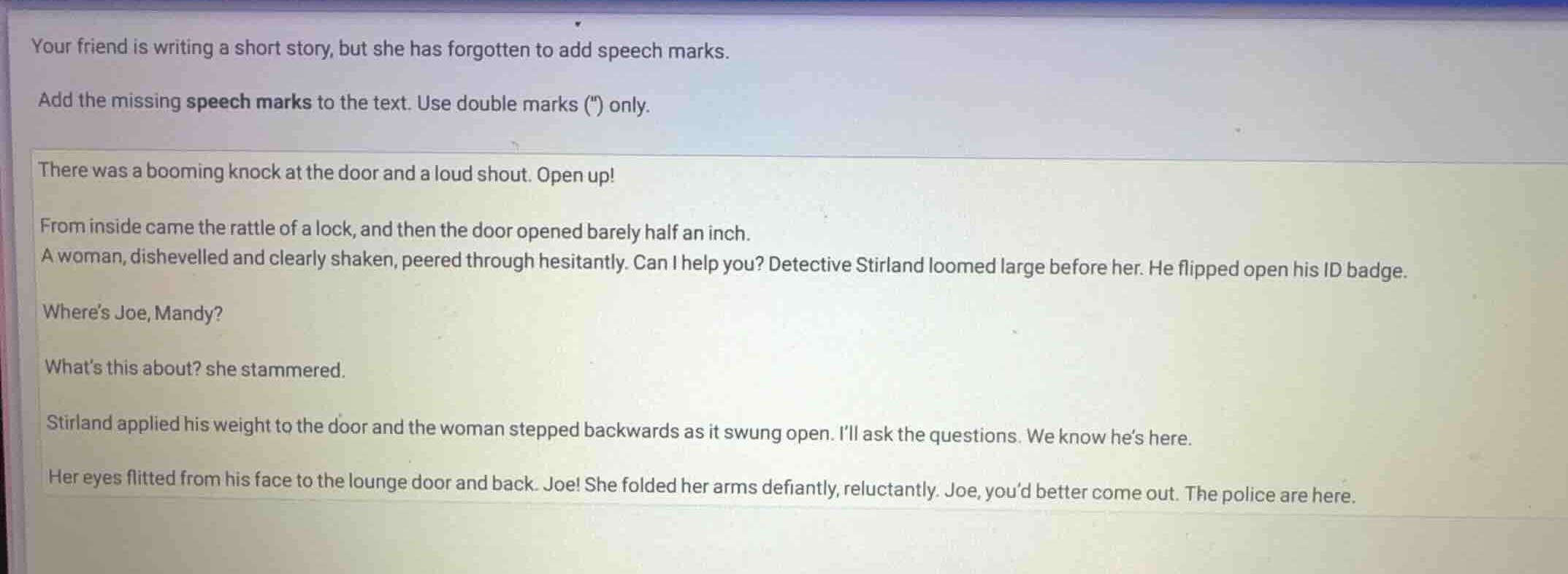
there was a booming knock at the door and a loud shout. open up!
from inside came the rattle of a lock, and then the door opened barely half an inch.
a woman, dishevelled and clearly shaken, peered through hesitantly. can i help you? detective stirland loomed large before her. he flipped open his id badge.
wheres joe, mandy?
whats this about? she stammered.
stirland applied his weight to the door and the woman stepped backwards as it swung open. ill ask the questions. we know hes here.
her eyes flitted from his face to the lounge door and back. joe! she folded her arms defiantly, reluctantly. joe, youd better come out. the police are here.
🆕 New Concept Discovered: Punctuating Direct Speech
Enclosing spoken words in quotation marks to separate speech from narrative.
Step 1: Identify spoken words in the first paragraph
The first paragraph ends with a command shouted at the door:
- Narrative: "There was a booming knock at the door and a loud shout."
- Spoken words: "Open up!"
We place double speech marks around the spoken words:
- "Open up!"
Step 2: Identify spoken words in the second paragraph
The second paragraph contains a question asked by the woman peering through the door:
- Narrative: "From inside came the rattle of a lock, and then the door opened barely half an inch. A woman, dishevelled and clearly shaken, peered through hesitantly."
- Spoken words: "Can I help you?"
- Narrative continues: "Detective Stirland loomed large before her. He flipped open his ID badge."
We place double speech marks around the woman's question:
- "Can I help you?"
Step 3: Identify spoken words in the third and fourth paragraphs
The third paragraph is a direct question spoken by Detective Stirland:
- Spoken words: "Where's Joe, Mandy?"
The fourth paragraph is a question spoken by Mandy, followed by a reporting clause:
- Spoken words: "What's this about?"
- Narrative: "she stammered."
We enclose both spoken parts in double speech marks:
- "Where's Joe, Mandy?"
- "What's this about?" she stammered.
Step 4: Identify spoken words in the fifth paragraph
The fifth paragraph contains statements spoken by Detective Stirland after pushing the door open:
- Narrative: "Stirland applied his weight to the door and the woman stepped backwards as it swung open."
- Spoken words: "I'll ask the questions. We know he's here."
We enclose his spoken sentences in double speech marks:
- "I'll ask the questions. We know he's here."
Step 5: Identify spoken words in the final paragraph
The final paragraph contains two separate instances of Mandy calling out to Joe:
- Narrative: "Her eyes flitted from his face to the lounge door and back."
- Spoken words 1: "Joe!"
- Narrative: "She folded her arms defiantly, reluctantly."
- Spoken words 2: "Joe, you'd better come out. The police are here."
We enclose both spoken sections in double speech marks:
- "Joe!" She folded her arms defiantly, reluctantly. "Joe, you'd better come out. The police are here."

Snap & solve any problem in the app
Get step-by-step solutions on Sovi AI
Photo-based solutions with guided steps
Explore more problems and detailed explanations
There was a booming knock at the door and a loud shout. "Open up!"
From inside came the rattle of a lock, and then the door opened barely half an inch. A woman, dishevelled and clearly shaken, peered through hesitantly. "Can I help you?" Detective Stirland loomed large before her. He flipped open his ID badge.
"Where's Joe, Mandy?"
"What's this about?" she stammered.
Stirland applied his weight to the door and the woman stepped backwards as it swung open. "I'll ask the questions. We know he's here."
Her eyes flitted from his face to the lounge door and back. "Joe!" She folded her arms defiantly, reluctantly. **"Joe, you'd