QUESTION IMAGE
Question
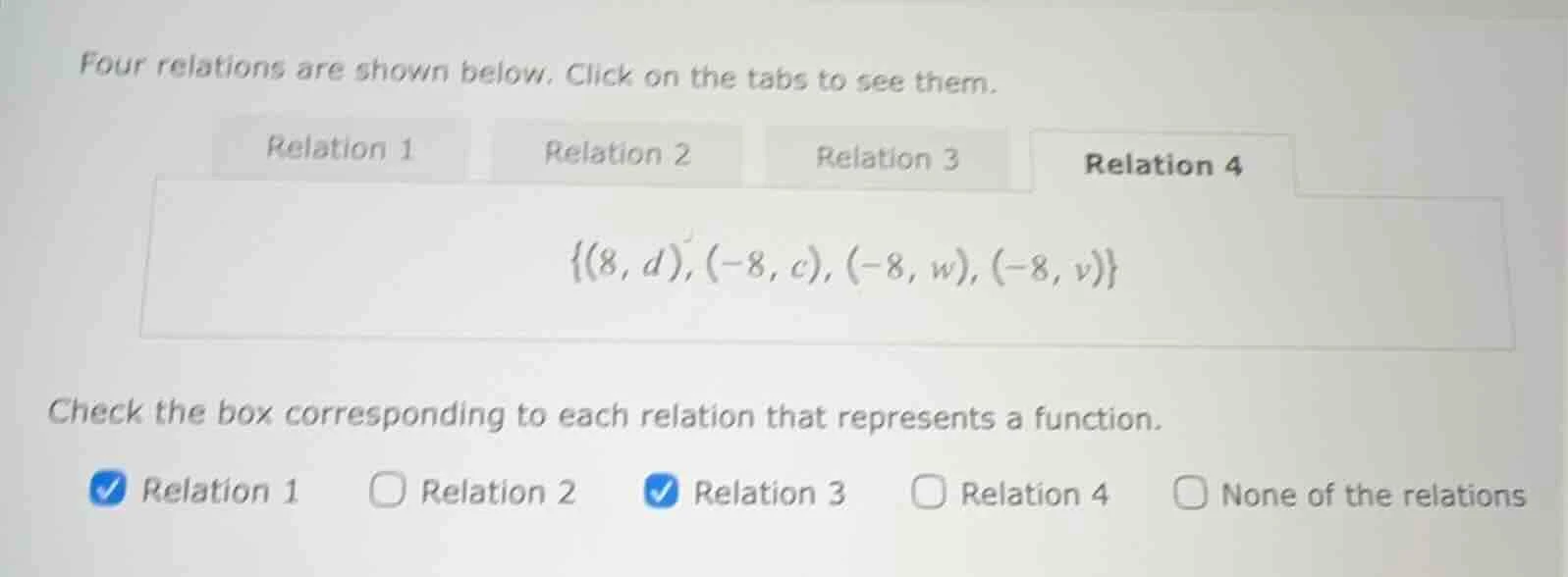
four relations are shown below. click on the tabs to see them.
relation 1 relation 2 relation 3 relation 4
{(8, d), (-8, c), (-8, w), (-8, v)}
check the box corresponding to each relation that represents a function.
☑️ relation 1 ☐ relation 2 ☑️ relation 3 ☐ relation 4 ☐ none of the relations
To determine if a relation is a function, we use the definition: a relation is a function if every input (x - value) has exactly one output (y - value).
Analyzing Relation 4
The relation for Relation 4 is \(\{(8,d),(- 8,c),(-8,w),(-8,v)\}\).
- The input \(x=-8\) is paired with three different outputs: \(c\), \(w\), and \(v\).
- Since an input (\(-8\)) has more than one output, Relation 4 does not satisfy the definition of a function.
Analyzing the Checked Relations (Assuming we can infer about Relation 1 and Relation 3)
For a relation to be a function, each \(x\) - value must map to exactly one \(y\) - value.
- If Relation 1 and Relation 3 (the ones with the blue check - marks) have each \(x\) - value paired with only one \(y\) - value, then they are functions. For example, if in Relation 1, every \(x\) in the ordered pairs has a unique \(y\), and the same for Relation 3, then they satisfy the function definition.
But since the question is about checking the boxes for functions, and we are to confirm the correct ones:
- A function requires each input (\(x\) - value) to have exactly one output (\(y\) - value).
- Relation 4: \(x = - 8\) has multiple outputs (\(c\), \(w\), \(v\)), so it is not a function.
- Relation 1 and Relation 3 (the checked ones) must have each \(x\) with a unique \(y\) (by the check - marks and function definition), so they are functions. Relation 2 is not checked, so it is not a function.

Snap & solve any problem in the app
Get step-by-step solutions on Sovi AI
Photo-based solutions with guided steps
Explore more problems and detailed explanations
A. Relation 1 (checked, as it is a function)
C. Relation 3 (checked, as it is a function)
(Note: Since we can't see Relation 1 and Relation 3's ordered pairs, but from the check - marks and the function definition, we assume that in Relation 1 and Relation 3, each \(x\) - value has a unique \(y\) - value. Relation 4 is not a function as \(x=-8\) has multiple \(y\) - values.)