QUESTION IMAGE
Question
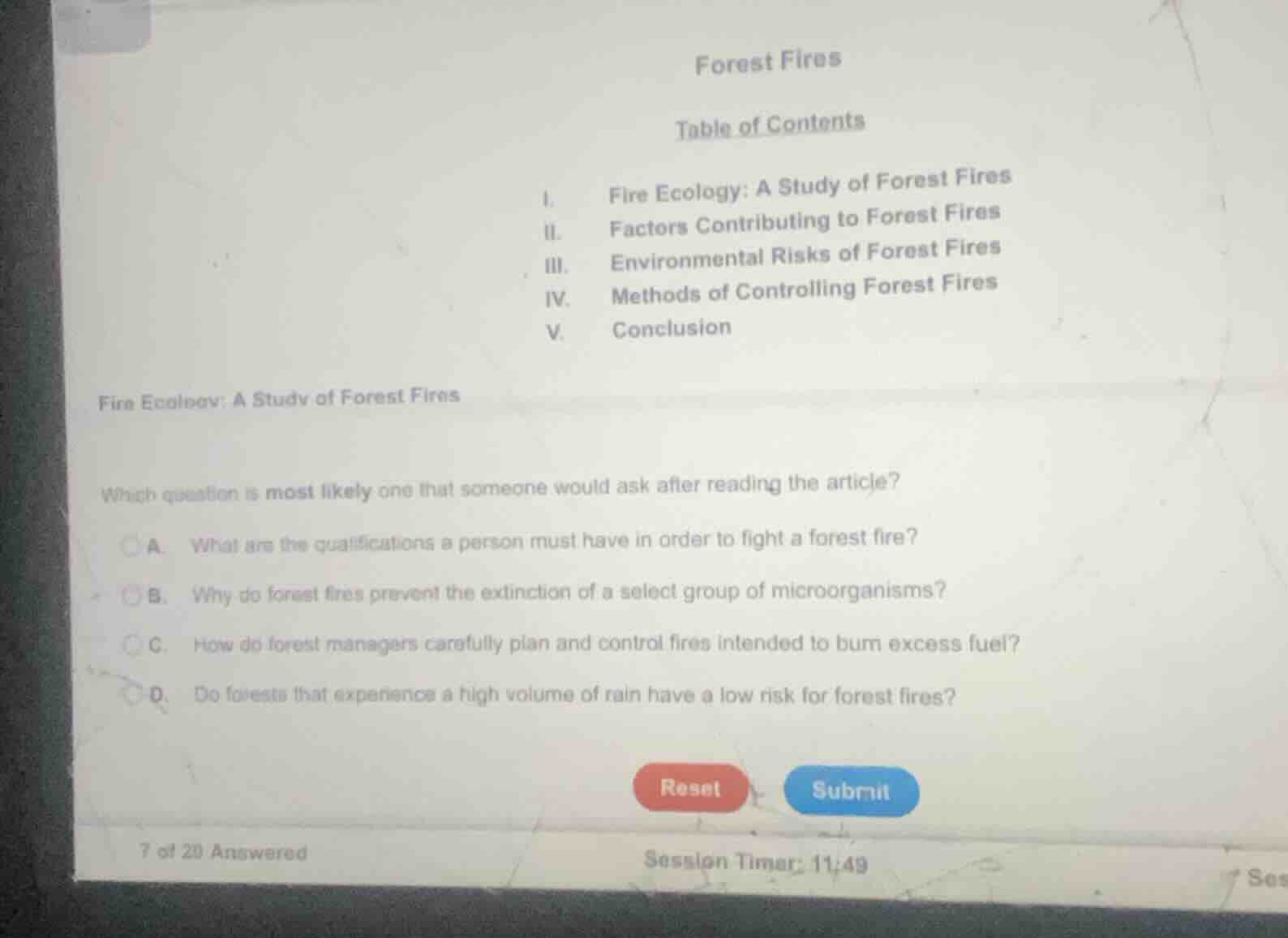
forest fires
table of contents
i. fire ecology: a study of forest fires
ii. factors contributing to forest fires
iii. environmental risks of forest fires
iv. methods of controlling forest fires
v. conclusion
fire ecology: a study of forest fires
which question is most likely one that someone would ask after reading the article?
a. what are the qualifications a person must have in order to fight a forest fire?
b. why do forest fires prevent the extinction of a select group of microorganisms?
c. how do forest managers carefully plan and control fires intended to burn excess fuel?
d. do forests that experience a high volume of rain have a low risk for forest fires?
Analyze the text structure
Using the Text Structure Analysis knowledge point
The image displays a Table of Contents for an article titled "Forest Fires":
- I. Fire Ecology: A Study of Forest Fires
- II. Factors Contributing to Forest Fires
- III. Environmental Risks of Forest Fires
- IV. Methods of Controlling Forest Fires
- V. Conclusion
This structure indicates a comprehensive, scientific overview of forest fires, covering ecological roles, causes, risks, and control methods.
Evaluate the reading purpose
Using the Reading Purpose knowledge point
The question asks which follow-up question a reader is most likely to ask after reading this broad, informative article. We must evaluate each option based on how logically it extends from the topics outlined in the Table of Contents:
- Option A: "What are the qualifications a person must have in order to fight a forest fire?"
- Analysis: This is highly specific to career/job training. While Section IV covers "Methods of Controlling Forest Fires," the article's academic and ecological focus makes professional firefighter qualifications an unlikely direct follow-up.
- Option B: "Why do forest fires prevent the extinction of a select group of microorganisms?"
- Analysis: This is extremely narrow and specific. While Section I covers "Fire Ecology," a general study of forest fires is unlikely to prompt a highly specialized question about specific microorganisms unless that was a central theme, which is not indicated by the broad outline.
- Option C: "How do forest managers carefully plan and control fires intended to burn excess fuel?"
- Analysis: This directly builds upon Section IV ("Methods of Controlling Forest Fires"). Controlled burns (prescribed fires) are a primary, widely discussed method of modern forest fire management and fuel reduction. A reader learning about control methods would naturally wonder how these planned fires are executed safely.
- Option D: "Do forests that experience a high volume of rain have a low risk for forest fires?"
- Analysis: This is a basic, factual question with an obvious answer (yes, wet forests have lower fire risk). A reader would likely find this answered directly within Section II ("Factors Contributing to Forest Fires") rather than asking it as a lingering question after reading.
Compare Option A and Option C
- Option A shifts the focus away from the natural science and management of forests toward human career requirements.
- Option C directly extends the scientific and management concepts introduced in Section IV, making it the most logical and relevant follow-up question for an academic article on this topic.

Snap & solve any problem in the app
Get step-by-step solutions on Sovi AI
Photo-based solutions with guided steps
Explore more problems and detailed explanations
- (A) What are the qualifications a person must have in order to fight a forest fire?
- (B) Why do forest fires prevent the extinction of a select group of microorganisms?
- (C) How do forest managers carefully plan and control fires intended to burn excess fuel? (Correct answer)
- (D) Do forests that experience a high volume of rain have a low risk for forest fires?