QUESTION IMAGE
Question
forces review assignment
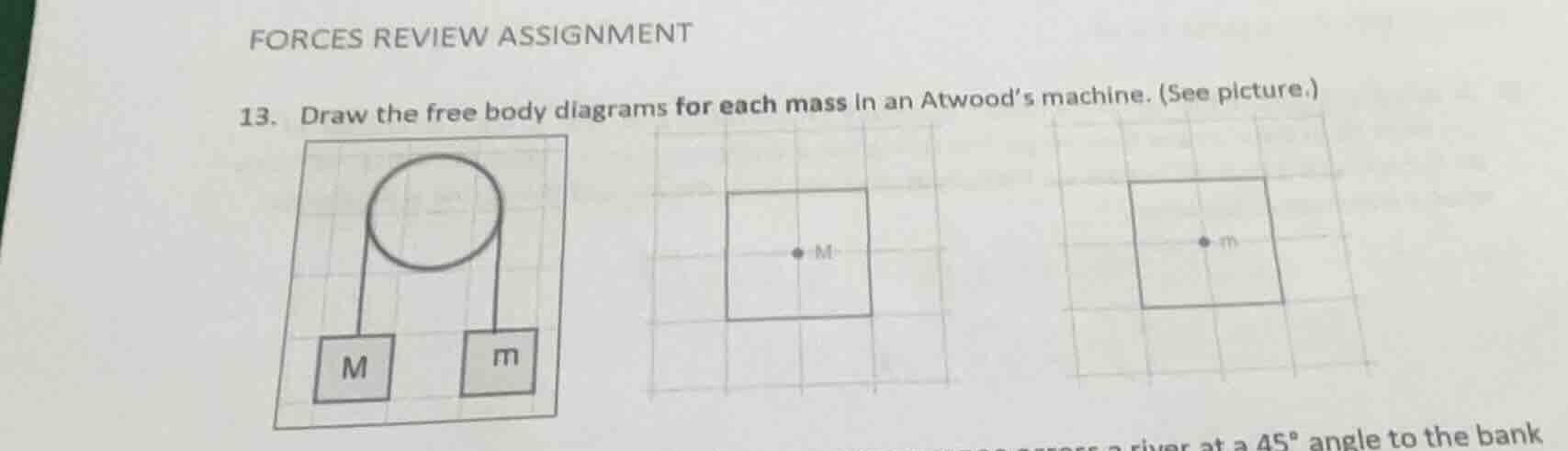
- draw the free body diagrams for each mass in an atwoods machine. (see picture.)
Identify the system and masses
We analyze the Atwood's machine consisting of two masses, \(M\) and \(m\), connected by a light, inextensible string passing over a frictionless pulley. From the diagram, mass \(M\) is visually larger than mass \(m\), implying \(M > m\).
Analyze forces on mass M
Using the Free Body Diagram concept, we identify the forces acting on the larger mass \(M\):
- Gravity pulling downward: \(F_{g,M} = Mg\)
- Tension from the string pulling upward: \(T\)
Since \(M > m\), mass \(M\) accelerates downward, meaning the downward gravitational force is larger than the upward tension force: \(Mg > T\).
Analyze forces on mass m
Using the Free Body Diagram concept, we identify the forces acting on the smaller mass \(m\):
- Gravity pulling downward: \(F_{g,m} = mg\)
- Tension from the string pulling upward: \(T\)
Since mass \(m\) accelerates upward, the upward tension force is larger than the downward gravitational force: \(T > mg\).
Compare force vector lengths
For a correct visual representation on the grid:
- The tension \(T\) is equal in magnitude for both masses because they are connected by the same light string.
- For mass \(M\), the downward vector \(F_{g,M}\) must be longer than the upward vector \(T\).
- For mass \(m\), the upward vector \(T\) must be longer than the downward vector \(F_{g,m}\).
- Thus, the relative lengths of the force vectors are: \(F_{g,M} > T > F_{g,m}\).

Snap & solve any problem in the app
Get step-by-step solutions on Sovi AI
Photo-based solutions with guided steps
Explore more problems and detailed explanations
To draw the free body diagrams for each mass in the Atwood's machine:
- For Mass \(M\) (larger mass):
- Draw a downward arrow from the center dot labeled \(F_{g,M}\) (or \(Mg\)) representing gravity.
- Draw an upward arrow from the center dot labeled \(T\) representing tension.
- Make the downward arrow \(F_{g,M}\) longer than the upward arrow \(T\) (e.g., \(F_{g,M}\) is 3 grid units long, and \(T\) is 2 grid units long).
- For Mass \(m\) (smaller mass):
- Draw a downward arrow from the center dot labeled \(F_{g,m}\) (or \(mg\)) representing gravity.
- Draw an upward arrow from the center dot labeled \(T\) representing tension.
- Make the upward arrow \(T\) longer than the downward arrow \(F_{g,m}\) (e.g., \(T\) is 2 grid units long, and \(F_{g,m}\) is 1 grid unit long).