QUESTION IMAGE
Question
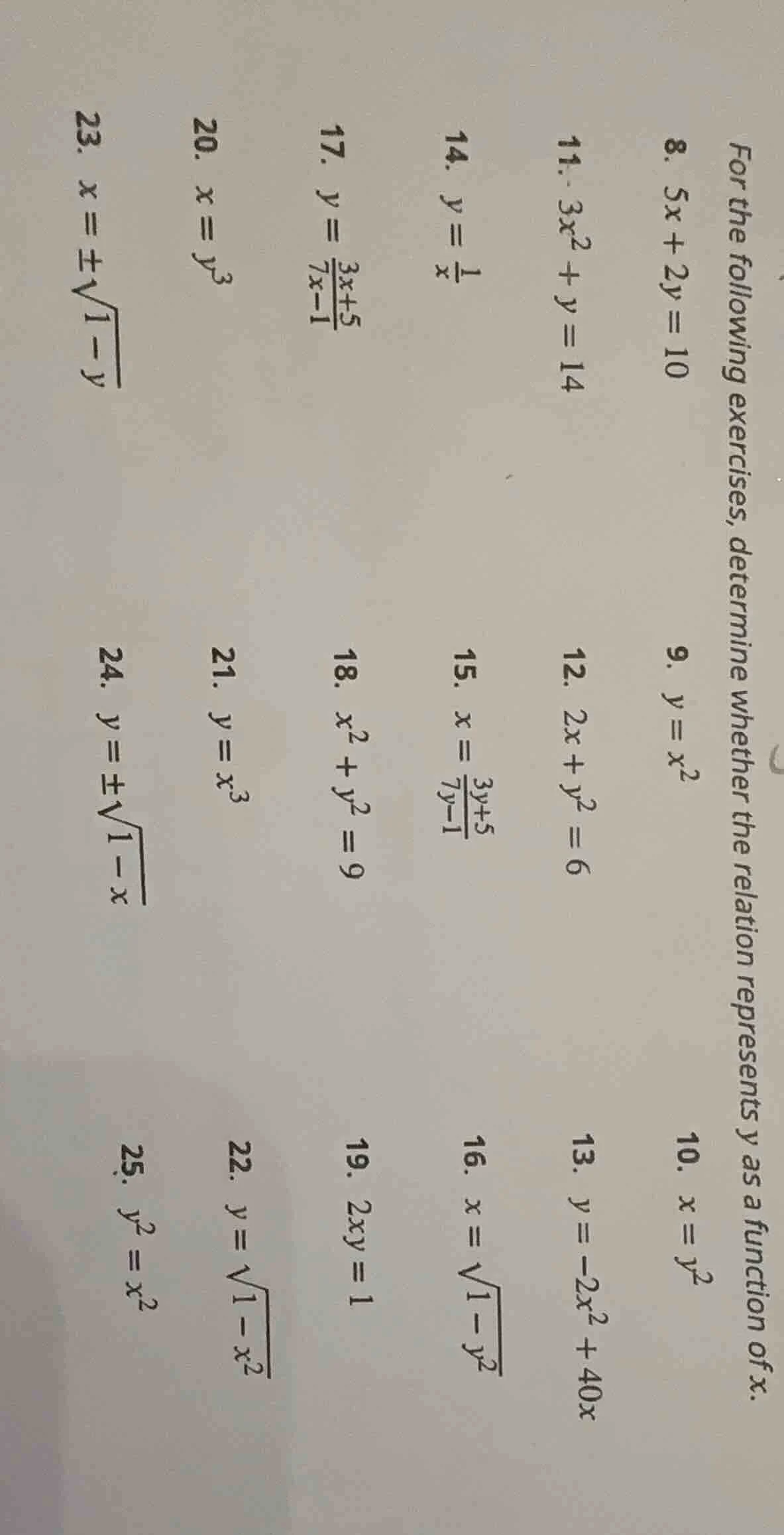
for the following exercises, determine whether the relation represents ( y ) as a function of ( x ).
- ( 5x + 2y = 10 )
- ( y = x^2 )
- ( x = y^2 )
- ( 3x^2 + y = 14 )
- ( 2x + y^2 = 6 )
- ( y = -2x^2 + 40x )
- ( y = \frac{1}{x} )
- ( x = \frac{3y + 5}{7y - 1} )
- ( x = sqrt{1 - y^2} )
- ( y = \frac{3x + 5}{7x - 1} )
- ( x^2 + y^2 = 9 )
- ( 2xy = 1 )
- ( x = y^3 )
- ( y = x^3 )
- ( y = sqrt{1 - x^2} )
- ( x = pm sqrt{1 - y} )
- ( y = pm sqrt{1 - x} )
- ( y^2 = x^2 )
To determine if \( y \) is a function of \( x \), we use the vertical line test: a relation represents \( y \) as a function of \( x \) if every \( x \)-value has at most one \( y \)-value. We analyze each problem:
Problem 8: \( 5x + 2y = 10 \)
Step 1: Solve for \( y \)
Rearrange: \( 2y = -5x + 10 \) → \( y = -\frac{5}{2}x + 5 \).
Step 2: Apply Vertical Line Test
For any \( x \), there is exactly one \( y \) (linear equation, slope \( -\frac{5}{2} \)).
Conclusion: \( y \) is a function of \( x \).
Problem 9: \( y = x^2 \)
Step 1: Analyze the Relation
For any \( x \), squaring \( x \) gives exactly one \( y \) (e.g., \( x=2 \) → \( y=4 \); \( x=-2 \) → \( y=4 \), but each \( x \) has one \( y \)).
Step 2: Vertical Line Test
A vertical line intersects the parabola at most once.
Conclusion: \( y \) is a function of \( x \).
Problem 10: \( x = y^2 \)
Step 1: Solve for \( y \)
\( y = \pm\sqrt{x} \) (e.g., \( x=4 \) → \( y=2 \) or \( y=-2 \)).
Step 2: Vertical Line Test
A vertical line (e.g., \( x=4 \)) intersects the graph at two points (\( (4,2) \) and \( (4,-2) \)).
Conclusion: \( y \) is not a function of \( x \).
Problem 11: \( 3x^2 + y = 14 \)
Step 1: Solve for \( y \)
\( y = -3x^2 + 14 \).
Step 2: Vertical Line Test
For any \( x \), there is exactly one \( y \) (quadratic, opens downward).
Conclusion: \( y \) is a function of \( x \).
Problem 12: \( 2x + y^2 = 6 \)
Step 1: Solve for \( y \)
\( y^2 = -2x + 6 \) → \( y = \pm\sqrt{-2x + 6} \) (e.g., \( x=1 \) → \( y=\pm2 \)).
Step 2: Vertical Line Test
A vertical line (e.g., \( x=1 \)) intersects the graph at two points.
Conclusion: \( y \) is not a function of \( x \).
Problem 13: \( y = -2x^2 + 40x \)
Step 1: Analyze the Relation
Quadratic function: for any \( x \), substituting \( x \) gives exactly one \( y \).
Step 2: Vertical Line Test
A vertical line intersects the parabola at most once.
Conclusion: \( y \) is a function of \( x \).
Problem 14: \( y = \frac{1}{x} \)
Step 1: Analyze the Relation
For \( x
eq 0 \), \( \frac{1}{x} \) gives exactly one \( y \) (e.g., \( x=2 \) → \( y=\frac{1}{2} \); \( x=-2 \) → \( y=-\frac{1}{2} \)).
Step 2: Vertical Line Test
No vertical line intersects the hyperbola more than once (excluding \( x=0 \), which is undefined).
Conclusion: \( y \) is a function of \( x \).
Problem 15: \( x = \frac{3y + 5}{7y - 1} \)
Step 1: Solve for \( y \) (optional, but analyze \( x \)-to-\( y \))
This is a rational function in \( y \). For a given \( x \), solving \( x(7y - 1) = 3y + 5 \) gives a linear equation in \( y \), so at most one \( y \) (except when \( 7x - 3 = 0 \), but \( x \) is defined such that \( 7y - 1
eq 0 \)).
Step 2: Vertical Line Test
Each \( x \) (in domain) maps to one \( y \).
Conclusion: \( y \) is a function of \( x \).
Problem 16: \( x = \sqrt{1 - y^2} \)
Step 1: Solve for \( y \)
Square both sides: \( x^2 = 1 - y^2 \) → \( y^2 = 1 - x^2 \) → \( y = \pm\sqrt{1 - x^2} \) (e.g., \( x=0 \) → \( y=\pm1 \)).
Step 2: Vertical Line Test
A vertical line (e.g., \( x=0 \)) intersects the circle at two points.
Conclusion: \( y \) is not a function of \( x \).
Problem 17: \( y = \frac{3x + 5}{7x - 1} \)
Step 1: Analyze the Relation
Rational function: for \( x
eq \frac{1}{7} \), substituting \( x \) gives exactly one \( y \).
Step 2: Vertical Line Test
No vertical line intersects the graph more than once (excluding \( x=\frac{1}{7} \), undefined).
Conclusion: \( y \) is a function o…

Snap & solve any problem in the app
Get step-by-step solutions on Sovi AI
Photo-based solutions with guided steps
Explore more problems and detailed explanations
To determine if \( y \) is a function of \( x \), we use the vertical line test: a relation represents \( y \) as a function of \( x \) if every \( x \)-value has at most one \( y \)-value. We analyze each problem:
Problem 8: \( 5x + 2y = 10 \)
Step 1: Solve for \( y \)
Rearrange: \( 2y = -5x + 10 \) → \( y = -\frac{5}{2}x + 5 \).
Step 2: Apply Vertical Line Test
For any \( x \), there is exactly one \( y \) (linear equation, slope \( -\frac{5}{2} \)).
Conclusion: \( y \) is a function of \( x \).
Problem 9: \( y = x^2 \)
Step 1: Analyze the Relation
For any \( x \), squaring \( x \) gives exactly one \( y \) (e.g., \( x=2 \) → \( y=4 \); \( x=-2 \) → \( y=4 \), but each \( x \) has one \( y \)).
Step 2: Vertical Line Test
A vertical line intersects the parabola at most once.
Conclusion: \( y \) is a function of \( x \).
Problem 10: \( x = y^2 \)
Step 1: Solve for \( y \)
\( y = \pm\sqrt{x} \) (e.g., \( x=4 \) → \( y=2 \) or \( y=-2 \)).
Step 2: Vertical Line Test
A vertical line (e.g., \( x=4 \)) intersects the graph at two points (\( (4,2) \) and \( (4,-2) \)).
Conclusion: \( y \) is not a function of \( x \).
Problem 11: \( 3x^2 + y = 14 \)
Step 1: Solve for \( y \)
\( y = -3x^2 + 14 \).
Step 2: Vertical Line Test
For any \( x \), there is exactly one \( y \) (quadratic, opens downward).
Conclusion: \( y \) is a function of \( x \).
Problem 12: \( 2x + y^2 = 6 \)
Step 1: Solve for \( y \)
\( y^2 = -2x + 6 \) → \( y = \pm\sqrt{-2x + 6} \) (e.g., \( x=1 \) → \( y=\pm2 \)).
Step 2: Vertical Line Test
A vertical line (e.g., \( x=1 \)) intersects the graph at two points.
Conclusion: \( y \) is not a function of \( x \).
Problem 13: \( y = -2x^2 + 40x \)
Step 1: Analyze the Relation
Quadratic function: for any \( x \), substituting \( x \) gives exactly one \( y \).
Step 2: Vertical Line Test
A vertical line intersects the parabola at most once.
Conclusion: \( y \) is a function of \( x \).
Problem 14: \( y = \frac{1}{x} \)
Step 1: Analyze the Relation
For \( x
eq 0 \), \( \frac{1}{x} \) gives exactly one \( y \) (e.g., \( x=2 \) → \( y=\frac{1}{2} \); \( x=-2 \) → \( y=-\frac{1}{2} \)).
Step 2: Vertical Line Test
No vertical line intersects the hyperbola more than once (excluding \( x=0 \), which is undefined).
Conclusion: \( y \) is a function of \( x \).
Problem 15: \( x = \frac{3y + 5}{7y - 1} \)
Step 1: Solve for \( y \) (optional, but analyze \( x \)-to-\( y \))
This is a rational function in \( y \). For a given \( x \), solving \( x(7y - 1) = 3y + 5 \) gives a linear equation in \( y \), so at most one \( y \) (except when \( 7x - 3 = 0 \), but \( x \) is defined such that \( 7y - 1
eq 0 \)).
Step 2: Vertical Line Test
Each \( x \) (in domain) maps to one \( y \).
Conclusion: \( y \) is a function of \( x \).
Problem 16: \( x = \sqrt{1 - y^2} \)
Step 1: Solve for \( y \)
Square both sides: \( x^2 = 1 - y^2 \) → \( y^2 = 1 - x^2 \) → \( y = \pm\sqrt{1 - x^2} \) (e.g., \( x=0 \) → \( y=\pm1 \)).
Step 2: Vertical Line Test
A vertical line (e.g., \( x=0 \)) intersects the circle at two points.
Conclusion: \( y \) is not a function of \( x \).
Problem 17: \( y = \frac{3x + 5}{7x - 1} \)
Step 1: Analyze the Relation
Rational function: for \( x
eq \frac{1}{7} \), substituting \( x \) gives exactly one \( y \).
Step 2: Vertical Line Test
No vertical line intersects the graph more than once (excluding \( x=\frac{1}{7} \), undefined).
Conclusion: \( y \) is a function of \( x \).
Problem 18: \( x^2 + y^2 = 9 \)
Step 1: Solve for \( y \)
\( y^2 = 9 - x^2 \) → \( y = \pm\sqrt{9 - x^2} \) (e.g., \( x=0 \) → \( y=\pm3 \)).
Step 2: Vertical Line Test
A vertical line (e.g., \( x=0 \)) intersects the circle at two points.
Conclusion: \( y \) is not a function of \( x \).
Problem 19: \( 2xy = 1 \)
Step 1: Solve for \( y \)
\( y = \frac{1}{2x} \) (for \( x
eq 0 \)).
Step 2: Vertical Line Test
For \( x
eq 0 \), each \( x \) maps to one \( y \) (hyperbola).
Conclusion: \( y \) is a function of \( x \).
Problem 20: \( x = y^3 \)
Step 1: Solve for \( y \)
\( y = \sqrt[3]{x} \) (cube root, which is one-to-one: \( x=8 \) → \( y=2 \); \( x=-8 \) → \( y=-2 \)).
Step 2: Vertical Line Test
Each \( x \) maps to exactly one \( y \).
Conclusion: \( y \) is a function of \( x \).
Problem 21: \( y = x^3 \)
Step 1: Analyze the Relation
Cubic function: for any \( x \), cubing \( x \) gives exactly one \( y \) (one-to-one, since \( y' = 3x^2 \geq 0 \)).
Step 2: Vertical Line Test
A vertical line intersects the cubic at most once.
Conclusion: \( y \) is a function of \( x \).
Problem 22: \( y = \sqrt{1 - x^2} \)
Step 1: Analyze the Relation
Square root function: for \( x \in [-1, 1] \), \( \sqrt{1 - x^2} \) gives exactly one non-negative \( y \) (e.g., \( x=0 \) → \( y=1 \); \( x=1 \) → \( y=0 \)).
Step 2: Vertical Line Test
A vertical line intersects the upper half of the circle at most once.
Conclusion: \( y \) is a function of \( x \).
Problem 23: \( x = \pm\sqrt{1 - y} \)
Step 1: Solve for \( y \)
Square both sides: \( x^2 = 1 - y \) → \( y = 1 - x^2 \). Wait, no—original is \( x = \pm\sqrt{1 - y} \), so \( 1 - y \geq 0 \) → \( y \leq 1 \), and \( x \) can be positive or negative for the same \( y \). Wait, the relation is \( x = \pm\sqrt{1 - y} \), so for a given \( y \), \( x \) has two values (e.g., \( y=0 \) → \( x=\pm1 \)). But we check if \( y \) is a function of \( x \): solve for \( y \): \( x^2 = 1 - y \) → \( y = 1 - x^2 \).
Step 2: Vertical Line Test
For any \( x \), \( y = 1 - x^2 \) gives exactly one \( y \) (quadratic, opens downward).
Conclusion: \( y \) is a function of \( x \).
Problem 24: \( y = \pm\sqrt{1 - x} \)
Step 1: Analyze the Relation
For \( x \leq 1 \), \( y \) has two values (e.g., \( x=0 \) → \( y=\pm1 \)).
Step 2: Vertical Line Test
A vertical line (e.g., \( x=0 \)) intersects the graph at two points.
Conclusion: \( y \) is not a function of \( x \).
Problem 25: \( y^2 = x^2 \)
Step 1: Solve for \( y \)
\( y = \pm x \) (e.g., \( x=2 \) → \( y=\pm2 \)).
Step 2: Vertical Line Test
A vertical line (e.g., \( x=2 \)) intersects the graph at two points.
Conclusion: \( y \) is not a function of \( x \).
Summary of Results:
| Problem | \( y \) is a function of \( x \)? |
|---|---|
| 9 | Yes |
| 10 | No |
| 11 | Yes |
| 12 | No |
| 13 | Yes |
| 14 | Yes |
| 15 | Yes |
| 16 | No |
| 17 | Yes |
| 18 | No |
| 19 | Yes |
| 20 | Yes |
| 21 | Yes |
| 22 | Yes |
| 23 | Yes |
| 24 | No |
| 25 | No |
(Note: For clarity, recheck Problem 23: original is \( x = \pm\sqrt{1 - y} \), but solving for \( y \) gives \( y = 1 - x^2 \), which is a function. Problem 24: \( y = \pm\sqrt{1 - x} \) is not a function of \( x \) because one \( x \) gives two \( y \)-values.)