QUESTION IMAGE
Question
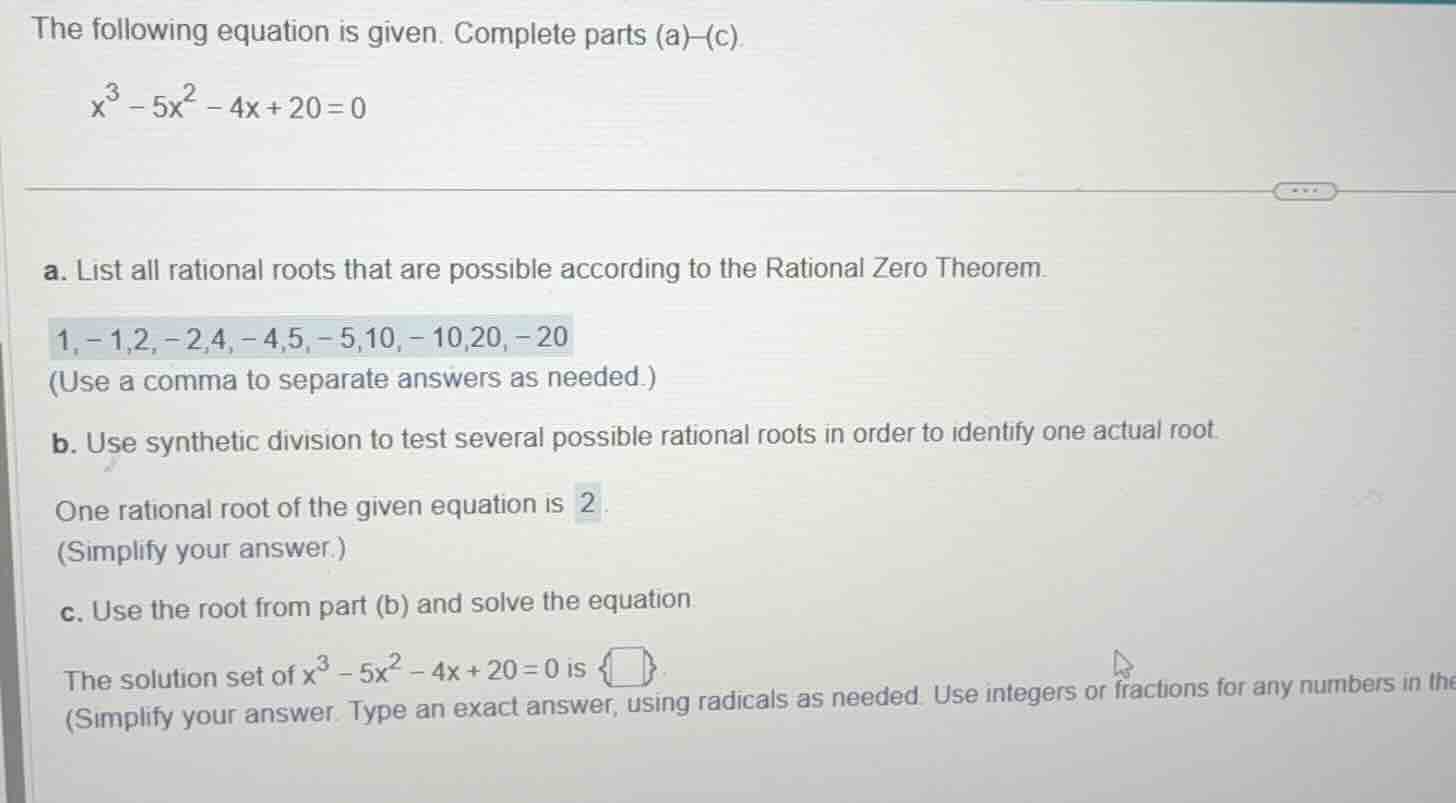
the following equation is given. complete parts (a)-(c).
\\x^3 - 5x^2 - 4x + 20 = 0\\
a. list all rational roots that are possible according to the rational zero theorem.
1, -1, 2, -2, 4, -4, 5, -5, 10, -10, 20, -20
(use a comma to separate answers as needed.)
b. use synthetic division to test several possible rational roots in order to identify one actual root.
one rational root of the given equation is 2.
(simplify your answer.)
c. use the root from part (b) and solve the equation.
the solution set of \\x^3 - 5x^2 - 4x + 20 = 0\\ is \\{\quad\\}.
(simplify your answer. type an exact answer, using radicals as needed. use integers or fractions for any numbers in the expression.)
<pre_analysis>
{
"quality": "clear",
"question_count": 1,
"skills_matched": [
"step_cot",
"blank_filling_formatter",
"explain_then_answer",
"tutor",
"mastery_adaptive_brevity"
],
"needs_drawing": false,
"concepts_used": [
"Rational Root Theorem",
"Synthetic Division",
"Solving by Radicals"
],
"new_concepts": [],
"current_concepts": [
"Rational Root Theorem",
"Synthetic Division",
"Solving by Radicals",
"Quadratic Equations"
]
}
</pre_analysis>
<reasoning>
List possible rational roots
Using the Rational Root Theorem knowledge point
\[
\]
Test possible roots using synthetic division
Using the Synthetic Division knowledge point
\[
\]
Solve the remaining quadratic equation
Using the Solving by Radicals knowledge point
\[
\]
State the complete solution set
Combine all found roots to form the solution set:
\[
x = 2, \quad x = 5, \quad x = -2
\]
</reasoning>
<answer>
The following equation is given. Complete parts (a)–(c).
\[x^3 - 5x^2 - 4x + 20 = 0\]
a. List all rational roots that are possible according to the Rational Zero Theorem.
<blank>\(1, -1, 2, -2, 4, -4, 5, -5, 10, -10, 20, -20\)</blank>
(Use a comma to separate answers as needed.)
b. Use synthetic division to test several possible rational roots in order to identify one actual root.
One rational root of the given equation is <blank>\(2\)</blank>.
(Simplify your answer.)
c. Use the root from part (b) and solve the equation.
The solution set of \(x^3 - 5x^2 - 4x + 20 = 0\) is <blank>\(2, 5, -2\)</blank>.
(Simplify your answer. Type an exact answer, using radicals as needed. Use integers or fractions for any numbers in the expression.)
</answer>
<post_analysis>
{
"subject": "Mathematics",
"question_type": "Fill-in-the-blank",
"knowledge_point": [
"Mathematics",
"Algebra",
"Rational Root Theorem"
]
}
</post_analysis>
Snap & solve any problem in the app
Get step-by-step solutions on Sovi AI
Photo-based solutions with guided steps
Explore more problems and detailed explanations
<pre_analysis>
{
"quality": "clear",
"question_count": 1,
"skills_matched": [
"step_cot",
"blank_filling_formatter",
"explain_then_answer",
"tutor",
"mastery_adaptive_brevity"
],
"needs_drawing": false,
"concepts_used": [
"Rational Root Theorem",
"Synthetic Division",
"Solving by Radicals"
],
"new_concepts": [],
"current_concepts": [
"Rational Root Theorem",
"Synthetic Division",
"Solving by Radicals",
"Quadratic Equations"
]
}
</pre_analysis>
<reasoning>
List possible rational roots
Using the Rational Root Theorem knowledge point
\[
\]
Test possible roots using synthetic division
Using the Synthetic Division knowledge point
\[
\]
Solve the remaining quadratic equation
Using the Solving by Radicals knowledge point
\[
\]
State the complete solution set
Combine all found roots to form the solution set:
\[
x = 2, \quad x = 5, \quad x = -2
\]
</reasoning>
<answer>
The following equation is given. Complete parts (a)–(c).
\[x^3 - 5x^2 - 4x + 20 = 0\]
a. List all rational roots that are possible according to the Rational Zero Theorem.
<blank>\(1, -1, 2, -2, 4, -4, 5, -5, 10, -10, 20, -20\)</blank>
(Use a comma to separate answers as needed.)
b. Use synthetic division to test several possible rational roots in order to identify one actual root.
One rational root of the given equation is <blank>\(2\)</blank>.
(Simplify your answer.)
c. Use the root from part (b) and solve the equation.
The solution set of \(x^3 - 5x^2 - 4x + 20 = 0\) is <blank>\(2, 5, -2\)</blank>.
(Simplify your answer. Type an exact answer, using radicals as needed. Use integers or fractions for any numbers in the expression.)
</answer>
<post_analysis>
{
"subject": "Mathematics",
"question_type": "Fill-in-the-blank",
"knowledge_point": [
"Mathematics",
"Algebra",
"Rational Root Theorem"
]
}
</post_analysis>