QUESTION IMAGE
Question
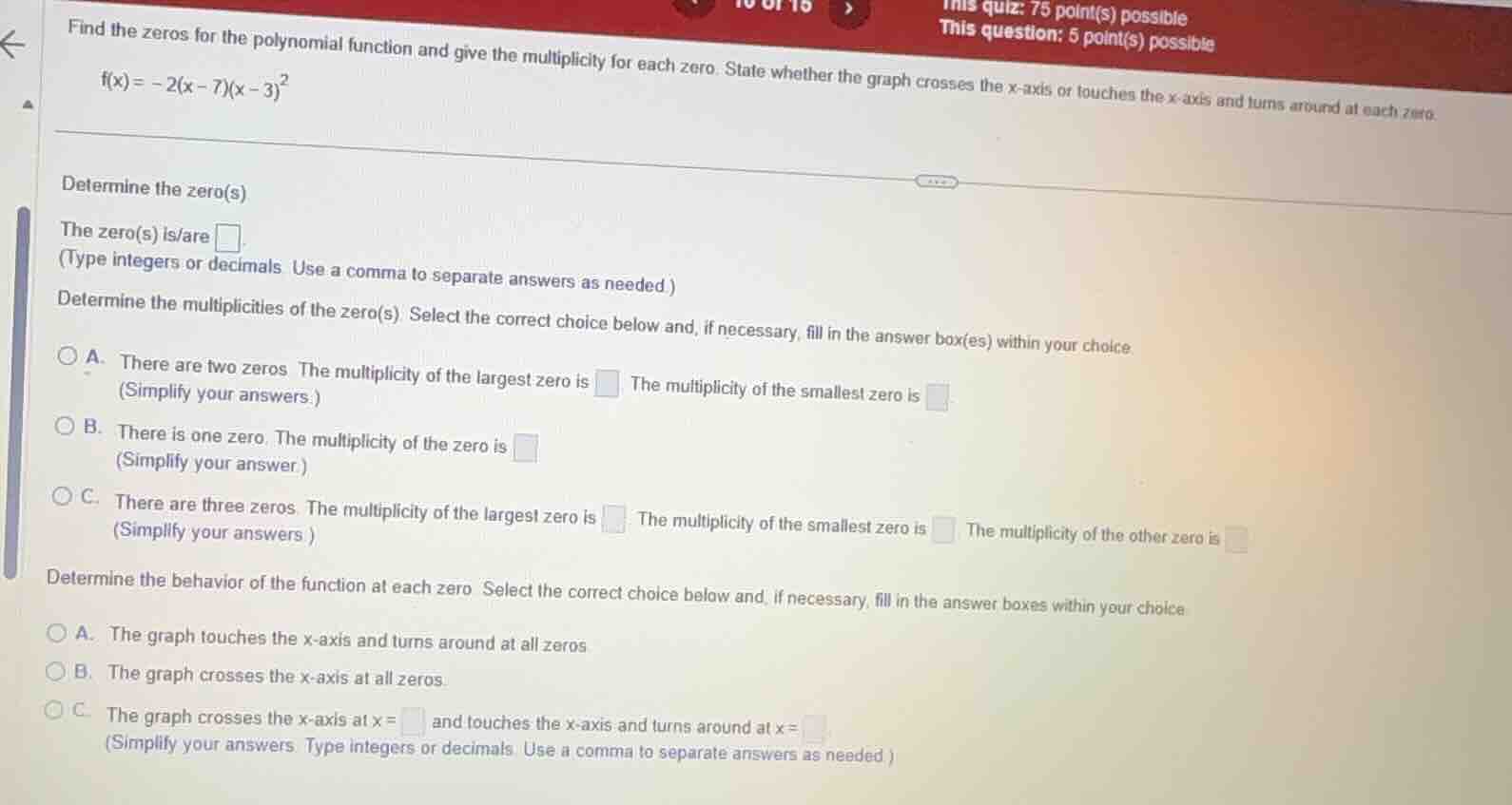
find the zeros for the polynomial function and give the multiplicity for each zero. state whether the graph crosses the x-axis or touches the x-axis and turns around at each zero.
\\(f(x) = -2(x-7)(x-3)^2\\)
determine the zero(s).
the zero(s) is/are .
(type integers or decimals. use a comma to separate answers as needed.)
determine the multiplicities of the zero(s). select the correct choice below and, if necessary, fill in the answer box(es) within your choice.
a. there are two zeros. the multiplicity of the largest zero is . the multiplicity of the smallest zero is .
(simplify your answers.)
b. there is one zero. the multiplicity of the zero is .
(simplify your answer.)
c. there are three zeros. the multiplicity of the largest zero is . the multiplicity of the smallest zero is . the multiplicity of the other zero is .
(simplify your answers.)
determine the behavior of the function at each zero. select the correct choice below and, if necessary, fill in the answer boxes within your choice.
a. the graph touches the x-axis and turns around at all zeros.
b. the graph crosses the x-axis at all zeros.
c. the graph crosses the x-axis at \\(x =\\) and touches the x-axis and turns around at \\(x =\\) .
(simplify your answers. type integers or decimals. use a comma to separate answers as needed.)
Find the zeros of the function
To find the zeros of the polynomial function \(f(x) = -2(x-7)(x-3)^2\), we set \(f(x) = 0\):
This gives the solutions:
Thus, the zeros are \(3, 7\).
Determine the multiplicities
The multiplicity of a zero is the exponent of its corresponding linear factor in the factored form of the polynomial:
- For the zero \(x = 7\), the factor is \((x-7)^1\), so its multiplicity is \(1\).
- For the zero \(x = 3\), the factor is \((x-3)^2\), so its multiplicity is \(2\).
There are two zeros. The largest zero is \(7\) with multiplicity \(1\). The smallest zero is \(3\) with multiplicity \(2\). This matches option A.
Determine the behavior at each zero
The behavior of the graph at an \(x\)-intercept depends on the multiplicity of the zero:
- If the multiplicity is odd, the graph crosses the \(x\)-axis.
- If the multiplicity is even, the graph touches the \(x\)-axis and turns around.
For our zeros:
- At \(x = 7\) (multiplicity \(1\), odd), the graph crosses the \(x\)-axis.
- At \(x = 3\) (multiplicity \(2\), even), the graph touches the \(x\)-axis and turns around.
This matches option C.

Snap & solve any problem in the app
Get step-by-step solutions on Sovi AI
Photo-based solutions with guided steps
Explore more problems and detailed explanations
Question 1
The zero(s) is/are <blank>3, 7</blank>
Question 2
- A. There are two zeros. The multiplicity of the largest zero is <blank>1</blank>. The multiplicity of the smallest zero is <blank>2</blank>. (Correct answer)
- B. There is one zero. The multiplicity of the zero is [ ].
- C. There are three zeros. The multiplicity of the largest zero is [ ]. The multiplicity of the smallest zero is [ ]. The multiplicity of the other zero is [ ].
Question 3
- A. The graph touches the x-axis and turns around at all zeros.
- B. The graph crosses the x-axis at all zeros.
- C. The graph crosses the x-axis at x = <blank>7</blank> and touches the x-axis and turns around at x = <blank>3</blank>. (Correct answer)