QUESTION IMAGE
Question
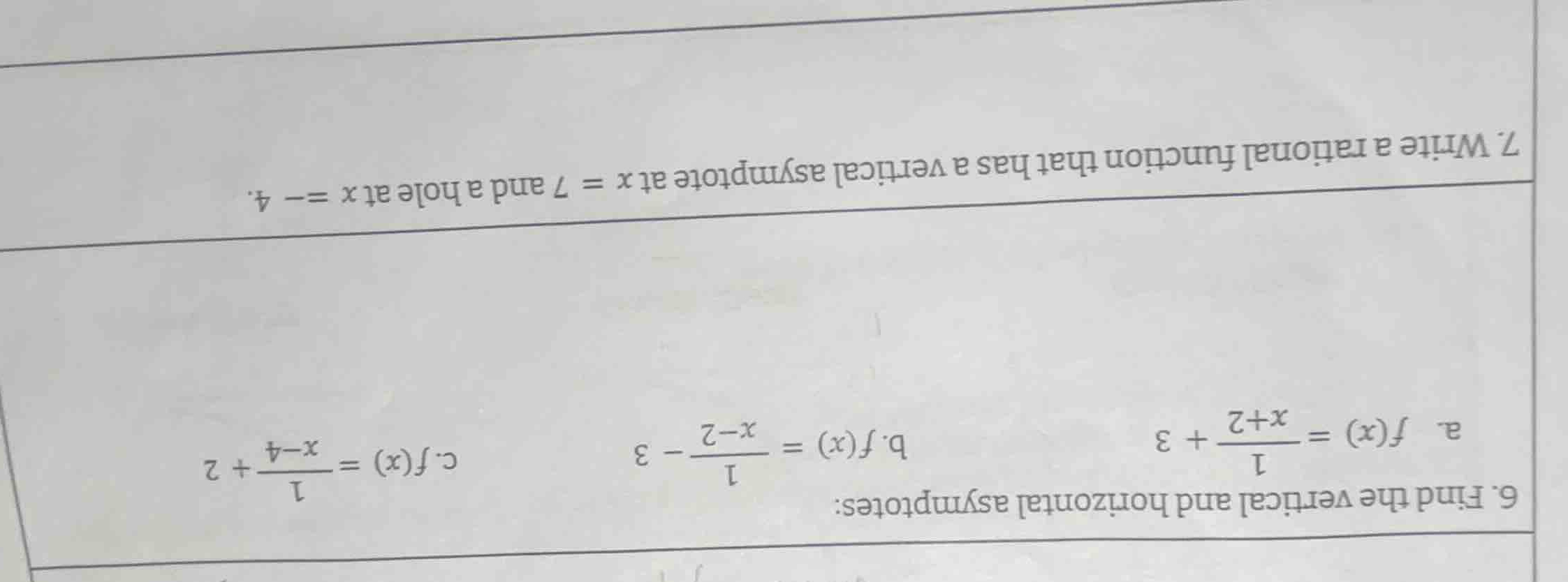
- find the vertical and horizontal asymptotes:
a. (f(x) = \frac{1}{x+2} + 3)
b. (f(x) = \frac{1}{x-2} - 3)
c. (f(x) = \frac{1}{x-4} + 2)
- write a rational function that has a vertical asymptote at (x = 7) and a hole at (x = -4).
Analyze the orientation of the image
The image is upside down. Let's read the text by rotating it 180 degrees:
- Question 6: Find the vertical and horizontal asymptotes:
- a. \(f(x) = \frac{1}{x+2} + 3\)
- b. \(f(x) = \frac{1}{x-2} - 3\)
- c. \(f(x) = \frac{1}{x-4} + 2\)
- Question 7: Write a rational function that has a vertical asymptote at \(x = 7\) and a hole at \(x = -4\).
Determine asymptotes for Question 6
Using the Rational Graphs knowledge point
For a rational function in the form \(f(x) = \frac{a}{x-h} + k\):
- The vertical asymptote occurs where the denominator is zero: \(x - h = 0 \implies x = h\).
- The horizontal asymptote is the horizontal shift: \(y = k\).
Let's apply this to each sub-question:
- 6a: \(f(x) = \frac{1}{x+2} + 3\)
- Vertical asymptote: \(x + 2 = 0 \implies x = -2\)
- Horizontal asymptote: \(y = 3\)
- 6b: \(f(x) = \frac{1}{x-2} - 3\)
- Vertical asymptote: \(x - 2 = 0 \implies x = 2\)
- Horizontal asymptote: \(y = -3\)
- 6c: \(f(x) = \frac{1}{x-4} + 2\)
- Vertical asymptote: \(x - 4 = 0 \implies x = 4\)
- Horizontal asymptote: \(y = 2\)
Construct the rational function for Question 7
Using the Rational Expressions knowledge point
To construct a rational function \(f(x) = \frac{P(x)}{Q(x)}\):
- A vertical asymptote at \(x = 7\) means there is a factor of \((x - 7)\) in the denominator that does not cancel out.
- A hole at \(x = -4\) means there is a common factor of \((x - (-4)) = (x + 4)\) in both the numerator and the denominator.
Thus, we can write the function as:

Snap & solve any problem in the app
Get step-by-step solutions on Sovi AI
Photo-based solutions with guided steps
Explore more problems and detailed explanations
Question 6
a. Vertical asymptote: \(x = -2\), Horizontal asymptote: \(y = 3\)
b. Vertical asymptote: \(x = 2\), Horizontal asymptote: \(y = -3\)
c. Vertical asymptote: \(x = 4\), Horizontal asymptote: \(y = 2\)
Question 7
An example of such a rational function is: