QUESTION IMAGE
Question
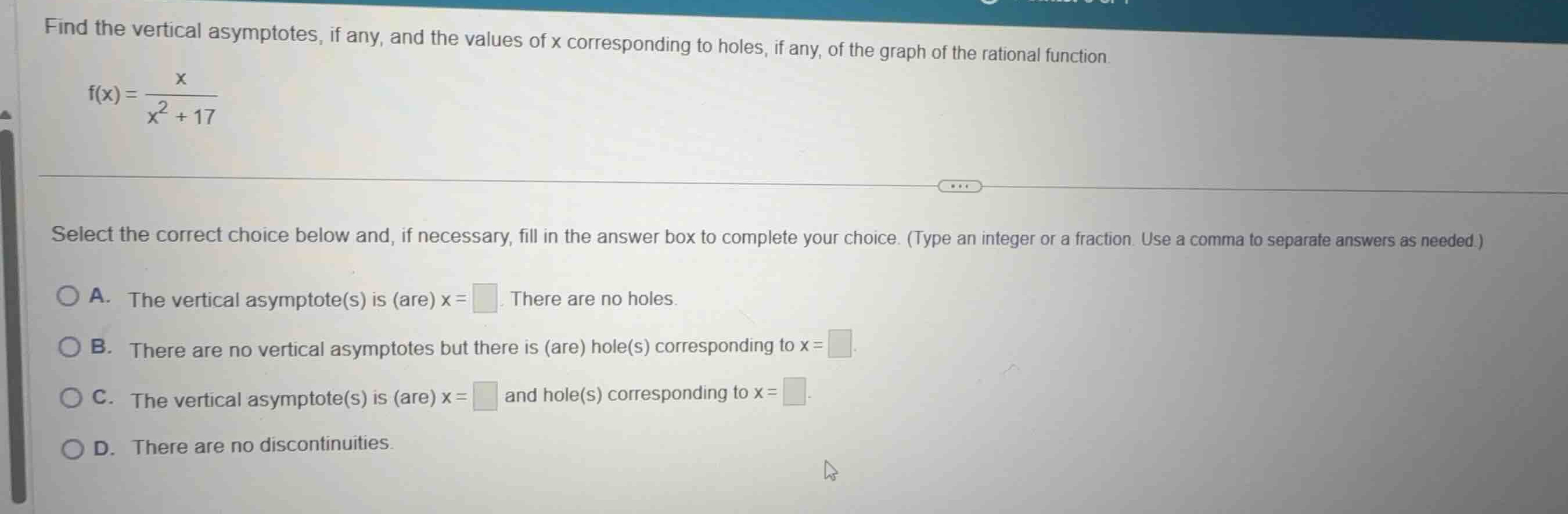
find the vertical asymptotes, if any, and the values of x corresponding to holes, if any, of the graph of the rational function.
(f(x) = \frac{x}{x^2 + 17})
select the correct choice below and, if necessary, fill in the answer box to complete your choice. (type an integer or a fraction. use a comma to separate answers as needed.)
a. the vertical asymptote(s) is (are) (x =) . there are no holes.
b. there are no vertical asymptotes but there is (are) hole(s) corresponding to (x =) .
c. the vertical asymptote(s) is (are) (x =) and hole(s) corresponding to (x =) .
d. there are no discontinuities.
<pre_analysis>
{
"quality": "clear",
"question_count": 1,
"skills_matched": [
"step_cot",
"multiple_choice_formatter",
"explain_then_answer",
"tutor",
"mastery_adaptive_brevity"
],
"needs_drawing": false,
"concepts_used": [
"Vertical Asymptotes Determination",
"Rational Function Holes"
],
"new_concepts": [],
"current_concepts": [
"Vertical Asymptotes Determination",
"Rational Function Holes",
"Domain Exclusion"
]
}
</pre_analysis>
<reasoning>
Analyze the denominator for domain exclusions
Using the Vertical Asymptotes Determination and Rational Function Holes knowledge points
\[
\]
Determine real discontinuities
Using the Domain Exclusion knowledge point
\[
\]
Identify asymptotes and holes
Using the Vertical Asymptotes Determination and Rational Function Holes knowledge points
\[
\]
</reasoning>
<answer>
<mcq-option>A. The vertical asymptote(s) is (are) \(x =\) [blank]. There are no holes.</mcq-option>
<mcq-option>B. There are no vertical asymptotes but there is (are) hole(s) corresponding to \(x =\) [blank].</mcq-option>
<mcq-option>C. The vertical asymptote(s) is (are) \(x =\) [blank] and hole(s) corresponding to \(x =\) [blank].</mcq-option>
<mcq-correct>D. There are no discontinuities.</mcq-correct>
</answer>
<post_analysis>
{
"subject": "Mathematics",
"question_type": "Multiple Choice",
"knowledge_point": [
"Mathematics",
"Algebra",
"Vertical Asymptotes Determination"
]
}
</post_analysis>
Snap & solve any problem in the app
Get step-by-step solutions on Sovi AI
Photo-based solutions with guided steps
Explore more problems and detailed explanations
<pre_analysis>
{
"quality": "clear",
"question_count": 1,
"skills_matched": [
"step_cot",
"multiple_choice_formatter",
"explain_then_answer",
"tutor",
"mastery_adaptive_brevity"
],
"needs_drawing": false,
"concepts_used": [
"Vertical Asymptotes Determination",
"Rational Function Holes"
],
"new_concepts": [],
"current_concepts": [
"Vertical Asymptotes Determination",
"Rational Function Holes",
"Domain Exclusion"
]
}
</pre_analysis>
<reasoning>
Analyze the denominator for domain exclusions
Using the Vertical Asymptotes Determination and Rational Function Holes knowledge points
\[
\]
Determine real discontinuities
Using the Domain Exclusion knowledge point
\[
\]
Identify asymptotes and holes
Using the Vertical Asymptotes Determination and Rational Function Holes knowledge points
\[
\]
</reasoning>
<answer>
<mcq-option>A. The vertical asymptote(s) is (are) \(x =\) [blank]. There are no holes.</mcq-option>
<mcq-option>B. There are no vertical asymptotes but there is (are) hole(s) corresponding to \(x =\) [blank].</mcq-option>
<mcq-option>C. The vertical asymptote(s) is (are) \(x =\) [blank] and hole(s) corresponding to \(x =\) [blank].</mcq-option>
<mcq-correct>D. There are no discontinuities.</mcq-correct>
</answer>
<post_analysis>
{
"subject": "Mathematics",
"question_type": "Multiple Choice",
"knowledge_point": [
"Mathematics",
"Algebra",
"Vertical Asymptotes Determination"
]
}
</post_analysis>