QUESTION IMAGE
Question
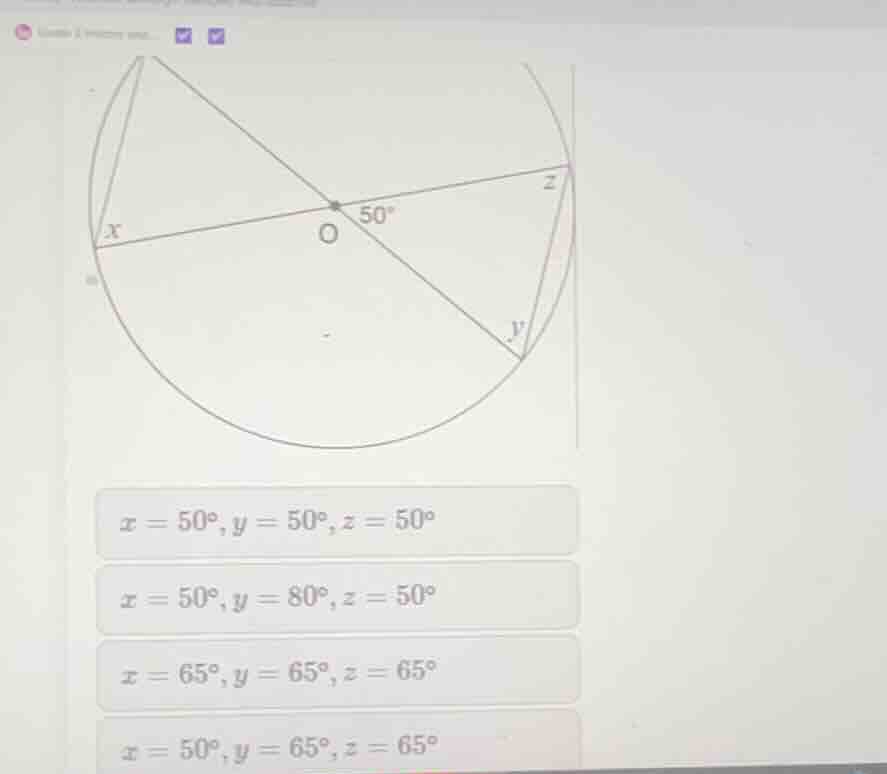
find the values of \\(x\\), \\(y\\), and \\(z\\).
\\(x = 50^{\circ}, y = 50^{\circ}, z = 50^{\circ}\\)
\\(x = 50^{\circ}, y = 80^{\circ}, z = 50^{\circ}\\)
\\(x = 65^{\circ}, y = 65^{\circ}, z = 65^{\circ}\\)
\\(x = 50^{\circ}, y = 65^{\circ}, z = 65^{\circ}\\)
Identify the geometric properties of the circle
The center of the circle is labeled \(O\). The line segments connecting \(O\) to the points on the circle are radii. Thus, the triangles formed with the center \(O\) as a vertex are isosceles triangles because their legs are radii of the circle.
Find the vertical angle
The angle opposite to the given \(50^\circ\) angle at the intersection point \(O\) is also \(50^\circ\) because vertical angles are equal. This means the central angle for the triangle on the left is \(50^\circ\).
Determine the value of \(x\)
The triangle on the left is an isosceles triangle with two sides equal to the radius \(r\). The vertex angle at \(O\) is \(50^\circ\). The base angles must be equal. Since one base angle is \(x\), we have:
Determine the values of \(y\) and \(z\)
Similarly, the triangle on the right is also an isosceles triangle with two sides equal to the radius \(r\). The vertex angle at \(O\) is given as \(50^\circ\). The base angles are \(y\) and \(z\), which must be equal:
Using the sum of angles in this triangle:
Match with the options
We have found:
This matches the third option.

Snap & solve any problem in the app
Get step-by-step solutions on Sovi AI
Photo-based solutions with guided steps
Explore more problems and detailed explanations
- (A) \(x = 50^\circ, y = 50^\circ, z = 50^\circ\)
- (B) \(x = 50^\circ, y = 80^\circ, z = 50^\circ\)
- (C) \(x = 65^\circ, y = 65^\circ, z = 65^\circ\) (Correct answer)
- (D) \(x = 50^\circ, y = 65^\circ, z = 65^\circ\)