QUESTION IMAGE
Question
find the term and substitute it with the appropriate medical term.
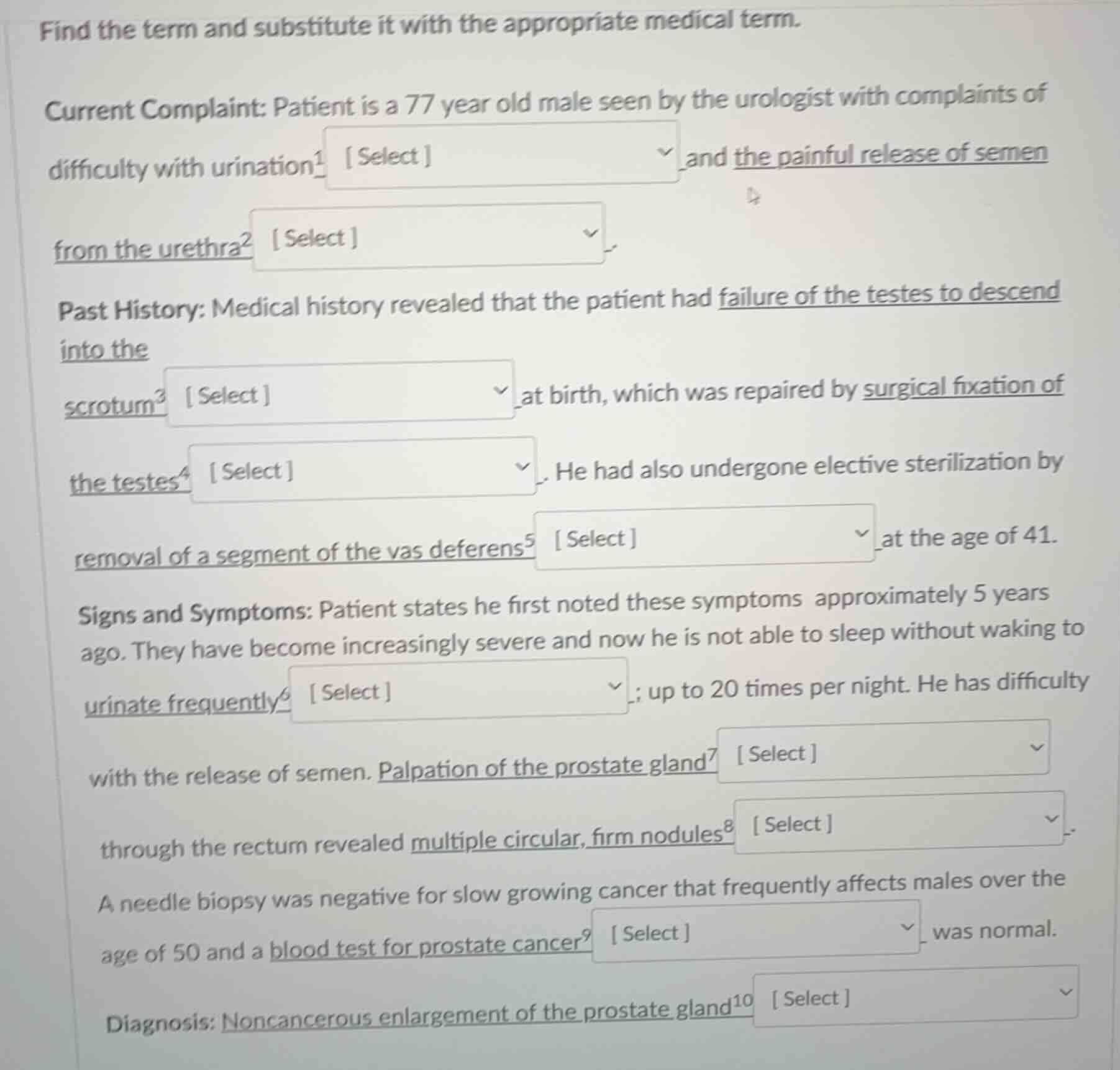
current complaint: patient is a 77 year old male seen by the urologist with complaints of difficulty with urination\\(^1\\) select and the painful release of semen from the urethra\\(^2\\) select .
past history: medical history revealed that the patient had failure of the testes to descend into the scrotum\\(^3\\) select at birth, which was repaired by surgical fixation of the testes\\(^4\\) select . he had also undergone elective sterilization by removal of a segment of the vas deferens\\(^5\\) select at the age of 41.
signs and symptoms: patient states he first noted these symptoms approximately 5 years ago. they have become increasingly severe and now he is not able to sleep without waking to urinate frequently\\(^6\\) select ; up to 20 times per night. he has difficulty with the release of semen. palpation of the prostate gland\\(^7\\) select through the rectum revealed multiple circular, firm nodules\\(^8\\) select . a needle biopsy was negative for slow growing cancer that frequently affects males over the age of 50 and a blood test for prostate cancer\\(^9\\) select was normal.
diagnosis: noncancerous enlargement of the prostate gland\\(^{10}\\) select
Identify urinary and reproductive symptoms
The first two terms describe clinical symptoms related to urination and ejaculation:
- "difficulty with urination" is clinically termed dysuria (or sometimes strangury, but dysuria is the standard medical term for painful or difficult urination).
- "painful release of semen from the urethra" is medically termed hemospermia (if bloody) or more directly dyspermia / painful ejaculation (often represented by odynophallia or dyspermia; in standard medical terminology curricula, painful ejaculation is referred to as dyspermia).
Identify congenital and surgical terms
The next three terms describe congenital conditions and surgical procedures of the male reproductive system:
- "failure of the testes to descend into the scrotum" is the definition of cryptorchidism.
- "surgical fixation of the testes" is the surgical procedure known as orchiopexy (or orchidopexy).
- "removal of a segment of the vas deferens" is the sterilization procedure known as vasectomy.
Identify urinary frequency and examination terms
The next three terms describe symptoms and clinical examination methods:
- "urinate frequently" (specifically at night, as the context says "unable to sleep without waking to urinate frequently; up to 20 times per night") is medically termed nocturia.
- "Palpation of the prostate gland through the rectum" is the clinical examination known as a digital rectal examination (DRE).
- "multiple circular, firm nodules" refers to prostatic nodules or simply nodules.
Identify diagnostic tests and final diagnosis
The last two terms describe a specific blood test and the final pathological diagnosis:
- "blood test for prostate cancer" refers to the prostate-specific antigen (PSA) test.
- "Noncancerous enlargement of the prostate gland" is the medical definition of benign prostatic hyperplasia (BPH).

Snap & solve any problem in the app
Get step-by-step solutions on Sovi AI
Photo-based solutions with guided steps
Explore more problems and detailed explanations
| No. | Underlined Description | Medical Term |
|---|---|---|
| 2 | painful release of semen from the urethra | Dyspermia |
| 3 | failure of the testes to descend into the scrotum | Cryptorchidism |
| 4 | surgical fixation of the testes | Orchiopexy |
| 5 | removal of a segment of the vas deferens | Vasectomy |
| 6 | urinate frequently (at night) | Nocturia |
| 7 | Palpation of the prostate gland through the rectum | Digital rectal examination |
| 8 | multiple circular, firm nodules | Nodules |
| 9 | blood test for prostate cancer | Prostate-specific antigen |
| 10 | Noncancerous enlargement of the prostate gland | Benign prostatic hyperplasia |