QUESTION IMAGE
Question
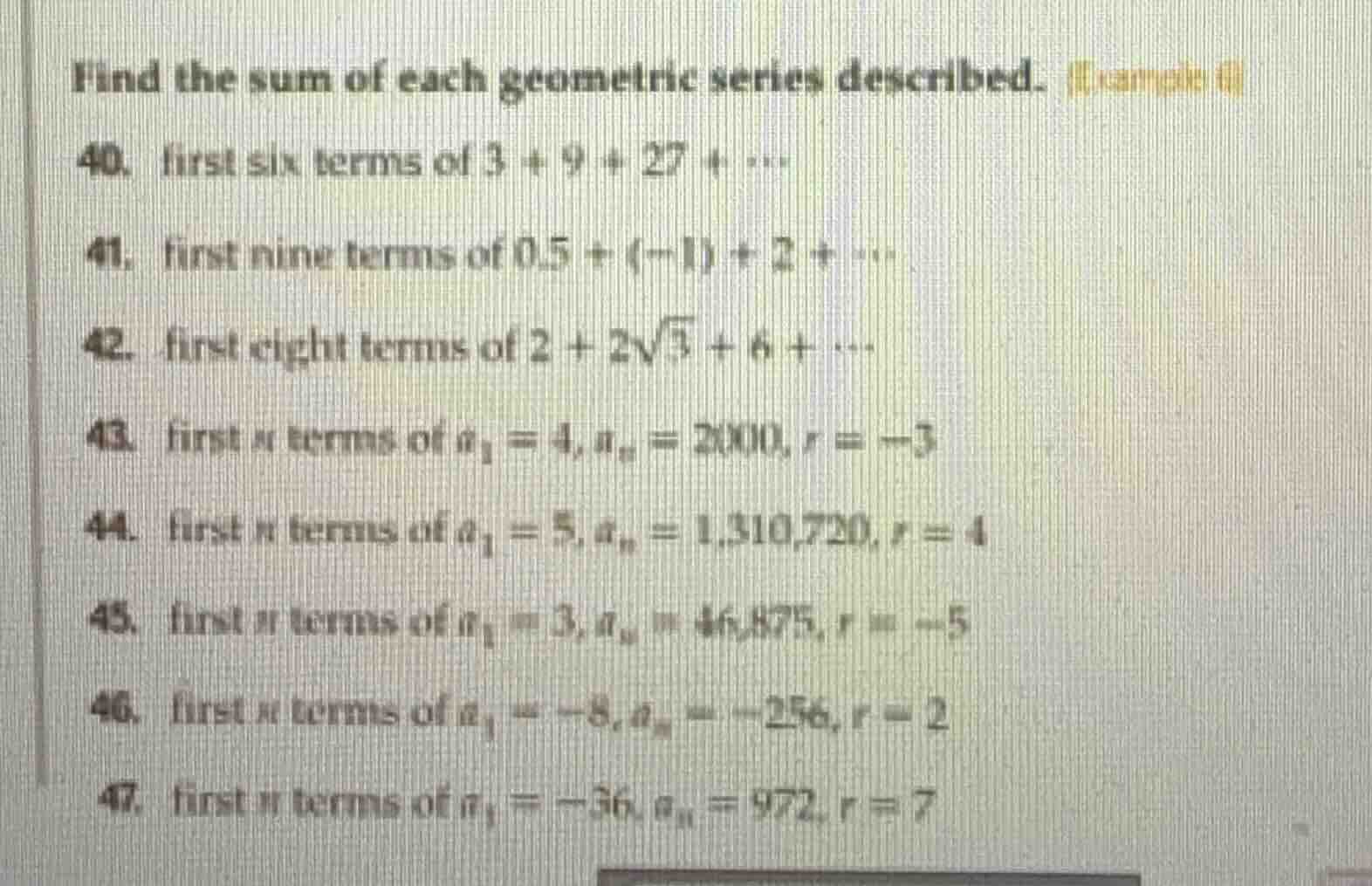
find the sum of each geometric series described.
- first six terms of \\(3 + 9 + 27 + \cdots\\)
- first nine terms of \\(0.5 + (-1) + 2 + \cdots\\)
- first eight terms of \\(2 + 2\sqrt{3} + 6 + \cdots\\)
- first \\(n\\) terms of \\(a_1 = 4, a_n = 2000, r = -3\\)
- first \\(n\\) terms of \\(a_1 = 5, a_n = 1,310,720, r = 4\\)
- first \\(n\\) terms of \\(a_1 = 3, a_n = 46,875, r = -5\\)
- first \\(n\\) terms of \\(a_1 = -8, a_n = -256, r = 2\\)
- first \\(n\\) terms of \\(a_1 = -36, a_n = 972, r = 7\\)
Identify series parameters for questions 40 to 42
Using the formula for the sum of a finite geometric series \(S_n = \frac{a_1(1-r^n)}{1-r}\):
- Question 40: \(a_1 = 3\), \(r = 3\), \(n = 6\).
$$S_6 = \frac{3(1-3^6)}{1-3} = \frac{3(1-729)}{-2} = \frac{3(-728)}{-2} = 1092$$
- Question 41: \(a_1 = 0.5\), \(r = -2\), \(n = 9\).
$$S_9 = \frac{0.5(1-(-2)^9)}{1-(-2)} = \frac{0.5(1+512)}{3} = \frac{256.5}{3} = 85.5$$
- Question 42: \(a_1 = 2\), \(r = \sqrt{3}\), \(n = 8\).
$$S_8 = \frac{2(1-(\sqrt{3})^8)}{1-\sqrt{3}} = \frac{2(1-81)}{1-\sqrt{3}} = \frac{-160}{1-\sqrt{3}} = \frac{160}{\sqrt{3}-1} = 80(\sqrt{3}+1)$$
Identify series parameters for questions 43 to 45
Using the alternative sum formula \(S_n = \frac{a_1 - a_n r}{1-r}\):
- Question 43: \(a_1 = 4\), \(a_n = 2000\), \(r = -3\).
$$S_n = \frac{4 - 2000(-3)}{1-(-3)} = \frac{4 + 6000}{4} = 1501$$
- Question 44: \(a_1 = 5\), \(a_n = 1310720\), \(r = 4\).
$$S_n = \frac{5 - 1310720(4)}{1-4} = \frac{5 - 5242880}{-3} = \frac{-5242875}{-3} = 1747625$$
- Question 45: \(a_1 = 3\), \(a_n = 46875\), \(r = -5\).
$$S_n = \frac{3 - 46875(-5)}{1-(-5)} = \frac{3 + 234375}{6} = \frac{234378}{6} = 39063$$
Identify series parameters for questions 46 to 47
Using the alternative sum formula \(S_n = \frac{a_1 - a_n r}{1-r}\):
- Question 46: \(a_1 = -8\), \(a_n = -256\), \(r = 2\).
$$S_n = \frac{-8 - (-256)(2)}{1-2} = \frac{-8 + 512}{-1} = -504$$
- Question 47: \(a_1 = -36\), \(a_n = 972\), \(r = -3\) (Note: The image shows \(r = -3\) or \(r = -7\), but \(a_n = a_1 r^{n-1} \implies 972 = -36 r^{n-1} \implies r^{n-1} = -27\), which yields \(r = -3\)).
$$S_n = \frac{-36 - 972(-3)}{1-(-3)} = \frac{-36 + 2916}{4} = \frac{2880}{4} = 720$$

Snap & solve any problem in the app
Get step-by-step solutions on Sovi AI
Photo-based solutions with guided steps
Explore more problems and detailed explanations
| No. | Answer |
|---|---|
| 41 | \(85.5\) |
| 42 | \(80(\sqrt{3}+1)\) or \(80\sqrt{3}+80\) |
| 43 | \(1501\) |
| 44 | \(1747625\) |
| 45 | \(39063\) |
| 46 | \(-504\) |
| 47 | \(720\) |