QUESTION IMAGE
Question
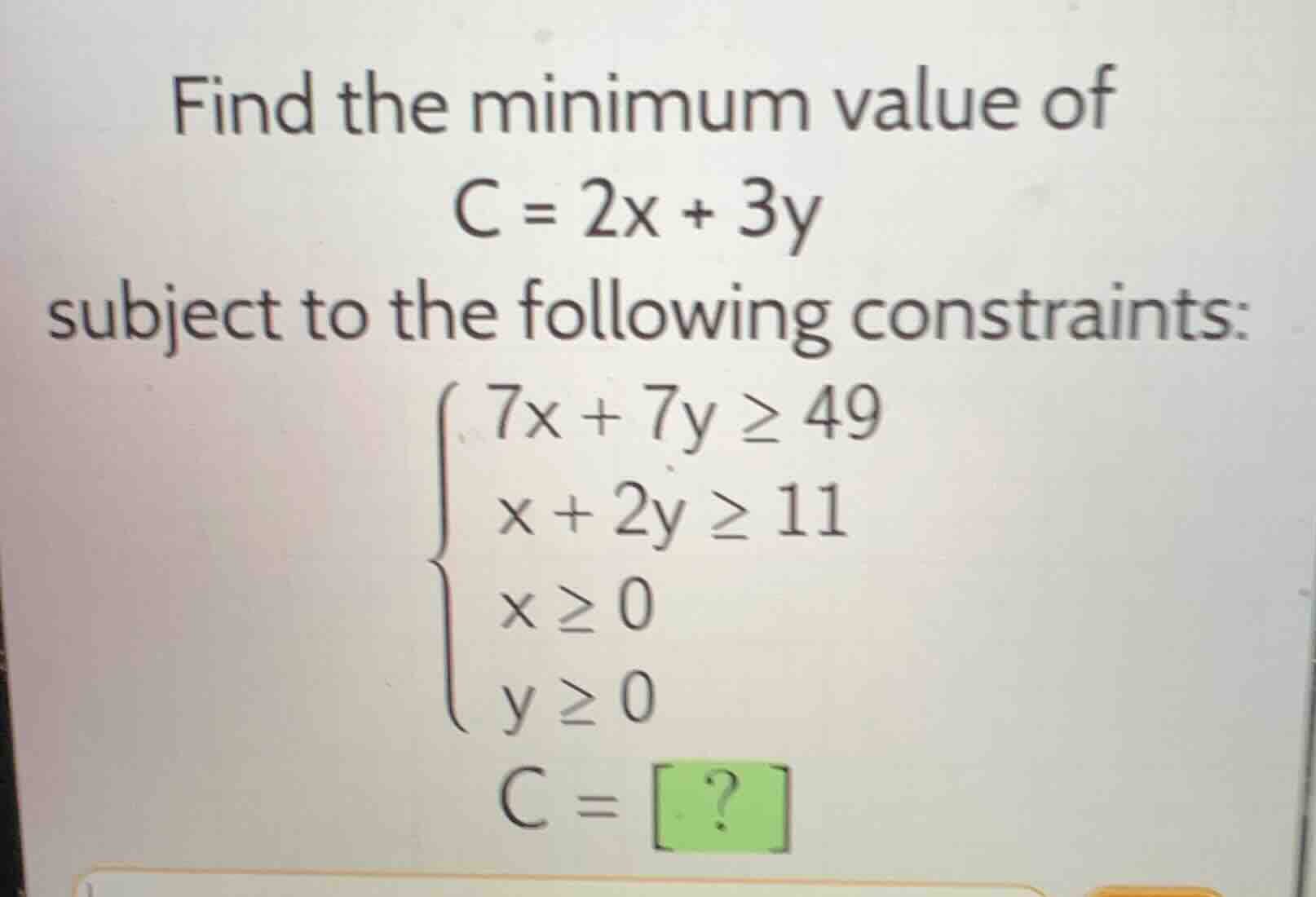
find the minimum value of
c = 2x + 3y
subject to the following constraints:
\
c = ?
Step1: Simplify the first constraint
The first constraint is \(7x + 7y \geq 49\). Divide both sides by 7: \(x + y \geq 7\). So now we have two main inequality constraints: \(x + y \geq 7\) and \(x + 2y \geq 11\), along with \(x \geq 0\), \(y \geq 0\).
Step2: Find the intersection of the two main inequalities
We have the system of equations:
\[
\]
Subtract the first equation from the second: \((x + 2y) - (x + y) = 11 - 7\), which simplifies to \(y = 4\). Then substitute \(y = 4\) into \(x + y = 7\), we get \(x = 7 - 4 = 3\). So the intersection point is \((3, 4)\).
Step3: Analyze the feasible region vertices
The feasible region is determined by the constraints. The vertices of the feasible region (where the minimum of the linear function \(C = 2x + 3y\) will occur, by the Fundamental Theorem of Linear Programming) can be found by looking at the intersections of the boundary lines with the axes and with each other.
- Intersection of \(x + y = 7\) with \(x = 0\): \(y = 7\), so the point is \((0, 7)\).
- Intersection of \(x + 2y = 11\) with \(y = 0\): \(x = 11\), so the point is \((11, 0)\).
- Intersection of \(x + y = 7\) with \(y = 0\): \(x = 7\), so the point is \((7, 0)\). But we also have the intersection point \((3, 4)\) from Step 2.
Now we evaluate \(C = 2x + 3y\) at each vertex:
- At \((0, 7)\): \(C = 2(0) + 3(7) = 21\)
- At \((11, 0)\): \(C = 2(11) + 3(0) = 22\)
- At \((3, 4)\): \(C = 2(3) + 3(4) = 6 + 12 = 18\)
- At \((7, 0)\): \(C = 2(7) + 3(0) = 14\)? Wait, no, wait. Wait, when \(x = 7\), \(y = 0\), but let's check if \((7, 0)\) satisfies \(x + 2y \geq 11\): \(7 + 0 = 7 < 11\), so \((7, 0)\) is not in the feasible region. Wait, I made a mistake earlier. Let's re - evaluate the feasible region.
The feasible region is defined by \(x + y \geq 7\), \(x + 2y \geq 11\), \(x\geq0\), \(y\geq0\).
To find the vertices:
- Intersection of \(x + 2y = 11\) and \(y = 0\): \(x = 11\), \(y = 0\) (point \((11, 0)\))
- Intersection of \(x + y = 7\) and \(x = 0\): \(x = 0\), \(y = 7\) (point \((0, 7)\))
- Intersection of \(x + y = 7\) and \(x + 2y = 11\): we found \((3, 4)\) earlier.
Wait, is there another vertex? Let's check the intersection of \(x + 2y = 11\) with \(x = 0\): \(0+2y = 11\), \(y = 5.5\), so the point \((0, 5.5)\). Wait, I missed this earlier. Let's check if \((0, 5.5)\) satisfies \(x + y \geq 7\): \(0 + 5.5=5.5 < 7\), so it does not satisfy \(x + y \geq 7\), so it's not in the feasible region.
Now re - evaluate the valid vertices:
- \((0, 7)\): \(C = 2(0)+3(7)=21\)
- \((11, 0)\): \(C = 2(11)+3(0) = 22\)
- \((3, 4)\): \(C = 2(3)+3(4)=6 + 12=18\)
Wait, but let's check the boundary of \(x + y \geq 7\) and \(x + 2y \geq 11\). Let's take a point on \(x + y = 7\) where \(x\) is large, say \(x = 10\), then \(y=- 3\), but \(y\geq0\), so that's not valid. The feasible region is the area that satisfies all constraints. The vertices are where two boundary lines (of the inequalities) intersect and also where the boundary lines meet the axes (but only if they satisfy all other constraints).
Wait, another way: the feasible region is the set of points \((x,y)\) such that \(x + y\geq7\), \(x + 2y\geq11\), \(x\geq0\), \(y\geq0\). Let's graph the lines:
- \(x + y = 7\) is a line with intercepts \((7,0)\) and \((0,7)\)
- \(x + 2y = 11\) is a line with intercepts \((11,0)\) and \((0, 5.5)\)
The feasible region is above both lines and in the first quadrant. The intersection of the two lines is \((3,4)\), and the other "corners" of the feasible region are \((0,7)\) (since a…

Snap & solve any problem in the app
Get step-by-step solutions on Sovi AI
Photo-based solutions with guided steps
Explore more problems and detailed explanations
\(18\)