QUESTION IMAGE
Question
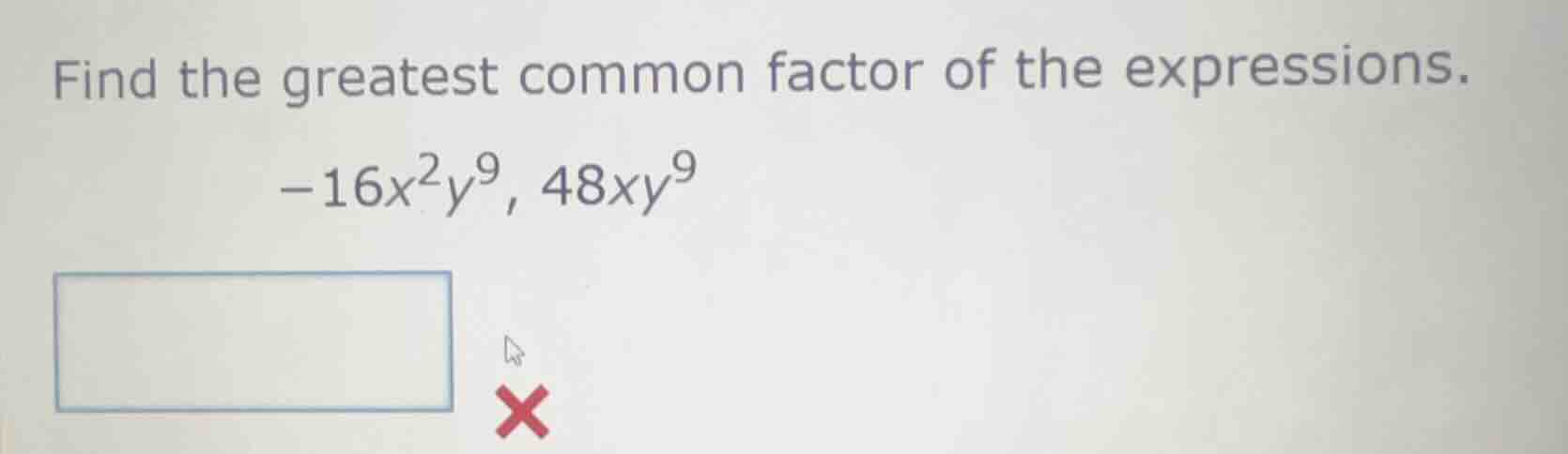
find the greatest common factor of the expressions.
-16x²y⁹, 48xy⁹
Step1: Find GCF of coefficients
Find GCF of -16 and 48. Factors of 16: 1,2,4,8,16. Factors of 48: 1,2,3,4,6,8,12,16,24,48. GCF is 16. Since one coefficient is negative, we take 16 (considering absolute values for GCF of coefficients, then sign is handled by the negative term's factor).
Step2: Find GCF of x terms
For \(x^2\) and \(x\), the GCF of \(x^2\) (which is \(x \cdot x\)) and \(x\) (which is \(x\)) is \(x\) (the lowest power of \(x\) present).
Step3: Find GCF of y terms
For \(y^9\) and \(y^9\), the GCF is \(y^9\) (same power, so the term itself).
Step4: Combine the GCFs
Multiply the GCF of coefficients, GCF of x terms, and GCF of y terms. So \(16 \times x \times y^9 = 16xy^9\). We also consider the sign: the first term is -16x²y⁹, so the GCF can include the negative sign? Wait, no. Wait, GCF is the greatest common factor, which is a positive integer (for coefficients, but when dealing with monomials, we can have a negative GCF? Wait, actually, the GCF of -16 and 48: the GCF of 16 and 48 is 16, and since -16 is a factor of 48? Wait, 48 divided by -16 is -3, which is an integer. Wait, maybe I made a mistake earlier. Let's re - evaluate the coefficient GCF. The factors of -16 are \(\pm1,\pm2,\pm4,\pm8,\pm16\). The factors of 48 are \(\pm1,\pm2,\pm3,\pm4,\pm6,\pm8,\pm12,\pm16,\pm24,\pm48\). The greatest common factor (the largest number that divides both) is 16 (since 16 divides -16 and 48). But also, -16 divides -16 and -16 divides 48? 48 divided by -16 is -3, which is an integer. Wait, but GCF is usually taken as the positive greatest common factor, but when dealing with monomials, we can have a negative GCF? Wait, no. Let's check: The GCF of two monomials is the product of the GCF of their coefficients and the GCF of their variable parts. For the coefficients -16 and 48: the GCF of -16 and 48. Let's use the formula: GCF(a,b)=GCF(|a|,|b|) when considering positive GCF, but if we want to include the sign, since -16 is a factor of 48 (48 = (-16)(-3)), and -16 is a factor of -16. But usually, GCF is defined as the greatest positive integer that divides both numbers. However, in the context of monomials, sometimes we can have a negative GCF if it's more convenient. Wait, let's see: If we take the GCF of -16 and 48 as -16? But 48 divided by -16 is -3, which is an integer, and -16 divided by -16 is 1. But the GCF of 16 and 48 is 16. Wait, maybe I was wrong earlier. Let's recast: The coefficient of the first term is -16, the second is 48. The common factors of -16 and 48 (as integers) are \(\pm1,\pm2,\pm4,\pm8,\pm16\). The greatest among these is 16 (positive) or -16 (negative). But when we factor out, we can factor out -16 or 16. Let's see: If we factor out 16, then -16x²y⁹ = 16(-x²y⁹), 48xy⁹ = 16(3xy⁹). If we factor out -16, then -16x²y⁹=-16(x²y⁹), 48xy⁹=-16(-3xy⁹). Both are valid, but the GCF is the greatest common factor, so we take the one with the highest absolute value. The absolute value of 16 is 16, which is greater than the absolute value of -16 (same, 16). Wait, no, absolute value is same. But in terms of monomials, the GCF is the product of the GCF of the coefficients (considering sign? Or not?). Let's check the variable parts: x² and x: GCF is x (since x is the lowest power). y⁹ and y⁹: GCF is y⁹. Coefficients: GCF of -16 and 48. Let's compute GCF(-16,48). Using the Euclidean algorithm: GCF(48, -16)=GCF(-16, 48 mod -16). 48 divided by -16 is -3 with a remainder of 0 (since -16(-3)=48, 48 - 48 = 0). So GCF is -16? Wait, the Euclidean algorithm for integers: GCF(a,b)=GCF(b, a mod b). So GCF(48, -16)=GCF(-16,…

Snap & solve any problem in the app
Get step-by-step solutions on Sovi AI
Photo-based solutions with guided steps
Explore more problems and detailed explanations
\(16xy^{9}\)