QUESTION IMAGE
Question
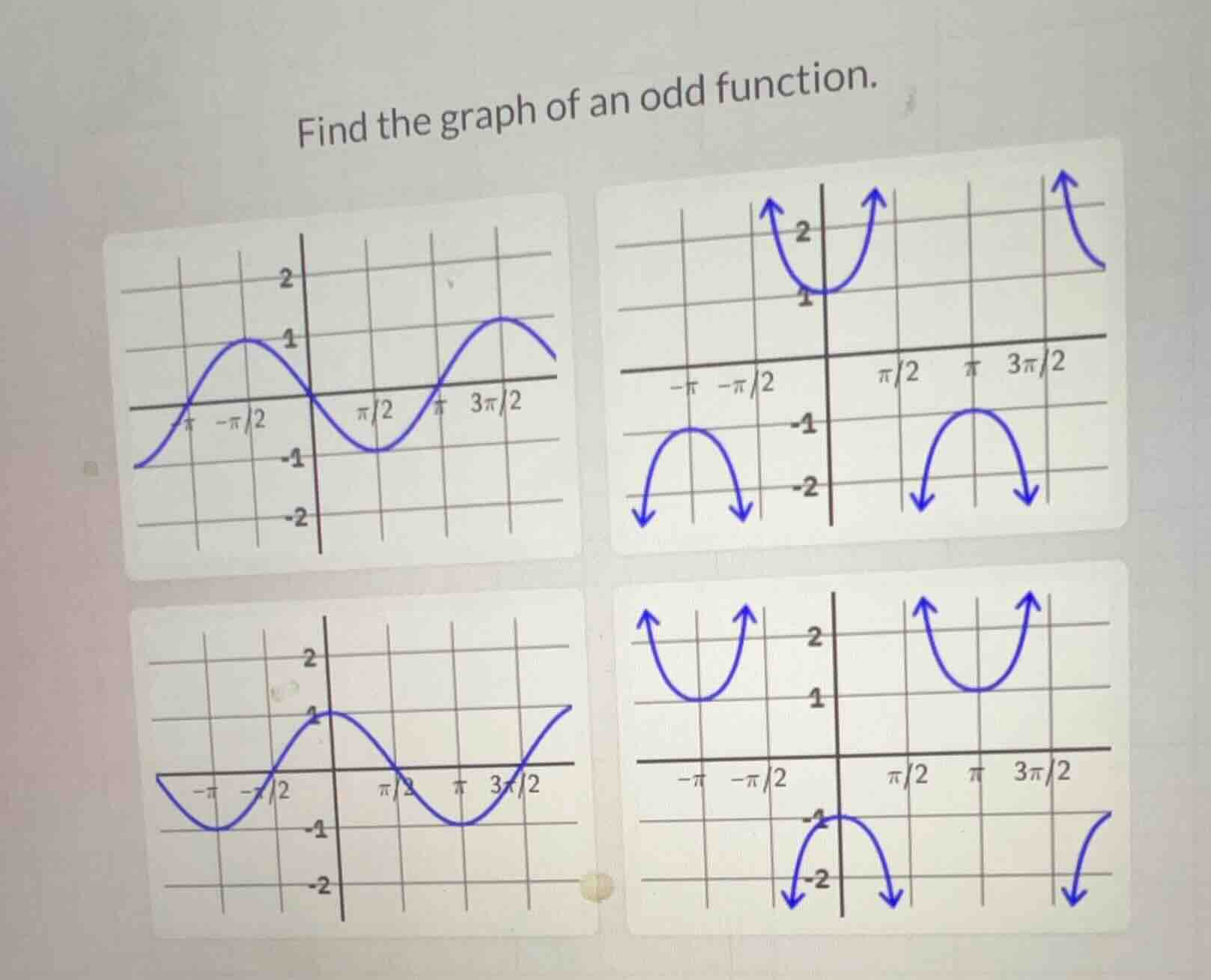
find the graph of an odd function.
🆕 New Concept Discovered: Even and Odd Functions
Symmetry about the origin versus the y-axis
Step 1: Understand Odd Functions
An odd function satisfies the algebraic condition:
Graphically, this means the function is symmetric with respect to the origin \((0,0)\). If you rotate the graph \(180^\circ\) around the origin, it will look exactly the same. Any point \((x, y)\) on the graph must have a corresponding point \((-x, -y)\) on the graph.
Step 2: Analyze the Options
- Top-Left Graph:
- This is a sine-like wave shifted vertically or horizontally.
- Let's check the origin \((0,0)\). The graph passes through \((0,0)\).
- Let's check points: at \(x = \frac{\pi}{2}\), \(y = -1\). For symmetry about the origin, at \(x = -\frac{\pi}{2}\), we should have \(y = 1\). Looking at the graph, at \(x = -\frac{\pi}{2}\), the value is indeed \(1\).
- Rotating this graph \(180^\circ\) around the origin maps the curve in the first and second quadrants perfectly onto the third and fourth quadrants. This graph represents an odd function.
- Bottom-Left Graph:
- This graph passes through \((0, 1)\).
- For an odd function defined at \(x = 0\), we must have \(f(0) = 0\) because \(f(-0) = -f(0) \implies f(0) = -f(0) \implies 2f(0) = 0 \implies f(0) = 0\).
- Since this graph has a y-intercept at \((0,1)\), it cannot be an odd function. It is symmetric across the y-axis, which makes it an even function.
- Top-Right and Bottom-Right Graphs:
- These graphs consist of multiple disconnected pieces that are symmetric across the y-axis (even symmetry) rather than the origin.

Snap & solve any problem in the app
Get step-by-step solutions on Sovi AI
Photo-based solutions with guided steps
Explore more problems and detailed explanations
The graph of the odd function is the top-left graph (the wave that passes through the origin \((0,0)\), with a peak of \(1\) at \(x = -\frac{\pi}{2}\) and a trough of \(-1\) at \(x = \frac{\pi}{2}\)).