QUESTION IMAGE
Question
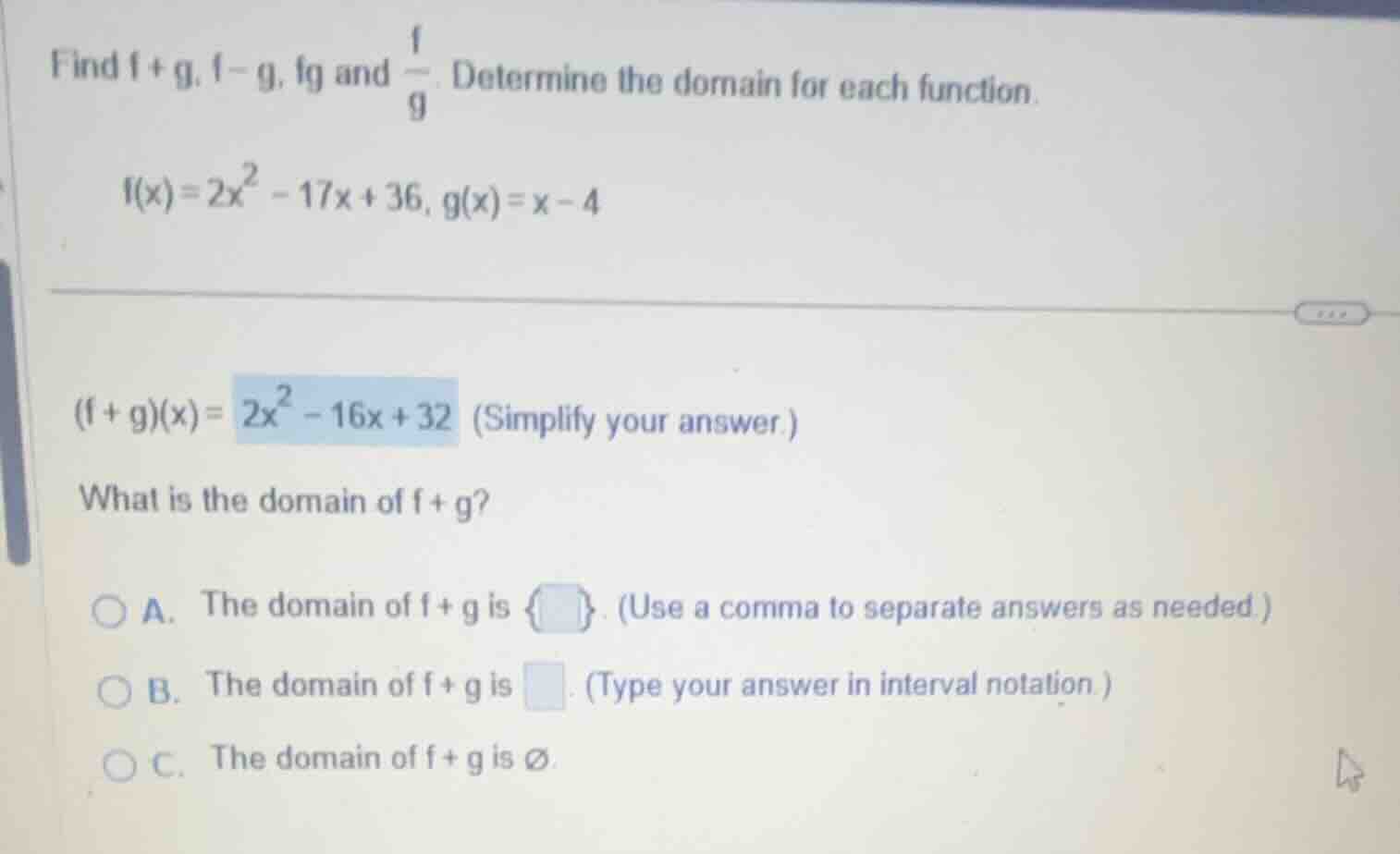
find \\(f + g\\), \\(f - g\\), \\(fg\\) and \\(\frac{f}{g}\\). determine the domain for each function.
\\(f(x) = 2x^2 - 17x + 36\\), \\(g(x) = x - 4\\)
\\((f + g)(x) = 2x^2 - 16x + 32\\) (simplify your answer.)
what is the domain of \\(f + g\\)?
a. the domain of \\(f + g\\) is \\(\\{\quad\\}\\). (use a comma to separate answers as needed.)
b. the domain of \\(f + g\\) is \\(\quad\\). (type your answer in interval notation.)
c. the domain of \\(f + g\\) is \\(\varnothing\\).
Find the domain of the individual functions
The given functions are:
Both \(f(x)\) and \(g(x)\) are polynomial functions. The domain of any polynomial function is all real numbers:
Determine the domain of the sum function
The sum function is defined as:
The domain of the sum of two functions is the intersection of their individual domains:
Match with the given options
Option B states: "The domain of \(f + g\) is \(\quad\) (Type your answer in interval notation.)"
The correct interval notation for all real numbers is \((-\infty, \infty)\).

Snap & solve any problem in the app
Get step-by-step solutions on Sovi AI
Photo-based solutions with guided steps
Explore more problems and detailed explanations
- A. The domain of \(f + g\) is \(\{ \quad \}\). (Use a comma to separate answers as needed.)
- B. The domain of \(f + g\) is \((-\infty, \infty)\). (Type your answer in interval notation.) (Correct answer)
- C. The domain of \(f + g\) is \(\varnothing\).