QUESTION IMAGE
Question
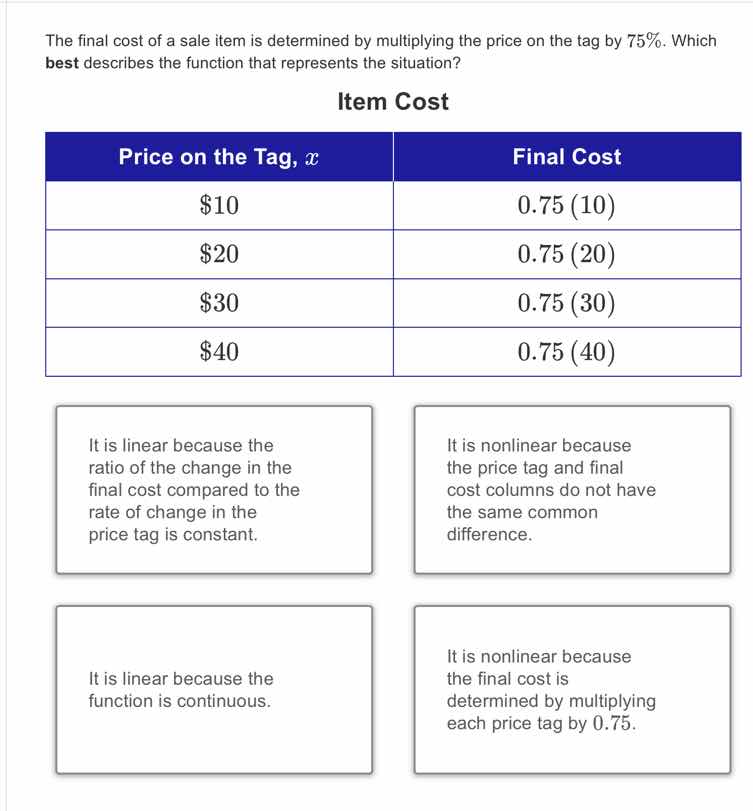
the final cost of a sale item is determined by multiplying the price on the tag by 75%. which best describes the function that represents the situation?
item cost
| price on the tag, $x$ | final cost |
|---|---|
| $\\$20$ | $0.75(20)$ |
| $\\$30$ | $0.75(30)$ |
| $\\$40$ | $0.75(40)$ |
it is linear because the ratio of the change in the final cost compared to the rate of change in the price tag is constant.
it is nonlinear because the price tag and final cost columns do not have the same common difference.
it is linear because the function is continuous.
it is nonlinear because the final cost is determined by multiplying each price tag by 0.75.
Step1: Recall linear function definition
A linear function has a constant rate of change (slope). The general form is \( y = mx + b \), where \( m \) is the slope (constant rate of change).
Step2: Analyze the given situation
Let \( x \) be the price on the tag, and \( y \) be the final cost. From the table, \( y = 0.75x \). The rate of change (slope) here is \( 0.75 \), which is constant.
Step3: Evaluate each option
- Option 1: "It is linear because the ratio of the change in the final cost compared to the rate of change in the price tag is constant."
- The change in \( x \) (price tag) between consecutive values (e.g., from 10 to 20, change is 10; 20 to 30, change is 10, etc.) is constant (10). The change in \( y \) (final cost) between consecutive values: \( 0.75(20)-0.75(10)=15 - 7.5 = 7.5 \); \( 0.75(30)-0.75(20)=22.5 - 15 = 7.5 \), etc. The ratio of change in \( y \) to change in \( x \) is \( \frac{7.5}{10}=0.75 \), which is constant (the slope). So this makes sense for a linear function.
- Option 2: "It is nonlinear because the price tag and final cost columns do not have the same common difference."
- The "common difference" for linear functions refers to the rate of change (slope), not the difference between \( x \) and \( y \) values. Also, the rate of change here is constant, so this is incorrect.
- Option 3: "It is linear because the function is continuous."
- Linear functions can be discrete (like in a table with specific \( x \) values) or continuous. The key for linearity is the constant rate of change, not continuity. So this reasoning is incorrect.
- Option 4: "It is nonlinear because the final cost is determined by multiplying each price tag by 0.75."
- Multiplying by a constant (0.75) gives a linear function ( \( y = 0.75x \) is linear with slope 0.75), so this is incorrect.

Snap & solve any problem in the app
Get step-by-step solutions on Sovi AI
Photo-based solutions with guided steps
Explore more problems and detailed explanations
It is linear because the ratio of the change in the final cost compared to the rate of change in the price tag is constant.