QUESTION IMAGE
Question
fill in the blanks.
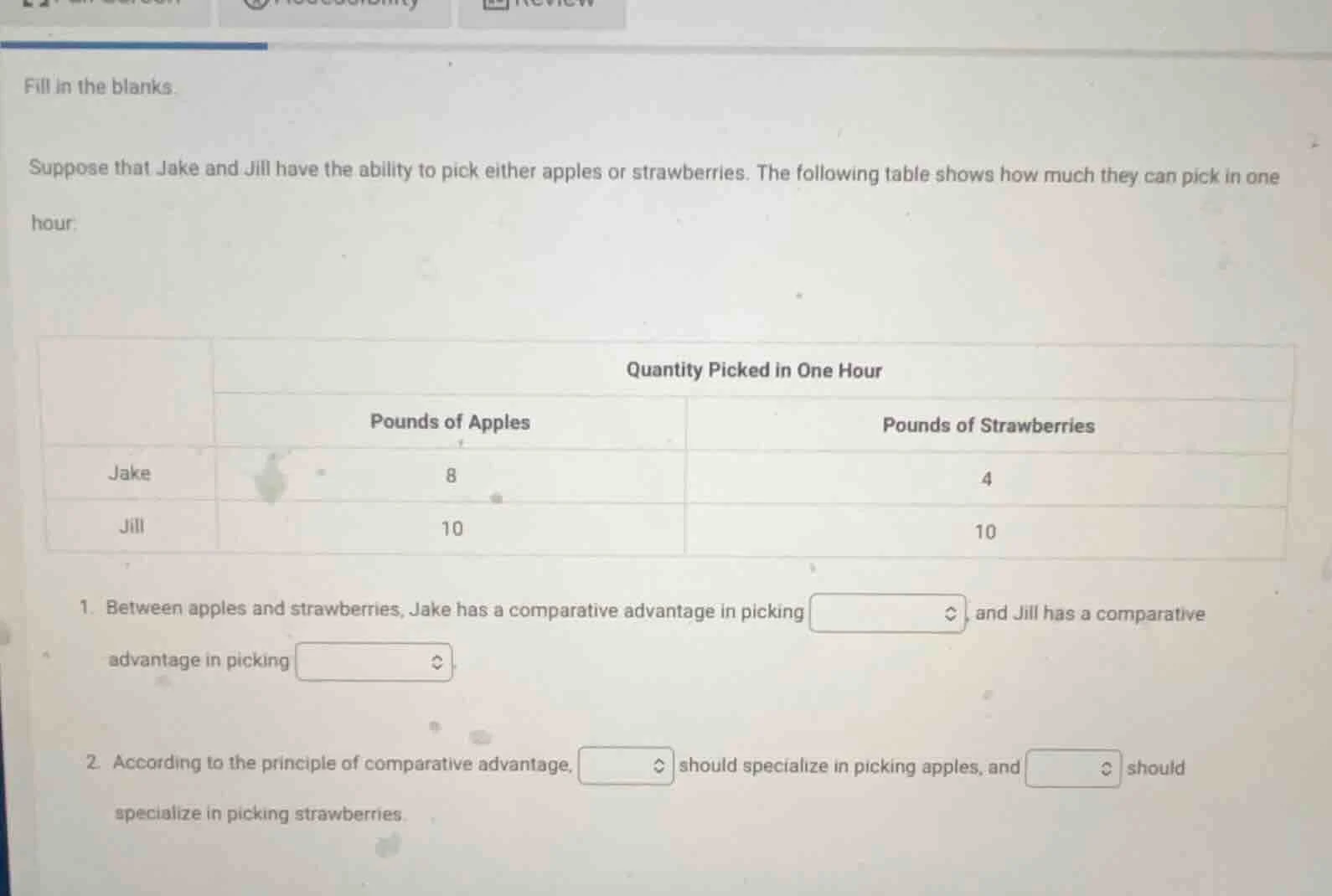
suppose that jake and jill have the ability to pick either apples or strawberries. the following table shows how much they can pick in one hour.
| multicolumn{2}{c}{quantity picked in one hour} | ||
|---|---|---|
| jake | 8 | 4 |
| jill | 10 | 10 |
- between apples and strawberries, jake has a comparative advantage in picking \boxed{}, and jill has a comparative advantage in picking \boxed{}.
- according to the principle of comparative advantage, \boxed{} should specialize in picking apples, and \boxed{} should specialize in picking strawberries.
Step1: Calculate Jake's opportunity costs
Opportunity cost of 1 apple for Jake: $\frac{4}{8} = 0.5$ strawberries
Opportunity cost of 1 strawberry for Jake: $\frac{8}{4} = 2$ apples
Step2: Calculate Jill's opportunity costs
Opportunity cost of 1 apple for Jill: $\frac{10}{10} = 1$ strawberry
Opportunity cost of 1 strawberry for Jill: $\frac{10}{10} = 1$ apple
Step3: Compare for comparative advantage
Jake has lower apple opportunity cost ($0.5 < 1$), so he has comparative advantage in apples. Jill has lower strawberry opportunity cost ($1 < 2$), so she has comparative advantage in strawberries.
Step4: Assign specialization per comparative advantage
Specialize in the good with comparative advantage.

Snap & solve any problem in the app
Get step-by-step solutions on Sovi AI
Photo-based solutions with guided steps
Explore more problems and detailed explanations
- Between apples and strawberries, Jake has a comparative advantage in picking apples, and Jill has a comparative advantage in picking strawberries.
- According to the principle of comparative advantage, Jake should specialize in picking apples, and Jill should specialize in picking strawberries.