QUESTION IMAGE
Question
fill in the blanks.
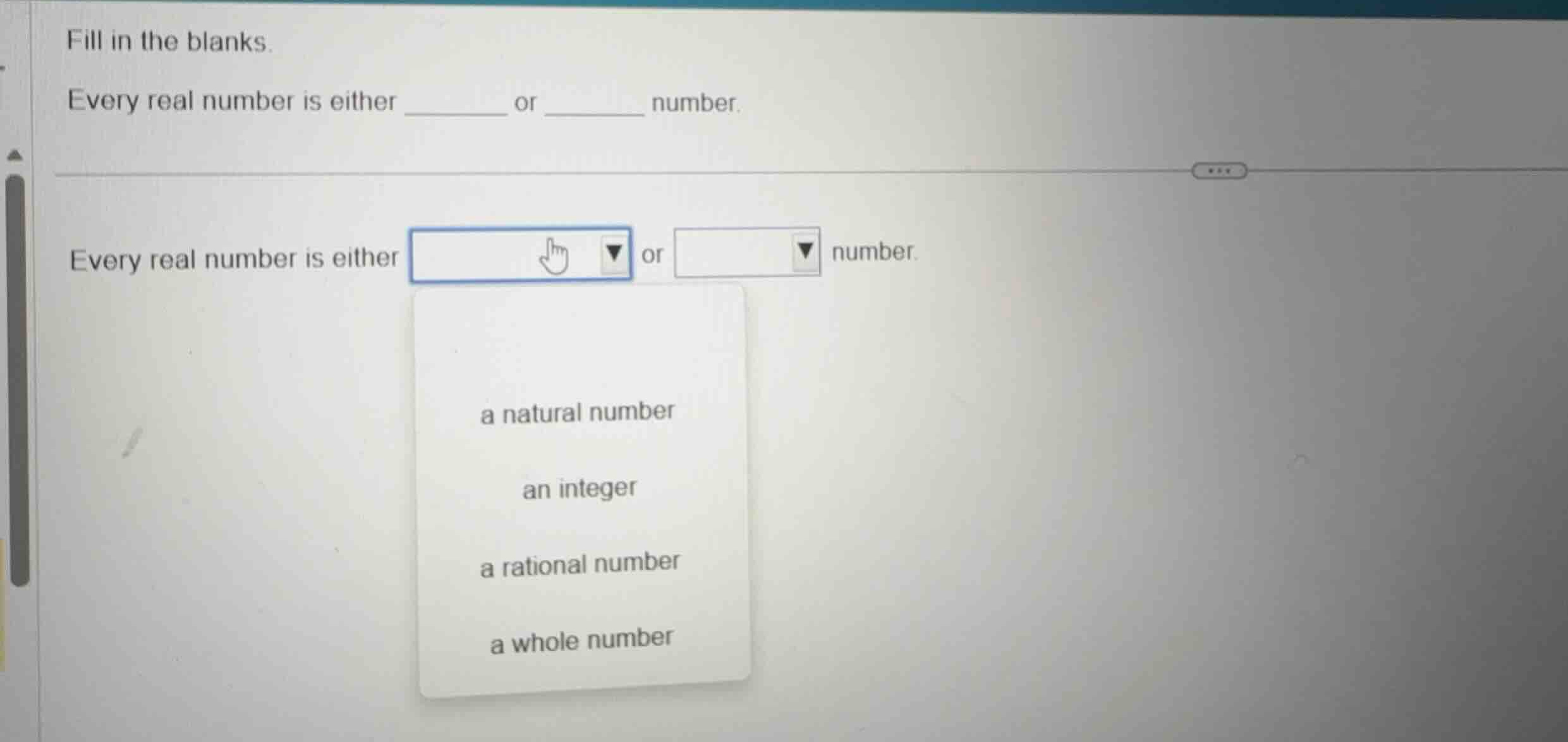
every real number is either \\_\\_\\_\\_\\_\\_ or \\_\\_\\_\\_\\_\\_ number.
every real number is either dropdown or dropdown number.
dropdown options:
a natural number
an integer
a rational number
a whole number
<pre_analysis>
{
"quality": "clear",
"question_count": 1,
"skills_matched": [
"direct_cot",
"blank_filling_formatter",
"explain_then_answer",
"tutor",
"mastery_adaptive_brevity"
],
"needs_drawing": false,
"concepts_used": [
"Number Systems",
"Rational Numbers",
"Irrational Numbers"
],
"new_concepts": [],
"current_concepts": [
"Number Systems",
"Rational Numbers",
"Irrational Numbers"
]
}
</pre_analysis>
<reasoning>
Define the real number system
Using the Number Systems knowledge point
The set of real numbers, denoted by \(\mathbb{R}\), represents all points on the continuous number line. This system is partitioned into two mutually exclusive and exhaustive subsets.
Identify the two disjoint subsets
Using the Rational Numbers and Irrational Numbers knowledge points
Every real number can be classified based on whether it can be expressed as a ratio of two integers.
- Rational Numbers: Numbers that can be written as \(\frac{a}{b}\) where \(a, b \in \mathbb{Z}\) and \(b
eq 0\).
- Irrational Numbers: Real numbers that cannot be written as a simple fraction; their decimal expansions are non-terminating and non-repeating.
Since these two sets do not overlap and together cover the entire real number line, every real number belongs to exactly one of these two categories.
</reasoning>
<answer>
Every real number is either <blank>a rational number</blank> or <blank>an irrational number</blank>.
</answer>
<post_analysis>
{
"subject": "Mathematics",
"question_type": "Fill-in-the-blank",
"knowledge_point": [
"Mathematics",
"Algebra",
"Number Systems"
]
}
</post_analysis>
Snap & solve any problem in the app
Get step-by-step solutions on Sovi AI
Photo-based solutions with guided steps
Explore more problems and detailed explanations
<pre_analysis>
{
"quality": "clear",
"question_count": 1,
"skills_matched": [
"direct_cot",
"blank_filling_formatter",
"explain_then_answer",
"tutor",
"mastery_adaptive_brevity"
],
"needs_drawing": false,
"concepts_used": [
"Number Systems",
"Rational Numbers",
"Irrational Numbers"
],
"new_concepts": [],
"current_concepts": [
"Number Systems",
"Rational Numbers",
"Irrational Numbers"
]
}
</pre_analysis>
<reasoning>
Define the real number system
Using the Number Systems knowledge point
The set of real numbers, denoted by \(\mathbb{R}\), represents all points on the continuous number line. This system is partitioned into two mutually exclusive and exhaustive subsets.
Identify the two disjoint subsets
Using the Rational Numbers and Irrational Numbers knowledge points
Every real number can be classified based on whether it can be expressed as a ratio of two integers.
- Rational Numbers: Numbers that can be written as \(\frac{a}{b}\) where \(a, b \in \mathbb{Z}\) and \(b
eq 0\).
- Irrational Numbers: Real numbers that cannot be written as a simple fraction; their decimal expansions are non-terminating and non-repeating.
Since these two sets do not overlap and together cover the entire real number line, every real number belongs to exactly one of these two categories.
</reasoning>
<answer>
Every real number is either <blank>a rational number</blank> or <blank>an irrational number</blank>.
</answer>
<post_analysis>
{
"subject": "Mathematics",
"question_type": "Fill-in-the-blank",
"knowledge_point": [
"Mathematics",
"Algebra",
"Number Systems"
]
}
</post_analysis>