QUESTION IMAGE
Question
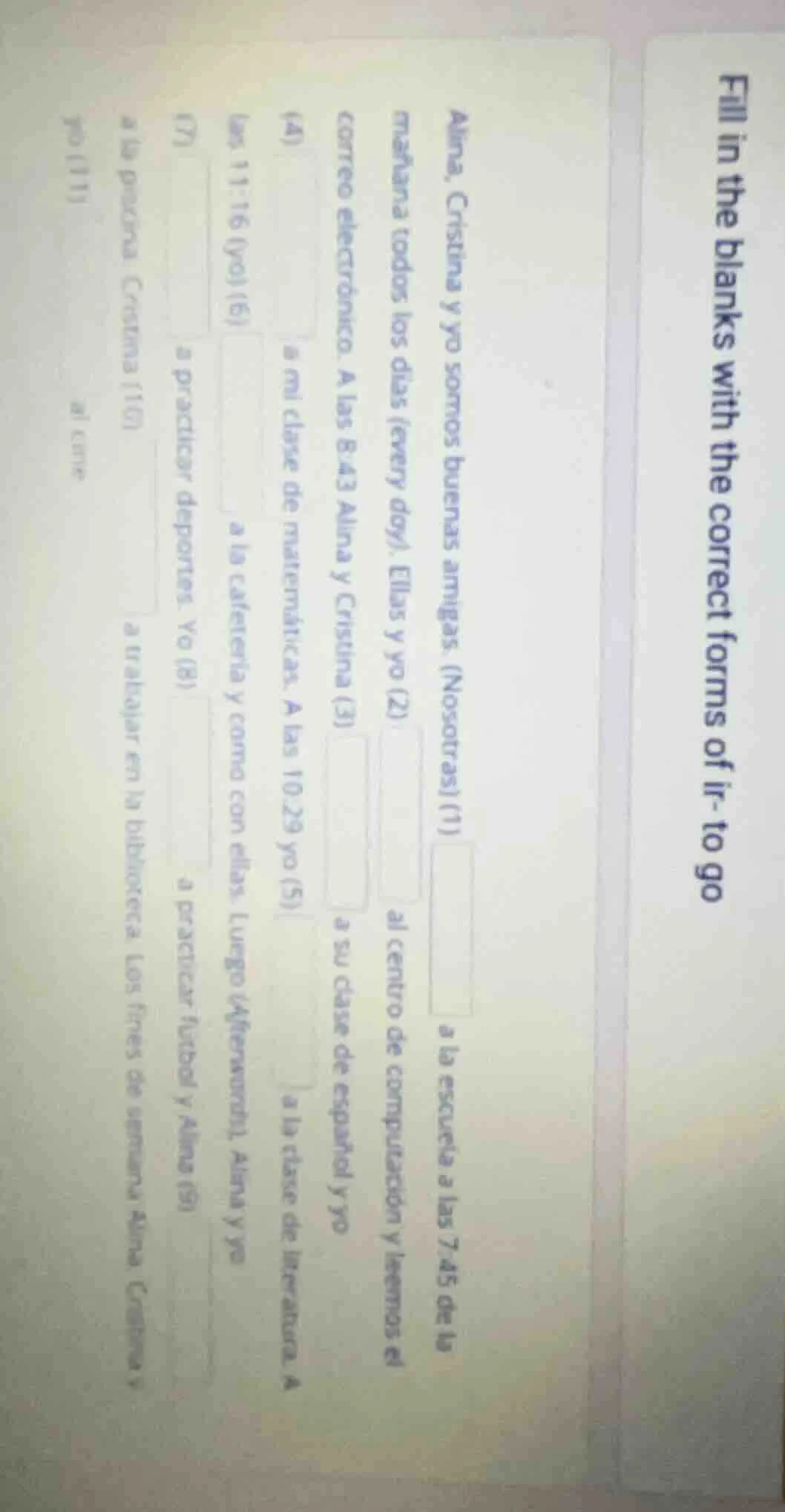
fill in the blanks with the correct forms of ir- to go
alina, cristina y yo somos buenas amigas. (nosotras) (1) │││ a la escuela a las 7:45 de la
mañana todos los días (every day). ellas y yo (2) │││ al centro de computación y leemos el
correo electrónico. a las 8:43 alina y cristina (3) │││ a su clase de español y yo
(4) │││ a mi clase de matemáticas. a las 10:29 yo (5) │││ a la clase de literatura. a
las 11:16 (yo) (6) │││ a la cafetería y como con ellas. luego (afterward), alina y yo
(7) │││ a practicar deportes. yo (8) │││ a practicar fútbol y alina (9)
a la primera. cristina (10) │││ a trabajar en la biblioteca los fines de semana. alina, cristina y
o (11) │││ al cine
To solve this, we use the conjugation of the verb "ir" (to go) in Spanish. The present tense conjugations are: yo - voy, tú - vas, él/ella/usted - va, nosotros/nosotras - vamos, vosotros/vosotras - vais, ellos/ellas/ustedes - van.
Step 1: (1) Nosotras (we, feminine) → vamos
Since "nosotras" is the first - person plural feminine subject, the conjugation of "ir" is "vamos". So we fill in "vamos".
Step 2: (2) Ellas y yo (they and I; the "yo" makes it "nosotros" - like in terms of subject for "ir" conjugation? Wait, no. Wait, "ellas y yo" is a mixed subject. But in Spanish, when the subject includes "yo", the conjugation for "ir" when the main subject group (including yo) is considered as "nosotros" (if there are others). Wait, "ellas y yo" - the correct conjugation for "ir" here: "yo" + "ellas" (third - person plural). But the verb "ir" for "nosotros" (we, including yo and others) is "vamos". Wait, maybe the intended subject here is "nosotros" (since it's "ellas y yo" - but maybe the problem considers it as "nosotros" - like. Wait, no, let's re - examine. Wait, the sentence is "Ellas y yo (2) al centro de computación...". Wait, maybe I made a mistake. Wait, "yo" and "ellas" - the subject is a combination, but in Spanish, when the subject is "yo" plus others, the verb "ir" is conjugated as "vamos" (nosotros form). So we fill in "vamos".
Step 3: (3) Alina y Cristina (they, feminine, third - person plural) → van
"Alina y Cristina" is a third - person plural feminine subject, so the conjugation of "ir" is "van". So we fill in "van".
Step 4: (4) yo (first - person singular) → voy
The subject is "yo", so the conjugation of "ir" is "voy". So we fill in "voy".
Step 5: (5) yo (first - person singular) → voy
Again, the subject is "yo", so we use "voy".
Step 6: (6) yo (first - person singular) → voy
Subject is "yo", so "voy".
Step 7: (7) Alina y yo (we, since it's Alina (ella) and yo (I) → vamos
"Alina y yo" is a first - person plural subject (nosotras, since Alina is female and yo is female? Wait, "Alina y yo" - if Alina is female and "yo" is female, then "nosotras". The conjugation of "ir" for "nosotras" is "vamos". So we fill in "vamos".
Step 8: (8) Yo (first - person singular) → voy
Subject is "yo", so "voy".
Step 9: (9) Alina (third - person singular, feminine) → va
"Alina" is a third - person singular feminine subject, so the conjugation of "ir" is "va".
Step 10: (10) Cristina (third - person singular, feminine) → va
"Cristina" is a third - person singular feminine subject, so we use "va".
Step 11: (11) Alina, Cristina y yo (we, since it's three people including yo; if Alina and Cristina are female and yo is female, then "nosotras") → vamos
The subject is a first - person plural (nosotras) subject, so the conjugation of "ir" is "vamos".
Final Answers
- vamos
- vamos
- van
- voy
- voy
- voy
- vamos
- voy
- va
- va
- vamos

Snap & solve any problem in the app
Get step-by-step solutions on Sovi AI
Photo-based solutions with guided steps
Explore more problems and detailed explanations
To solve this, we use the conjugation of the verb "ir" (to go) in Spanish. The present tense conjugations are: yo - voy, tú - vas, él/ella/usted - va, nosotros/nosotras - vamos, vosotros/vosotras - vais, ellos/ellas/ustedes - van.
Step 1: (1) Nosotras (we, feminine) → vamos
Since "nosotras" is the first - person plural feminine subject, the conjugation of "ir" is "vamos". So we fill in "vamos".
Step 2: (2) Ellas y yo (they and I; the "yo" makes it "nosotros" - like in terms of subject for "ir" conjugation? Wait, no. Wait, "ellas y yo" is a mixed subject. But in Spanish, when the subject includes "yo", the conjugation for "ir" when the main subject group (including yo) is considered as "nosotros" (if there are others). Wait, "ellas y yo" - the correct conjugation for "ir" here: "yo" + "ellas" (third - person plural). But the verb "ir" for "nosotros" (we, including yo and others) is "vamos". Wait, maybe the intended subject here is "nosotros" (since it's "ellas y yo" - but maybe the problem considers it as "nosotros" - like. Wait, no, let's re - examine. Wait, the sentence is "Ellas y yo (2) al centro de computación...". Wait, maybe I made a mistake. Wait, "yo" and "ellas" - the subject is a combination, but in Spanish, when the subject is "yo" plus others, the verb "ir" is conjugated as "vamos" (nosotros form). So we fill in "vamos".
Step 3: (3) Alina y Cristina (they, feminine, third - person plural) → van
"Alina y Cristina" is a third - person plural feminine subject, so the conjugation of "ir" is "van". So we fill in "van".
Step 4: (4) yo (first - person singular) → voy
The subject is "yo", so the conjugation of "ir" is "voy". So we fill in "voy".
Step 5: (5) yo (first - person singular) → voy
Again, the subject is "yo", so we use "voy".
Step 6: (6) yo (first - person singular) → voy
Subject is "yo", so "voy".
Step 7: (7) Alina y yo (we, since it's Alina (ella) and yo (I) → vamos
"Alina y yo" is a first - person plural subject (nosotras, since Alina is female and yo is female? Wait, "Alina y yo" - if Alina is female and "yo" is female, then "nosotras". The conjugation of "ir" for "nosotras" is "vamos". So we fill in "vamos".
Step 8: (8) Yo (first - person singular) → voy
Subject is "yo", so "voy".
Step 9: (9) Alina (third - person singular, feminine) → va
"Alina" is a third - person singular feminine subject, so the conjugation of "ir" is "va".
Step 10: (10) Cristina (third - person singular, feminine) → va
"Cristina" is a third - person singular feminine subject, so we use "va".
Step 11: (11) Alina, Cristina y yo (we, since it's three people including yo; if Alina and Cristina are female and yo is female, then "nosotras") → vamos
The subject is a first - person plural (nosotras) subject, so the conjugation of "ir" is "vamos".
Final Answers
- vamos
- vamos
- van
- voy
- voy
- voy
- vamos
- voy
- va
- va
- vamos