QUESTION IMAGE
Question
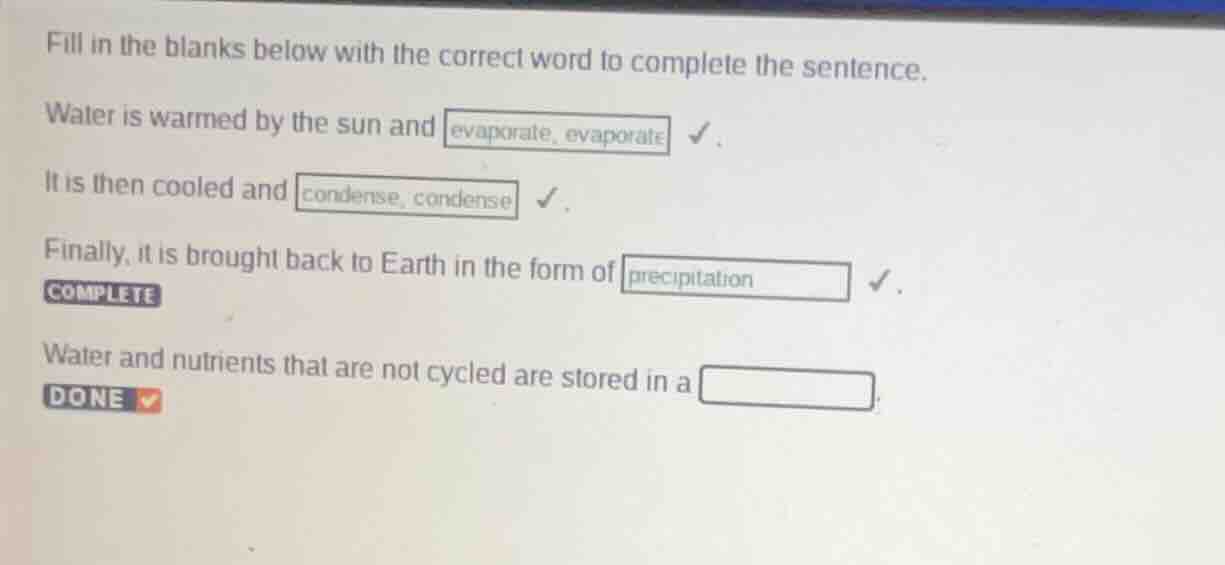
fill in the blanks below with the correct word to complete the sentence.
water is warmed by the sun and evaporates.
it is then cooled and condenses.
finally, it is brought back to earth in the form of precipitation.
water and nutrients that are not cycled are stored in a
<pre_analysis>
{
"quality": "clear",
"question_count": 1,
"skills_matched": [
"direct_cot",
"blank_filling_formatter",
"explain_then_answer",
"tutor"
],
"needs_drawing": false,
"concepts_used": [
"Water Cycle Processes",
"Biogeochemical Reservoirs"
],
"new_concepts": [],
"current_concepts": [
"Water Cycle Processes",
"Biogeochemical Reservoirs"
]
}
</pre_analysis>
<reasoning>
Analyze the water cycle processes
The first three sentences describe the movement of water through the atmosphere. Water is warmed by the sun and evaporates (or evaporate as shown in the completed field). It is then cooled and condenses (or condense). Finally, it returns to Earth as precipitation. These steps represent the core Water Cycle Processes.
Identify nutrient storage locations
The final sentence asks where water and nutrients that are not actively cycled are stored. In biogeochemical cycles, elements and compounds that are temporarily or permanently removed from active circulation are stored in a reservoir (or sink). This relates directly to Biogeochemical Reservoirs.
</reasoning>
<answer>
Fill in the blanks below with the correct word to complete the sentence.
Water is warmed by the sun and <blank>evaporates</blank>.
It is then cooled and <blank>condenses</blank>.
Finally, it is brought back to Earth in the form of <blank>precipitation</blank>.
Water and nutrients that are not cycled are stored in a <blank>reservoir</blank>.
</answer>
<post_analysis>
{
"subject": "Natural Science",
"question_type": "Fill-in-the-blank",
"knowledge_point": [
"Natural Science",
"Biology",
"Biogeochemical Cycles"
]
}
</post_analysis>
Snap & solve any problem in the app
Get step-by-step solutions on Sovi AI
Photo-based solutions with guided steps
Explore more problems and detailed explanations
<pre_analysis>
{
"quality": "clear",
"question_count": 1,
"skills_matched": [
"direct_cot",
"blank_filling_formatter",
"explain_then_answer",
"tutor"
],
"needs_drawing": false,
"concepts_used": [
"Water Cycle Processes",
"Biogeochemical Reservoirs"
],
"new_concepts": [],
"current_concepts": [
"Water Cycle Processes",
"Biogeochemical Reservoirs"
]
}
</pre_analysis>
<reasoning>
Analyze the water cycle processes
The first three sentences describe the movement of water through the atmosphere. Water is warmed by the sun and evaporates (or evaporate as shown in the completed field). It is then cooled and condenses (or condense). Finally, it returns to Earth as precipitation. These steps represent the core Water Cycle Processes.
Identify nutrient storage locations
The final sentence asks where water and nutrients that are not actively cycled are stored. In biogeochemical cycles, elements and compounds that are temporarily or permanently removed from active circulation are stored in a reservoir (or sink). This relates directly to Biogeochemical Reservoirs.
</reasoning>
<answer>
Fill in the blanks below with the correct word to complete the sentence.
Water is warmed by the sun and <blank>evaporates</blank>.
It is then cooled and <blank>condenses</blank>.
Finally, it is brought back to Earth in the form of <blank>precipitation</blank>.
Water and nutrients that are not cycled are stored in a <blank>reservoir</blank>.
</answer>
<post_analysis>
{
"subject": "Natural Science",
"question_type": "Fill-in-the-blank",
"knowledge_point": [
"Natural Science",
"Biology",
"Biogeochemical Cycles"
]
}
</post_analysis>