Sovi.AI - AI Math Tutor

Scan to solve math questions

QUESTION IMAGE

fill in the blank so that the resulting statement is true. if \\(a + bi…

Question

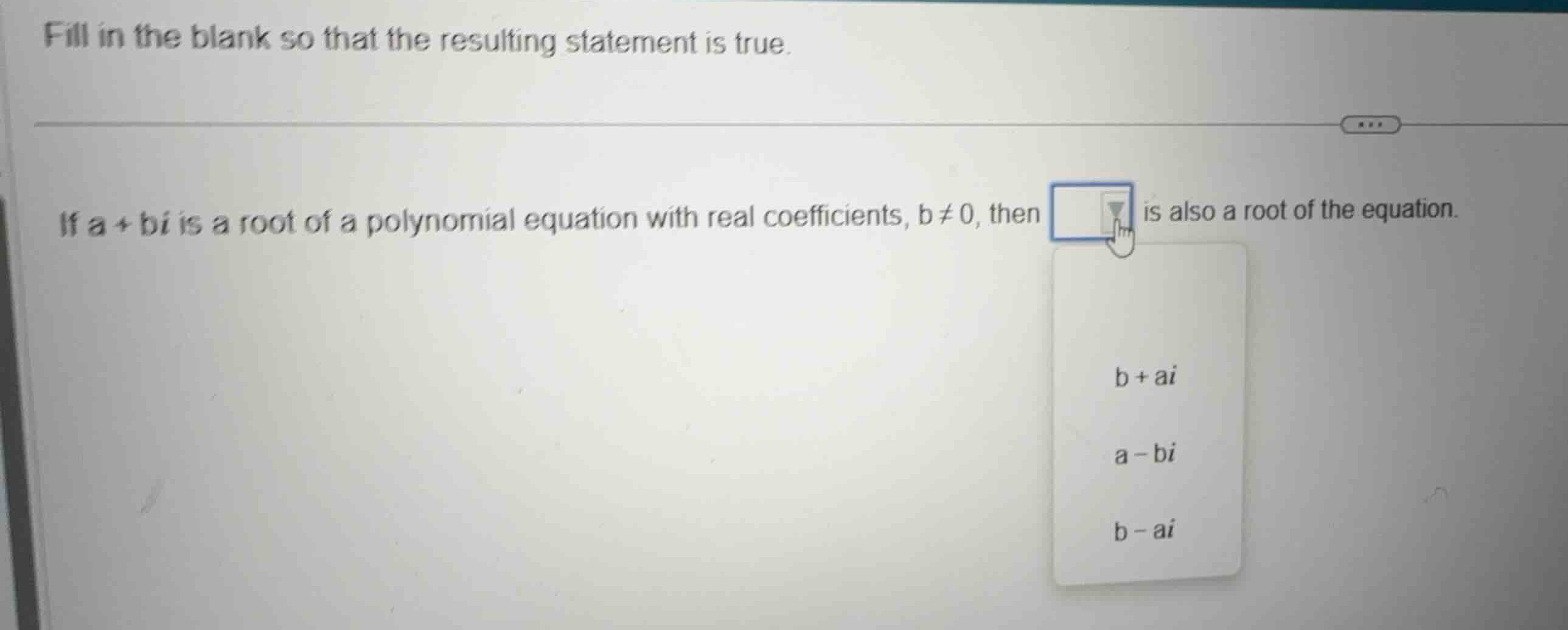
fill in the blank so that the resulting statement is true.

if \\(a + bi\\) is a root of a polynomial equation with real coefficients, \\(b \
eq 0\\), then is also a root of the equation.

options:
\\(b + ai\\)
\\(a - bi\\)
\\(b - ai\\)

Explanation:

Response

<pre_analysis>
{
"quality": "clear",
"question_count": 1,
"skills_matched": [
"step_cot",
"blank_filling_formatter",
"explain_then_answer",
"tutor",
"mastery_adaptive_brevity"
],
"needs_drawing": false,
"concepts_used": [
"Complex Numbers",
"Fundamental Theorem of Algebra"
],
"new_concepts": [
"Complex Conjugate Root Theorem"
],
"current_concepts": [
"Complex Numbers",
"Fundamental Theorem of Algebra",
"Complex Conjugate Root Theorem"
]
}
</pre_analysis>

<reasoning>

Identify the given statement and theorem

Using the Complex Numbers and Fundamental Theorem of Algebra knowledge points
\[
\text{Given root: } a + bi \quad (b
eq 0)
\]
\[
\text{Polynomial coefficients: } \mathbb{R} \text{ (real numbers)}
\]

Apply the Complex Conjugate Root Theorem

For any polynomial equation with real coefficients, non-real complex roots must occur in conjugate pairs.
\[
\text{If } z = a + bi \text{ is a root, then its conjugate } \bar{z} = a - bi \text{ is also a root.}
\]

Match with the given options

The dropdown menu displays three choices:

  1. \(b + ai\)
  2. \(a - bi\)
  3. \(b - ai\)

The correct conjugate is \(a - bi\).
</reasoning>

<answer>
Fill in the blank so that the resulting statement is true.

If \(a + bi\) is a root of a polynomial equation with real coefficients, \(b
eq 0\), then <blank>\(a - bi\)</blank> is also a root of the equation.
</answer>

<post_analysis>
{
"subject": "Mathematics",
"question_type": "Fill-in-the-blank",
"knowledge_point": [
"Mathematics",
"Algebra",
"Complex Conjugate Root Theorem"
]
}
</post_analysis>

Answer:

<pre_analysis>
{
"quality": "clear",
"question_count": 1,
"skills_matched": [
"step_cot",
"blank_filling_formatter",
"explain_then_answer",
"tutor",
"mastery_adaptive_brevity"
],
"needs_drawing": false,
"concepts_used": [
"Complex Numbers",
"Fundamental Theorem of Algebra"
],
"new_concepts": [
"Complex Conjugate Root Theorem"
],
"current_concepts": [
"Complex Numbers",
"Fundamental Theorem of Algebra",
"Complex Conjugate Root Theorem"
]
}
</pre_analysis>

<reasoning>

Identify the given statement and theorem

Using the Complex Numbers and Fundamental Theorem of Algebra knowledge points
\[
\text{Given root: } a + bi \quad (b
eq 0)
\]
\[
\text{Polynomial coefficients: } \mathbb{R} \text{ (real numbers)}
\]

Apply the Complex Conjugate Root Theorem

For any polynomial equation with real coefficients, non-real complex roots must occur in conjugate pairs.
\[
\text{If } z = a + bi \text{ is a root, then its conjugate } \bar{z} = a - bi \text{ is also a root.}
\]

Match with the given options

The dropdown menu displays three choices:

  1. \(b + ai\)
  2. \(a - bi\)
  3. \(b - ai\)

The correct conjugate is \(a - bi\).
</reasoning>

<answer>
Fill in the blank so that the resulting statement is true.

If \(a + bi\) is a root of a polynomial equation with real coefficients, \(b
eq 0\), then <blank>\(a - bi\)</blank> is also a root of the equation.
</answer>

<post_analysis>
{
"subject": "Mathematics",
"question_type": "Fill-in-the-blank",
"knowledge_point": [
"Mathematics",
"Algebra",
"Complex Conjugate Root Theorem"
]
}
</post_analysis>