QUESTION IMAGE
Question
fill in the blank question
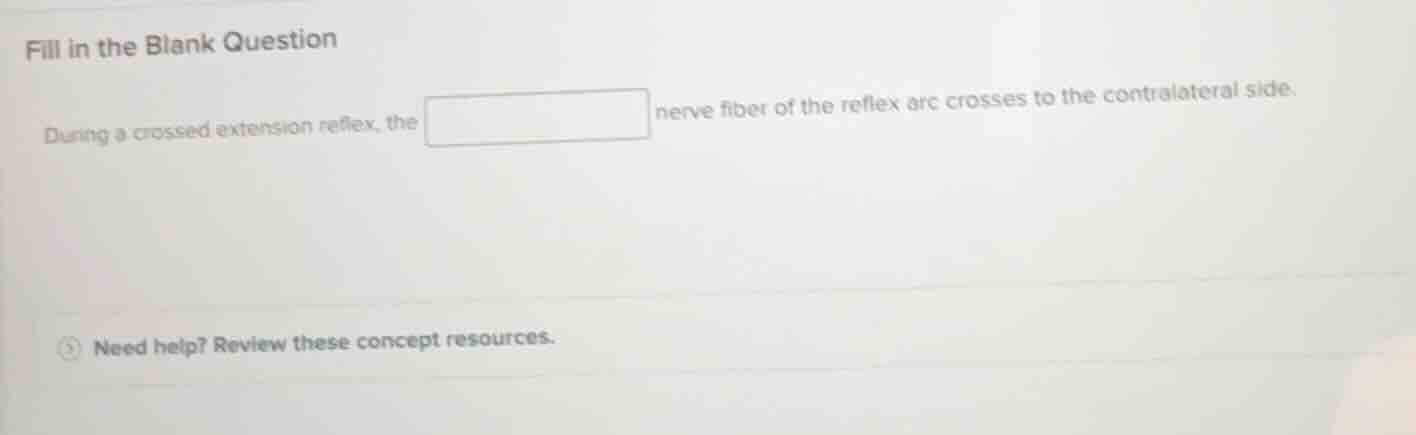
during a crossed extension reflex, the blank nerve fiber of the reflex arc crosses to the contralateral side.
Identify the reflex arc components
Using the Crossed Extensor Reflex knowledge point
The crossed extensor (or extension) reflex is a contralateral reflex arc. In this reflex, sensory input on one side of the body causes a motor response on the opposite (contralateral) side.
Determine the crossing fiber
Using the Crossed Extensor Reflex knowledge point
Within the spinal cord, the sensory neuron synapses with interneurons. It is the afferent (sensory) fiber that enters the ipsilateral side, but the afferent signal is processed by interneurons that decussate (cross over) to the contralateral side to synapse with contralateral motor neurons. Specifically, the pathway involves an afferent nerve fiber bringing the signal to the spinal cord, where interneurons cross the midline. However, in standard anatomical descriptions of reflex arcs, the fiber that decussates to carry the signal to the other side of the spinal cord is the afferent pathway's signal via decussating interneurons, or simply the afferent nerve fiber's signal pathway. Let's look at the exact phrasing: "During a crossed extension reflex, the [blank] nerve fiber of the reflex arc crosses to the contralateral side." The sensory input is carried by the afferent fiber, which synapses with interneurons that cross over. In many textbook contexts, the fiber that initiates this contralateral crossing is referred to as the afferent fiber (or sensory fiber) because it brings the signal into the cord where decussation occurs, or more specifically, the afferent pathway.

Snap & solve any problem in the app
Get step-by-step solutions on Sovi AI
Photo-based solutions with guided steps
Explore more problems and detailed explanations
During a crossed extension reflex, the <blank>afferent</blank> nerve fiber of the reflex arc crosses to the contralateral side.