QUESTION IMAGE
Question
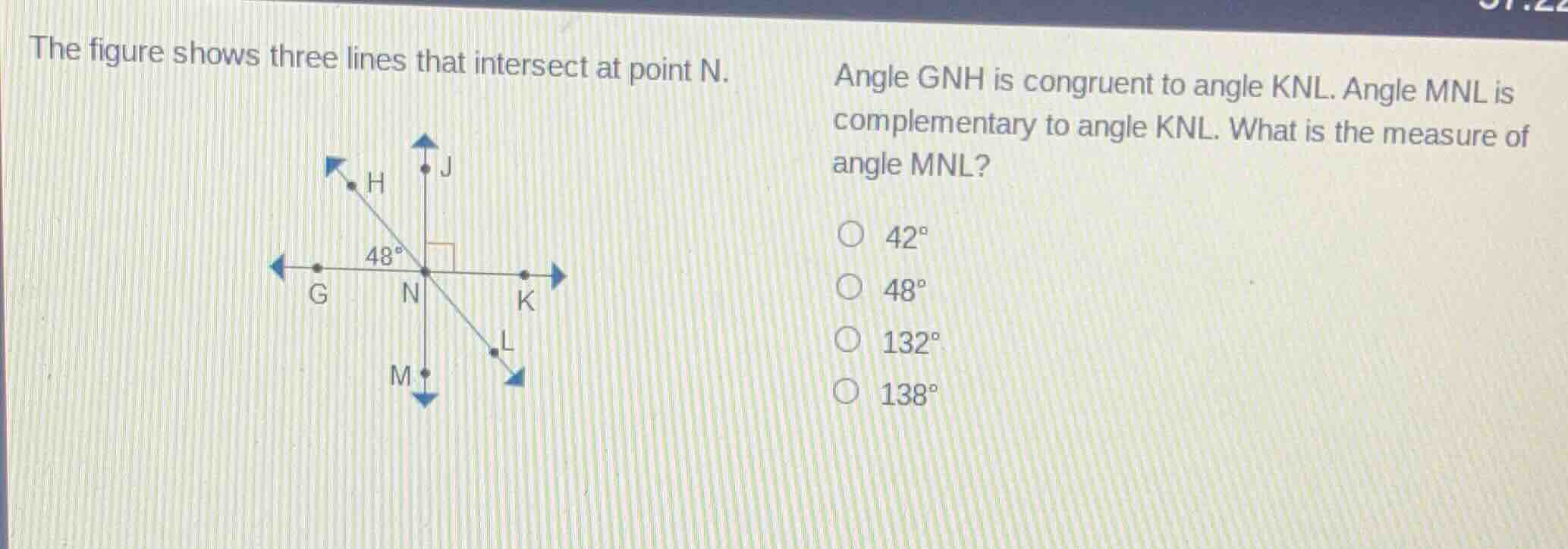
the figure shows three lines that intersect at point n. angle gnh is congruent to angle knl. angle mnl is complementary to angle knl. what is the measure of angle mnl? options: 42°, 48°, 132°, 138°
Step1: Identify congruent angles
Given $\angle GNH \cong \angle KNL$, and from the figure, $\angle GNH = 48^\circ$, so $\angle KNL = 48^\circ$.
Step2: Use complementary angles
$\angle MNL$ is complementary to $\angle KNL$, meaning $\angle MNL + \angle KNL = 90^\circ$. Wait, no, wait—wait, maybe I misread. Wait, actually, looking at the lines, $JM$ is perpendicular? Wait, no, let's re - examine. Wait, the problem says $\angle MNL$ is complementary to $\angle KNL$? Wait, no, maybe the lines: $JM$ and $GK$ are intersecting? Wait, no, the figure has three lines intersecting at $N$. Let's correct: If $\angle GNH = 48^\circ$, and $\angle GNH \cong \angle KNL$, so $\angle KNL = 48^\circ$. Now, if $JM$ is a vertical line (assuming $JM$ is perpendicular to $GK$? Wait, no, maybe $\angle MNL$ and $\angle KNL$: Wait, complementary angles sum to $90^\circ$, but maybe I made a mistake. Wait, no, maybe the angle between $JM$ and $GK$ is $90^\circ$? Wait, no, let's think again. Wait, the correct approach: Since $\angle GNH = 48^\circ$ and $\angle GNH \cong \angle KNL$, so $\angle KNL = 48^\circ$. Now, if $\angle MNL$ is complementary to $\angle KNL$, then $\angle MNL=90^\circ - 48^\circ = 42^\circ$? No, that can't be. Wait, maybe I got the complementary wrong. Wait, no, maybe the lines: $JM$ is a straight line? Wait, no, the three lines: $GK$, $HL$, and $JM$ intersect at $N$. Let's see, $\angle GNH = 48^\circ$, $\angle GNH \cong \angle KNL$, so $\angle KNL = 48^\circ$. Now, $\angle MNL$ and $\angle KNL$: if $JM$ is perpendicular to $GK$, then $\angle JNK = 90^\circ$, but no. Wait, maybe the angle $\angle MNL$: Wait, the sum of angles on a straight line is $180^\circ$? No, wait, the problem says $\angle MNL$ is complementary to $\angle KNL$, so $\angle MNL + \angle KNL = 90^\circ$. But $\angle KNL = 48^\circ$, so $\angle MNL = 90 - 48 = 42^\circ$? But that's one of the options. Wait, no, maybe I messed up the congruent angles. Wait, $\angle GNH$ and $\angle KNL$ are congruent, so $\angle KNL = 48^\circ$. Then, if $\angle MNL$ is complementary to $\angle KNL$, then $\angle MNL = 90 - 48 = 42^\circ$. But wait, another way: maybe $\angle MNL$ and $\angle KNL$: if $JM$ is a vertical line, and $GK$ is horizontal, then $\angle JNK = 90^\circ$, but no. Wait, the options are $42^\circ$, $48^\circ$, $132^\circ$, $138^\circ$. Wait, maybe I had the complementary wrong. Wait, maybe $\angle MNL$ is supplementary to $\angle KNL$? No, the problem says complementary. Wait, let's check the problem again: "Angle GNH is congruent to angle KNL. Angle MNL is complementary to angle KNL. What is the measure of angle MNL?" So $\angle GNH = 48^\circ$ (from the figure), so $\angle KNL = 48^\circ$. Complementary angles sum to $90^\circ$, so $\angle MNL = 90^\circ - 48^\circ = 42^\circ$. But wait, maybe the figure is different. Wait, maybe $\angle GNH$ and $\angle KNL$ are vertical angles? No, the problem says congruent. Wait, maybe the angle between $HL$ and $GK$ is $48^\circ$, and $\angle KNL$ is equal to that. Then $\angle MNL$ is complementary, so $90 - 48 = 42$. So the answer should be $42^\circ$.
Snap & solve any problem in the app
Get step-by-step solutions on Sovi AI
Photo-based solutions with guided steps
Explore more problems and detailed explanations
$42^\circ$