QUESTION IMAGE
Question
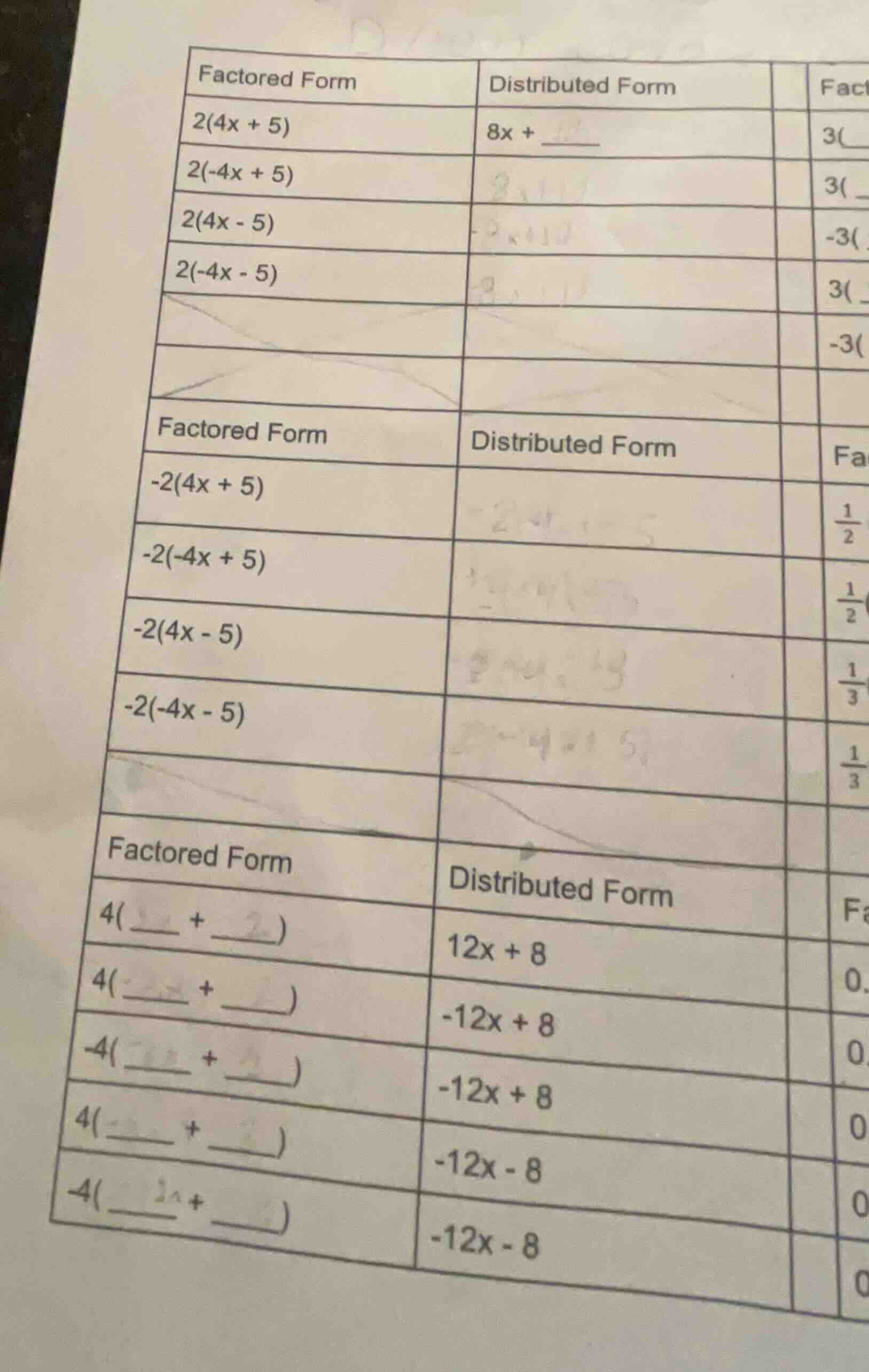
factored form | distributed form | fact
2(4x + 5) | 8x + ____ | 3(
2(-4x + 5) | | 3(
2(4x - 5) | | -3(
2(-4x - 5) | | 3(
| | -3(
| |
factored form | distributed form | fa
-2(4x + 5) | |
-2(-4x + 5) | |
-2(4x - 5) | |
-2(-4x - 5) | |
| |
| |
factored form | distributed form | fa
4(__ + __) | 12x + 8 |
4(__ + __) | -12x + 8 | 0.
-4(__ + __) | -12x + 8 | 0.
4(__ + __) | -12x - 8 | 0
-4(__ + __) | -12x - 8 | 0
| | 0
First, let's solve the first blank in the first row: \(2(4x + 5)\) to distributed form.
Step 1: Apply the distributive property \(a(b + c)=ab + ac\)
Here, \(a = 2\), \(b = 4x\), and \(c = 5\). So we calculate \(2\times4x\) and \(2\times5\).
\(2\times4x=8x\) and \(2\times5 = 10\). So the distributed form is \(8x+10\).
Now, let's solve the factored form for \(12x + 8\) (the row with \(4(\underline{\quad}+\underline{\quad})\)):
Step 1: Find the greatest common factor (GCF) of \(12x\) and \(8\)
The GCF of \(12\) and \(8\) is \(4\). So we factor out \(4\) from \(12x+8\).
Step 2: Divide each term by \(4\)
For \(12x\div4 = 3x\) and \(8\div4=2\). So the factored form is \(4(3x + 2)\).
Let's solve \(-2(4x + 5)\) to distributed form:
Step 1: Apply the distributive property \(a(b + c)=ab + ac\) with \(a=-2\), \(b = 4x\), \(c = 5\)
\(-2\times4x=-8x\) and \(-2\times5=-10\). So the distributed form is \(-8x-10\).
Let's solve \(-2(-4x + 5)\) to distributed form:
Step 1: Apply the distributive property \(a(b + c)=ab + ac\) with \(a = -2\), \(b=-4x\), \(c = 5\)
\(-2\times(-4x)=8x\) and \(-2\times5=-10\). So the distributed form is \(8x-10\).
Let's solve \(-2(4x - 5)\) to distributed form:
Step 1: Apply the distributive property \(a(b - c)=ab - ac\) with \(a=-2\), \(b = 4x\), \(c = 5\)
\(-2\times4x=-8x\) and \(-2\times(-5)=10\). So the distributed form is \(-8x + 10\).
Let's solve \(-2(-4x - 5)\) to distributed form:
Step 1: Apply the distributive property \(a(-b - c)=-ab - ac\) with \(a=-2\), \(b = 4x\), \(c = 5\)
\(-2\times(-4x)=8x\) and \(-2\times(-5)=10\). So the distributed form is \(8x + 10\).
Let's solve the factored form for \(-12x + 8\) with \(4(\underline{\quad}+\underline{\quad})\):
Step 1: Factor out \(4\) from \(-12x+8\)
\(-12x\div4=-3x\) and \(8\div4 = 2\). So the factored form is \(4(-3x + 2)\).
Let's solve the factored form for \(-12x + 8\) with \(-4(\underline{\quad}+\underline{\quad})\):
Step 1: Factor out \(-4\) from \(-12x+8\)
\(-12x\div(-4)=3x\) and \(8\div(-4)=-2\). So the factored form is \(-4(3x-2)\) (or we can also check: \(-4\times3x=-12x\) and \(-4\times(-2)=8\), so \(-4(3x - 2)=-12x + 8\)).
Let's solve the factored form for \(-12x - 8\) with \(4(\underline{\quad}+\underline{\quad})\):
Step 1: Factor out \(4\) from \(-12x-8\)
\(-12x\div4=-3x\) and \(-8\div4=-2\). So the factored form is \(4(-3x-2)\).
Let's solve the factored form for \(-12x - 8\) with \(-4(\underline{\quad}+\underline{\quad})\):
Step 1: Factor out \(-4\) from \(-12x-8\)
\(-12x\div(-4)=3x\) and \(-8\div(-4)=2\). So the factored form is \(-4(3x + 2)\).
For the first blank ( \(2(4x + 5)\) distributed form):

Snap & solve any problem in the app
Get step-by-step solutions on Sovi AI
Photo-based solutions with guided steps
Explore more problems and detailed explanations
\(10\)