QUESTION IMAGE
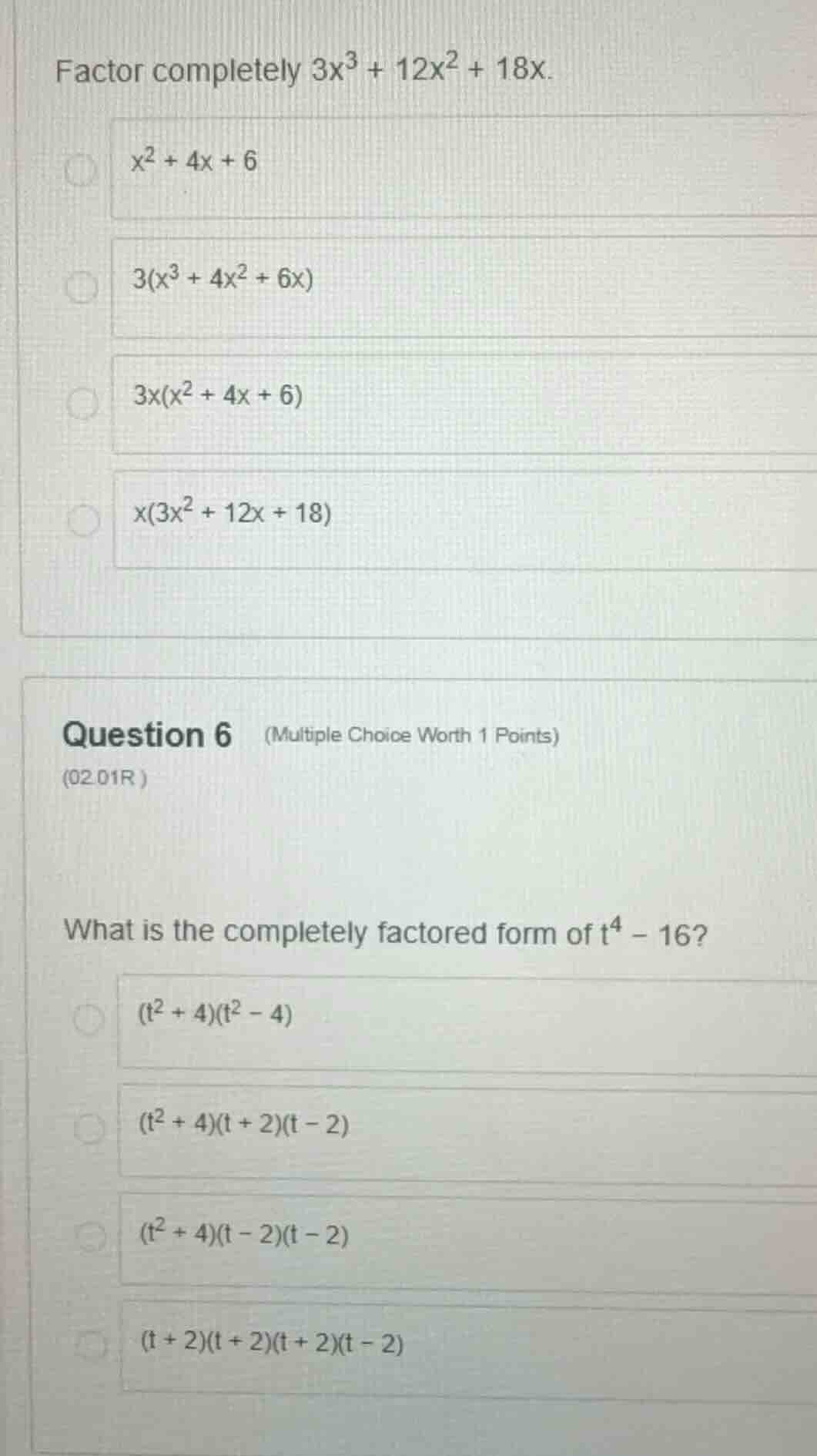
Question
factor completely (3x^3 + 12x^2 + 18x).
- (x^2 + 4x + 6)
- (3(x^3 + 4x^2 + 6x))
- (3x(x^2 + 4x + 6))
- (x(3x^2 + 12x + 18))
question 6 (multiple choice worth 1 points)
(02.01r)
what is the completely factored form of (t^4 - 16)?
- ((t^2 + 4)(t^2 - 4))
- ((t^2 + 4)(t + 2)(t - 2))
- ((t^2 + 4)(t - 2)(t - 2))
- ((t + 2)(t + 2)(t + 2)(t - 2))
Factor out the greatest common factor
Using the Greatest Common Factor knowledge point
$$
LATEXBLOCK0
$$
Check for further factorization
The remaining trinomial is \(x^2 + 4x + 6\).
We look for two integers that multiply to \(6\) and add to \(4\).
The factors of \(6\) are:
- \(1 \times 6\) (sum = \(7\))
- \(2 \times 3\) (sum = \(5\))
No such integers exist, so the trinomial cannot be factored further over the integers.
The completely factored form is:
$$
3x(x^2 + 4x + 6)
$$
Apply difference of squares to the second expression
Using the Difference of Squares knowledge point
$$
LATEXBLOCK1
$$
Factor the remaining binomial completely
Using the Difference of Squares knowledge point
$$
LATEXBLOCK2
$$
Combining these gives:
$$
(t^2 + 4)(t + 2)(t - 2)
$$

Snap & solve any problem in the app
Get step-by-step solutions on Sovi AI
Photo-based solutions with guided steps
Explore more problems and detailed explanations
Question 1
- (A) \(x^2 + 4x + 6\)
- (B) \(3(x^3 + 4x^2 + 6x)\)
- (C) \(3x(x^2 + 4x + 6)\) (Correct answer)
- (D) \(x(3x^2 + 12x + 18)\)
Question 2
- (A) \((t^2 + 4)(t^2 - 4)\)
- (B) \((t^2 + 4)(t + 2)(t - 2)\) (Correct answer)
- (C) \((t^2 + 4)(t - 2)(t - 2)\)
- (D) \((t + 2)(t + 2)(t + 2)(t - 2)\)