QUESTION IMAGE
Question
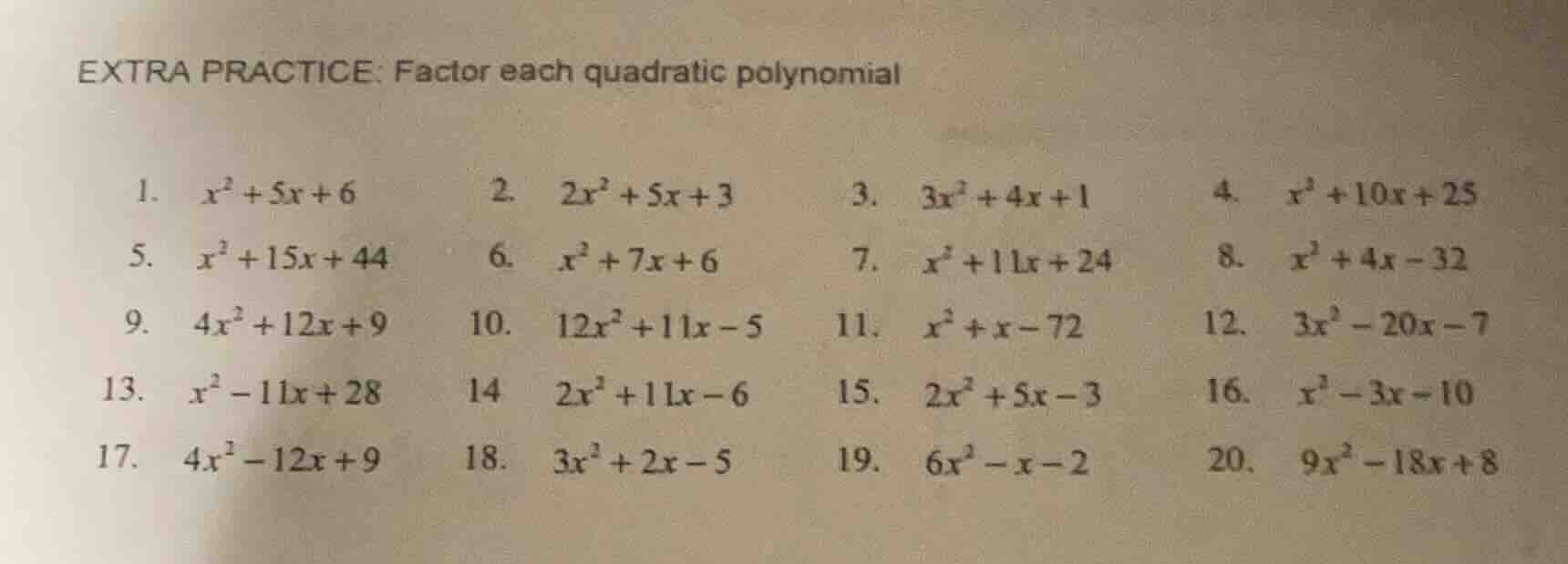
extra practice: factor each quadratic polynomial
- $x^2 + 5x + 6$ 2. $2x^2 + 5x + 3$ 3. $3x^2 + 4x + 1$ 4. $x^2 + 10x + 25$
- $x^2 + 15x + 44$ 6. $x^2 + 7x + 6$ 7. $x^2 + 11x + 24$ 8. $x^2 + 4x - 32$
- $4x^2 + 12x + 9$ 10. $12x^2 + 11x - 5$ 11. $x^2 + x - 72$ 12. $3x^2 - 20x - 7$
- $x^2 - 11x + 28$ 14. $2x^2 + 11x - 6$ 15. $2x^2 + 5x - 3$ 16. $x^2 - 3x - 10$
- $4x^2 - 12x + 9$ 18. $3x^2 + 2x - 5$ 19. $6x^2 - x - 2$ 20. $9x^2 - 18x + 8$
Let's solve these quadratic factoring problems one by one. We'll use the method of finding two numbers that multiply to the constant term (or the product of the leading coefficient and the constant term for non - monic quadratics) and add up to the coefficient of the middle term.
Problem 1: \(x^{2}+5x + 6\)
Step 1: Find two numbers
We need two numbers that multiply to \(6\) (the constant term) and add up to \(5\) (the coefficient of \(x\)). The numbers \(2\) and \(3\) work because \(2\times3 = 6\) and \(2 + 3=5\).
Step 2: Factor the quadratic
Using these two numbers, we can factor the quadratic as \((x + 2)(x+3)\).
Problem 2: \(2x^{2}+5x + 3\)
Step 1: For non - monic quadratic (\(ax^{2}+bx + c\) with \(a
eq1\)), we first find two numbers that multiply to \(a\times c=2\times3 = 6\) and add up to \(b = 5\). The numbers \(2\) and \(3\) work (\(2\times3=6\) and \(2 + 3 = 5\)).
Step 2: Rewrite the middle term and factor by grouping
We rewrite the middle term: \(2x^{2}+2x+3x + 3\). Then we group the terms: \((2x^{2}+2x)+(3x + 3)=2x(x + 1)+3(x + 1)\). Now we can factor out \((x + 1)\) to get \((2x + 3)(x + 1)\).
Problem 3: \(3x^{2}+4x + 1\)
Step 1: Find two numbers that multiply to \(a\times c=3\times1 = 3\) and add up to \(b = 4\). The numbers \(3\) and \(1\) work (\(3\times1 = 3\) and \(3+1 = 4\)).
Step 2: Rewrite the middle term and factor by grouping
Rewrite the middle term: \(3x^{2}+3x+x + 1\). Group the terms: \((3x^{2}+3x)+(x + 1)=3x(x + 1)+1(x + 1)\). Factor out \((x + 1)\) to get \((3x + 1)(x + 1)\).
Problem 4: \(x^{2}+10x + 25\)
This is a perfect square trinomial. We know that \((a + b)^{2}=a^{2}+2ab + b^{2}\). Here, \(a=x\), \(2ab = 10x\) (so \(b = 5\) since \(2\times x\times5=10x\)) and \(b^{2}=25\). So it factors as \((x + 5)^{2}\).
Problem 5: \(x^{2}+15x + 44\)
Step 1: Find two numbers that multiply to \(44\) and add up to \(15\). The numbers \(11\) and \(4\) work (\(11\times4 = 44\) and \(11 + 4=15\)).
Step 2: Factor the quadratic
We factor it as \((x + 11)(x + 4)\).
Problem 6: \(x^{2}+7x + 6\)
Step 1: Find two numbers that multiply to \(6\) and add up to \(7\). The numbers \(6\) and \(1\) work (\(6\times1 = 6\) and \(6+1 = 7\)).
Step 2: Factor the quadratic
Factor it as \((x + 6)(x + 1)\).
Problem 7: \(x^{2}+11x + 24\)
Step 1: Find two numbers that multiply to \(24\) and add up to \(11\). The numbers \(8\) and \(3\) work (\(8\times3 = 24\) and \(8 + 3=11\)).
Step 2: Factor the quadratic
Factor it as \((x + 8)(x + 3)\).
Problem 8: \(x^{2}+4x-32\)
Step 1: Find two numbers that multiply to \(- 32\) and add up to \(4\). The numbers \(8\) and \(-4\) work (\(8\times(-4)=-32\) and \(8+( - 4)=4\)).
Step 2: Factor the quadratic
Factor it as \((x + 8)(x-4)\).
Problem 9: \(4x^{2}+12x + 9\)
This is a perfect square trinomial. We know that \((a + b)^{2}=a^{2}+2ab + b^{2}\). Here, \(a = 2x\), \(2ab=12x\) (so \(b = 3\) since \(2\times(2x)\times3 = 12x\)) and \(b^{2}=9\). So it factors as \((2x + 3)^{2}\).
Problem 10: \(12x^{2}+11x-5\)
Step 1: Find two numbers that multiply to \(a\times c=12\times(-5)=-60\) and add up to \(b = 11\). The numbers \(15\) and \(-4\) work (\(15\times(-4)=-60\) and \(15+( - 4)=11\)).
Step 2: Rewrite the middle term and factor by grouping
Rewrite the middle term: \(12x^{2}+15x-4x - 5\). Group the terms: \((12x^{2}+15x)-(4x + 5)=3x(4x + 5)-1(4x + 5)\). Factor out \((4x + 5)\) to get \((3x - 1)(4x + 5)\).
Problem 11: \(x^{2}+x-72\)
Step 1: Find two numbers that multiply to \(-72\) and add up to \(1\). The numbe…

Snap & solve any problem in the app
Get step-by-step solutions on Sovi AI
Photo-based solutions with guided steps
Explore more problems and detailed explanations
Let's solve these quadratic factoring problems one by one. We'll use the method of finding two numbers that multiply to the constant term (or the product of the leading coefficient and the constant term for non - monic quadratics) and add up to the coefficient of the middle term.
Problem 1: \(x^{2}+5x + 6\)
Step 1: Find two numbers
We need two numbers that multiply to \(6\) (the constant term) and add up to \(5\) (the coefficient of \(x\)). The numbers \(2\) and \(3\) work because \(2\times3 = 6\) and \(2 + 3=5\).
Step 2: Factor the quadratic
Using these two numbers, we can factor the quadratic as \((x + 2)(x+3)\).
Problem 2: \(2x^{2}+5x + 3\)
Step 1: For non - monic quadratic (\(ax^{2}+bx + c\) with \(a
eq1\)), we first find two numbers that multiply to \(a\times c=2\times3 = 6\) and add up to \(b = 5\). The numbers \(2\) and \(3\) work (\(2\times3=6\) and \(2 + 3 = 5\)).
Step 2: Rewrite the middle term and factor by grouping
We rewrite the middle term: \(2x^{2}+2x+3x + 3\). Then we group the terms: \((2x^{2}+2x)+(3x + 3)=2x(x + 1)+3(x + 1)\). Now we can factor out \((x + 1)\) to get \((2x + 3)(x + 1)\).
Problem 3: \(3x^{2}+4x + 1\)
Step 1: Find two numbers that multiply to \(a\times c=3\times1 = 3\) and add up to \(b = 4\). The numbers \(3\) and \(1\) work (\(3\times1 = 3\) and \(3+1 = 4\)).
Step 2: Rewrite the middle term and factor by grouping
Rewrite the middle term: \(3x^{2}+3x+x + 1\). Group the terms: \((3x^{2}+3x)+(x + 1)=3x(x + 1)+1(x + 1)\). Factor out \((x + 1)\) to get \((3x + 1)(x + 1)\).
Problem 4: \(x^{2}+10x + 25\)
This is a perfect square trinomial. We know that \((a + b)^{2}=a^{2}+2ab + b^{2}\). Here, \(a=x\), \(2ab = 10x\) (so \(b = 5\) since \(2\times x\times5=10x\)) and \(b^{2}=25\). So it factors as \((x + 5)^{2}\).
Problem 5: \(x^{2}+15x + 44\)
Step 1: Find two numbers that multiply to \(44\) and add up to \(15\). The numbers \(11\) and \(4\) work (\(11\times4 = 44\) and \(11 + 4=15\)).
Step 2: Factor the quadratic
We factor it as \((x + 11)(x + 4)\).
Problem 6: \(x^{2}+7x + 6\)
Step 1: Find two numbers that multiply to \(6\) and add up to \(7\). The numbers \(6\) and \(1\) work (\(6\times1 = 6\) and \(6+1 = 7\)).
Step 2: Factor the quadratic
Factor it as \((x + 6)(x + 1)\).
Problem 7: \(x^{2}+11x + 24\)
Step 1: Find two numbers that multiply to \(24\) and add up to \(11\). The numbers \(8\) and \(3\) work (\(8\times3 = 24\) and \(8 + 3=11\)).
Step 2: Factor the quadratic
Factor it as \((x + 8)(x + 3)\).
Problem 8: \(x^{2}+4x-32\)
Step 1: Find two numbers that multiply to \(- 32\) and add up to \(4\). The numbers \(8\) and \(-4\) work (\(8\times(-4)=-32\) and \(8+( - 4)=4\)).
Step 2: Factor the quadratic
Factor it as \((x + 8)(x-4)\).
Problem 9: \(4x^{2}+12x + 9\)
This is a perfect square trinomial. We know that \((a + b)^{2}=a^{2}+2ab + b^{2}\). Here, \(a = 2x\), \(2ab=12x\) (so \(b = 3\) since \(2\times(2x)\times3 = 12x\)) and \(b^{2}=9\). So it factors as \((2x + 3)^{2}\).
Problem 10: \(12x^{2}+11x-5\)
Step 1: Find two numbers that multiply to \(a\times c=12\times(-5)=-60\) and add up to \(b = 11\). The numbers \(15\) and \(-4\) work (\(15\times(-4)=-60\) and \(15+( - 4)=11\)).
Step 2: Rewrite the middle term and factor by grouping
Rewrite the middle term: \(12x^{2}+15x-4x - 5\). Group the terms: \((12x^{2}+15x)-(4x + 5)=3x(4x + 5)-1(4x + 5)\). Factor out \((4x + 5)\) to get \((3x - 1)(4x + 5)\).
Problem 11: \(x^{2}+x-72\)
Step 1: Find two numbers that multiply to \(-72\) and add up to \(1\). The numbers \(9\) and \(-8\) work (\(9\times(-8)=-72\) and \(9+( - 8)=1\)).
Step 2: Factor the quadratic
Factor it as \((x + 9)(x-8)\).
Problem 12: \(3x^{2}-20x - 7\)
Step 1: Find two numbers that multiply to \(a\times c=3\times(-7)=-21\) and add up to \(b=-20\). The numbers \(-21\) and \(1\) work (\((-21)\times1=-21\) and \(-21 + 1=-20\)).
Step 2: Rewrite the middle term and factor by grouping
Rewrite the middle term: \(3x^{2}-21x+x - 7\). Group the terms: \((3x^{2}-21x)+(x - 7)=3x(x - 7)+1(x - 7)\). Factor out \((x - 7)\) to get \((3x + 1)(x - 7)\).
Problem 13: \(x^{2}-11x + 28\)
Step 1: Find two numbers that multiply to \(28\) and add up to \(-11\). The numbers \(-7\) and \(-4\) work (\((-7)\times(-4)=28\) and \(-7+( - 4)=-11\)).
Step 2: Factor the quadratic
Factor it as \((x - 7)(x - 4)\).
Problem 14: \(2x^{2}+11x-6\)
Step 1: Find two numbers that multiply to \(a\times c=2\times(-6)=-12\) and add up to \(b = 11\). The numbers \(12\) and \(-1\) work (\(12\times(-1)=-12\) and \(12+( - 1)=11\)).
Step 2: Rewrite the middle term and factor by grouping
Rewrite the middle term: \(2x^{2}+12x-x - 6\). Group the terms: \((2x^{2}+12x)-(x + 6)=2x(x + 6)-1(x + 6)\). Factor out \((x + 6)\) to get \((2x - 1)(x + 6)\).
Problem 15: \(2x^{2}+5x-3\)
Step 1: Find two numbers that multiply to \(a\times c=2\times(-3)=-6\) and add up to \(b = 5\). The numbers \(6\) and \(-1\) work (\(6\times(-1)=-6\) and \(6+( - 1)=5\)).
Step 2: Rewrite the middle term and factor by grouping
Rewrite the middle term: \(2x^{2}+6x-x - 3\). Group the terms: \((2x^{2}+6x)-(x + 3)=2x(x + 3)-1(x + 3)\). Factor out \((x + 3)\) to get \((2x - 1)(x + 3)\).
Problem 16: \(x^{2}-3x-10\)
Step 1: Find two numbers that multiply to \(-10\) and add up to \(-3\). The numbers \(-5\) and \(2\) work (\((-5)\times2=-10\) and \(-5 + 2=-3\)).
Step 2: Factor the quadratic
Factor it as \((x - 5)(x + 2)\).
Problem 17: \(4x^{2}-12x + 9\)
This is a perfect square trinomial. We know that \((a - b)^{2}=a^{2}-2ab + b^{2}\). Here, \(a = 2x\), \(2ab = 12x\) (so \(b = 3\) since \(2\times(2x)\times3=12x\)) and \(b^{2}=9\). So it factors as \((2x - 3)^{2}\).
Problem 18: \(3x^{2}+2x-5\)
Step 1: Find two numbers that multiply to \(a\times c=3\times(-5)=-15\) and add up to \(b = 2\). The numbers \(5\) and \(-3\) work (\(5\times(-3)=-15\) and \(5+( - 3)=2\)).
Step 2: Rewrite the middle term and factor by grouping
Rewrite the middle term: \(3x^{2}+5x-3x - 5\). Group the terms: \((3x^{2}+5x)-(3x + 5)=x(3x + 5)-1(3x + 5)\). Factor out \((3x + 5)\) to get \((x - 1)(3x + 5)\).
Problem 19: \(6x^{2}-x-2\)
Step 1: Find two numbers that multiply to \(a\times c=6\times(-2)=-12\) and add up to \(b=-1\). The numbers \(-4\) and \(3\) work (\((-4)\times3=-12\) and \(-4 + 3=-1\)).
Step 2: Rewrite the middle term and factor by grouping
Rewrite the middle term: \(6x^{2}-4x+3x - 2\). Group the terms: \((6x^{2}-4x)+(3x - 2)=2x(3x - 2)+1(3x - 2)\). Factor out \((3x - 2)\) to get \((2x + 1)(3x - 2)\).
Problem 20: \(9x^{2}-18x + 8\)
Step 1: Find two numbers that multiply to \(a\times c=9\times8 = 72\) and add up to \(b=-18\). The numbers \(-12\) and \(-6\) work (\((-12)\times(-6)=72\) and \(-12+( - 6)=-18\)).
Step 2: Rewrite the middle term and factor by grouping
Rewrite the middle term: \(9x^{2}-12x-6x + 8\). Group the terms: \((9x^{2}-12x)-(6x - 8)=3x(3x - 4)-2(3x - 4)\). Factor out \((3x - 4)\) to get \((3x - 2)(3x - 4)\).
Final Answers:
- \(\boldsymbol{(x + 2)(x + 3)}\)
- \(\boldsymbol{(2x + 3)(x + 1)}\)
- \(\boldsymbol{(3x + 1)(x + 1)}\)
- \(\boldsymbol{(x + 5)^{2}}\)
- \(\boldsymbol{(x + 11)(x + 4)}\)
- \(\boldsymbol{(x + 6)(x + 1)}\)
- \(\boldsymbol{(x + 8)(x + 3)}\)
- \(\boldsymbol{(x + 8)(x - 4)}\)
- \(\boldsymbol{(2x + 3)^{2}}\)
- \(\boldsymbol{(3x - 1)(4x + 5)}\)
- \(\boldsymbol{(x + 9)(x - 8)}\)
- \(\boldsymbol{(3x + 1)(x - 7)}\)
- \(\boldsymbol{(x - 7)(x - 4)}\)
- \(\boldsymbol{(2x - 1)(x + 6)}\)
- \(\boldsymbol{(2x - 1)(x + 3)}\)
- \(\boldsymbol{(x - 5)(x + 2)}\)
- \(\boldsymbol{(2x - 3)^{2}}\)
- \(\boldsymbol{(x - 1)(3x + 5)}\)
- \(\boldsymbol{(2x + 1)(3x - 2)}\)
- \(\boldsymbol{(3x - 2)(3x - 4)}\)