QUESTION IMAGE
Question
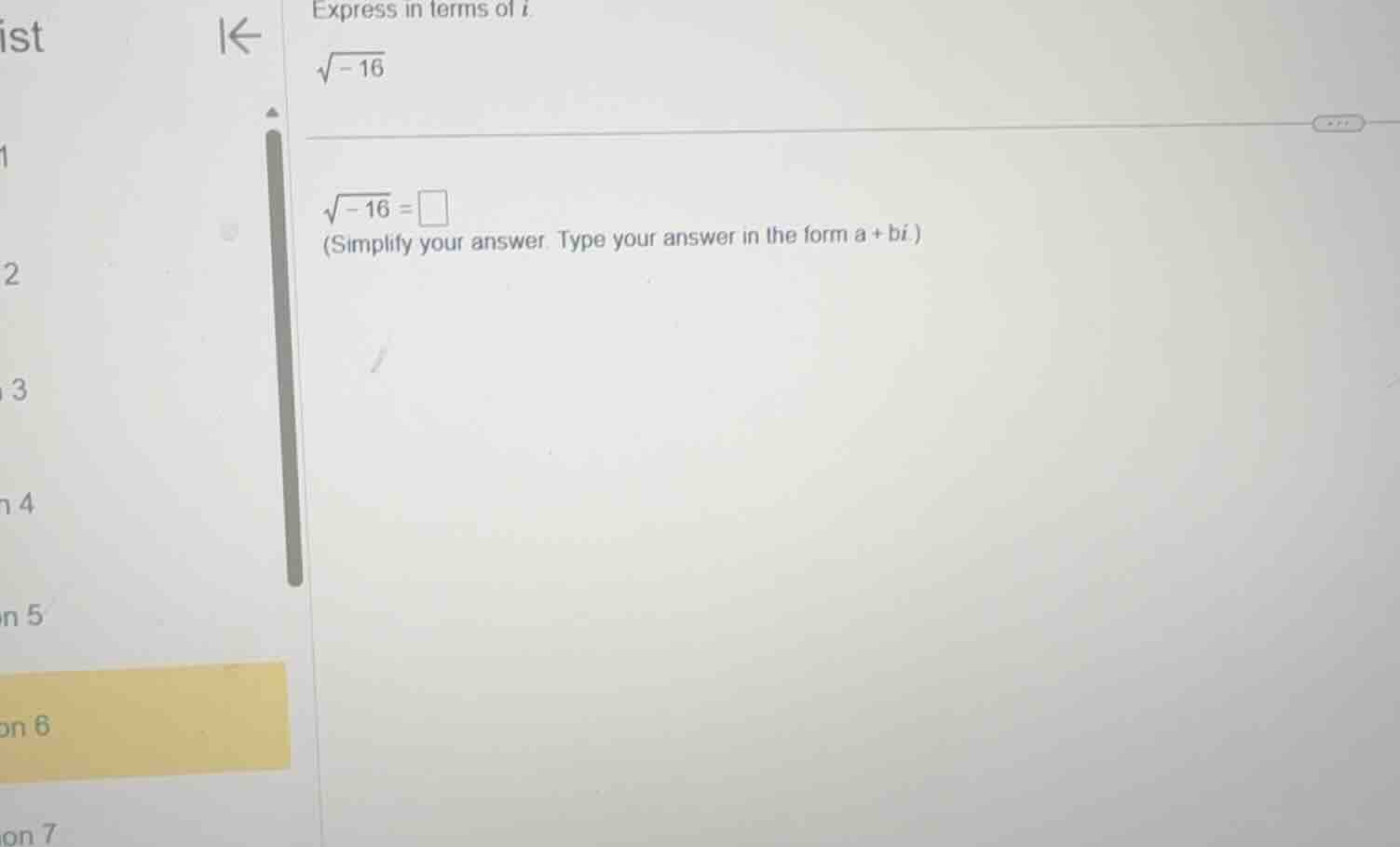
express in terms of \\(i\\).
\\(\sqrt{-16}\\)
\\(\sqrt{-16} = \square\\)
(simplify your answer. type your answer in the form \\(a + bi\\).)
<pre_analysis>
{
"quality": "clear",
"question_count": 1,
"skills_matched": [
"step_cot",
"blank_filling_formatter",
"explain_then_answer",
"tutor",
"mastery_adaptive_brevity"
],
"needs_drawing": false,
"concepts_used": [
"Product Rule for Radicals",
"Square Root Properties"
],
"new_concepts": [
"Imaginary Numbers",
"Complex Numbers"
],
"current_concepts": [
"Product Rule for Radicals",
"Square Root Properties",
"Imaginary Numbers",
"Complex Numbers"
]
}
</pre_analysis>
<reasoning>
Define the imaginary unit
We define the imaginary unit \(i\) to represent the square root of \(-1\):
\[i = \sqrt{-1}\]
Apply radical properties
Using the Product Rule for Radicals and Square Root Properties knowledge points
\[\sqrt{-16} = \sqrt{16 \cdot (-1)} = \sqrt{16} \cdot \sqrt{-1}\]
Simplify the expression
Using the Square Root Properties knowledge point
\[\sqrt{16} \cdot \sqrt{-1} = 4 \cdot i = 4i\]
Write in standard complex form
The standard form of a complex number is \(a + bi\), where \(a\) is the real part and \(b\) is the imaginary part. Since there is no real part, we write:
\[0 + 4i\]
</reasoning>
<answer>
\(\sqrt{-16} =\) <blank>\(0 + 4i\)</blank>
(Simplify your answer. Type your answer in the form a + bi.)
</answer>
<post_analysis>
{
"subject": "Mathematics",
"question_type": "Fill-in-the-blank",
"knowledge_point": [
"Mathematics",
"Algebra",
"Complex Numbers"
]
}
</post_analysis>
Snap & solve any problem in the app
Get step-by-step solutions on Sovi AI
Photo-based solutions with guided steps
Explore more problems and detailed explanations
<pre_analysis>
{
"quality": "clear",
"question_count": 1,
"skills_matched": [
"step_cot",
"blank_filling_formatter",
"explain_then_answer",
"tutor",
"mastery_adaptive_brevity"
],
"needs_drawing": false,
"concepts_used": [
"Product Rule for Radicals",
"Square Root Properties"
],
"new_concepts": [
"Imaginary Numbers",
"Complex Numbers"
],
"current_concepts": [
"Product Rule for Radicals",
"Square Root Properties",
"Imaginary Numbers",
"Complex Numbers"
]
}
</pre_analysis>
<reasoning>
Define the imaginary unit
We define the imaginary unit \(i\) to represent the square root of \(-1\):
\[i = \sqrt{-1}\]
Apply radical properties
Using the Product Rule for Radicals and Square Root Properties knowledge points
\[\sqrt{-16} = \sqrt{16 \cdot (-1)} = \sqrt{16} \cdot \sqrt{-1}\]
Simplify the expression
Using the Square Root Properties knowledge point
\[\sqrt{16} \cdot \sqrt{-1} = 4 \cdot i = 4i\]
Write in standard complex form
The standard form of a complex number is \(a + bi\), where \(a\) is the real part and \(b\) is the imaginary part. Since there is no real part, we write:
\[0 + 4i\]
</reasoning>
<answer>
\(\sqrt{-16} =\) <blank>\(0 + 4i\)</blank>
(Simplify your answer. Type your answer in the form a + bi.)
</answer>
<post_analysis>
{
"subject": "Mathematics",
"question_type": "Fill-in-the-blank",
"knowledge_point": [
"Mathematics",
"Algebra",
"Complex Numbers"
]
}
</post_analysis>