QUESTION IMAGE
Question
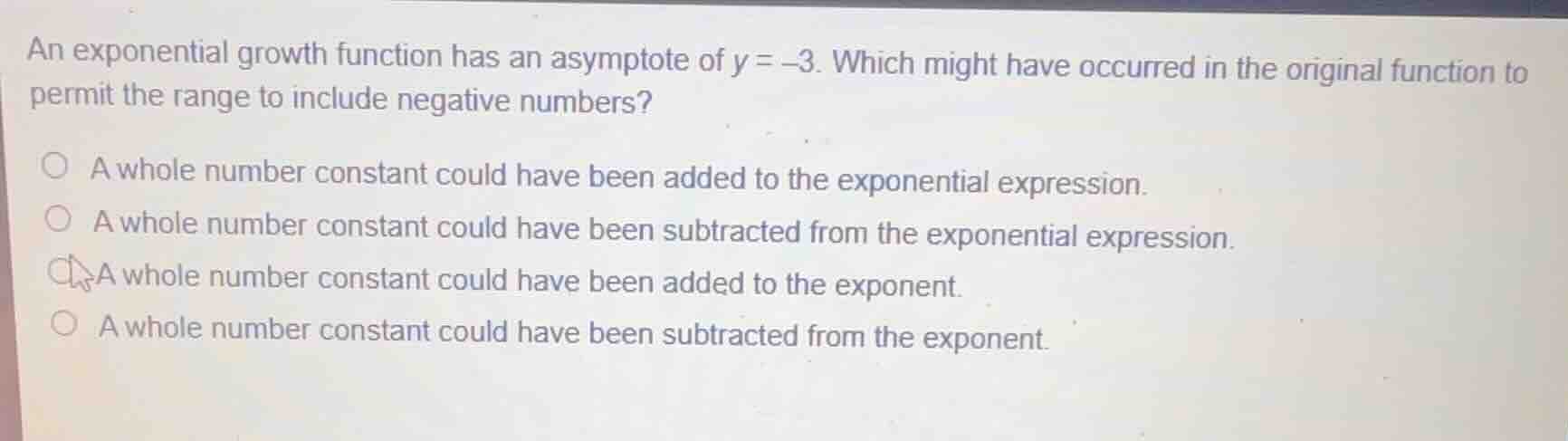
an exponential growth function has an asymptote of \\(y = -3\\). which might have occurred in the original function to permit the range to include negative numbers?
a whole number constant could have been added to the exponential expression.
a whole number constant could have been subtracted from the exponential expression.
a whole number constant could have been added to the exponent.
a whole number constant could have been subtracted from the exponent.
<pre_analysis>
{
"quality": "clear",
"question_count": 1,
"skills_matched": [
"step_cot",
"multiple_choice_formatter",
"explain_then_answer",
"tutor"
],
"needs_drawing": false,
"concepts_used": [
"Translation Rule"
],
"new_concepts": [
"Exponential Asymptotes",
"Exponential Range"
],
"current_concepts": [
"Translation Rule",
"Exponential Asymptotes",
"Exponential Range"
]
}
</pre_analysis>
<reasoning>
Analyze the parent exponential function
An exponential growth function in its simplest parent form is \(y = b^x\), where \(b > 1\). The range of this parent function is \((0, \infty)\), which contains only positive numbers, and its horizontal asymptote is \(y = 0\).
Determine the effect of transformations
To permit the range to include negative numbers, the graph must be shifted vertically downward. A vertical shift is achieved by adding or subtracting a constant to or from the entire exponential expression.
Using the Translation Rule concept, shifting a function \(f(x)\) vertically downward by \(k\) units is represented by \(f(x) - k\).
Evaluate the horizontal asymptote
The problem states that the transformed function has a horizontal asymptote of \(y = -3\). For a function of the form \(y = b^x + k\), the horizontal asymptote is \(y = k\). Therefore, \(k = -3\), which means a constant of \(3\) was subtracted from the exponential expression.
Match with the given options
Subtracting a whole number constant from the exponential expression shifts the graph down, moving the asymptote to \(y = -3\) and allowing the range to be \((-3, \infty)\), which includes negative numbers. This matches the second option.
</reasoning>
<answer>
<mcq-option>A whole number constant could have been added to the exponential expression.</mcq-option>
<mcq-correct>A whole number constant could have been subtracted from the exponential expression.</mcq-correct>
<mcq-option>A whole number constant could have been added to the exponent.</mcq-option>
<mcq-option>A whole number constant could have been subtracted from the exponent.</mcq-option>
</answer>
<post_analysis>
{
"subject": "Mathematics",
"question_type": "Multiple Choice",
"knowledge_point": [
"Mathematics",
"Algebra",
"Exponential Asymptotes"
]
}
</post_analysis>
Snap & solve any problem in the app
Get step-by-step solutions on Sovi AI
Photo-based solutions with guided steps
Explore more problems and detailed explanations
<pre_analysis>
{
"quality": "clear",
"question_count": 1,
"skills_matched": [
"step_cot",
"multiple_choice_formatter",
"explain_then_answer",
"tutor"
],
"needs_drawing": false,
"concepts_used": [
"Translation Rule"
],
"new_concepts": [
"Exponential Asymptotes",
"Exponential Range"
],
"current_concepts": [
"Translation Rule",
"Exponential Asymptotes",
"Exponential Range"
]
}
</pre_analysis>
<reasoning>
Analyze the parent exponential function
An exponential growth function in its simplest parent form is \(y = b^x\), where \(b > 1\). The range of this parent function is \((0, \infty)\), which contains only positive numbers, and its horizontal asymptote is \(y = 0\).
Determine the effect of transformations
To permit the range to include negative numbers, the graph must be shifted vertically downward. A vertical shift is achieved by adding or subtracting a constant to or from the entire exponential expression.
Using the Translation Rule concept, shifting a function \(f(x)\) vertically downward by \(k\) units is represented by \(f(x) - k\).
Evaluate the horizontal asymptote
The problem states that the transformed function has a horizontal asymptote of \(y = -3\). For a function of the form \(y = b^x + k\), the horizontal asymptote is \(y = k\). Therefore, \(k = -3\), which means a constant of \(3\) was subtracted from the exponential expression.
Match with the given options
Subtracting a whole number constant from the exponential expression shifts the graph down, moving the asymptote to \(y = -3\) and allowing the range to be \((-3, \infty)\), which includes negative numbers. This matches the second option.
</reasoning>
<answer>
<mcq-option>A whole number constant could have been added to the exponential expression.</mcq-option>
<mcq-correct>A whole number constant could have been subtracted from the exponential expression.</mcq-correct>
<mcq-option>A whole number constant could have been added to the exponent.</mcq-option>
<mcq-option>A whole number constant could have been subtracted from the exponent.</mcq-option>
</answer>
<post_analysis>
{
"subject": "Mathematics",
"question_type": "Multiple Choice",
"knowledge_point": [
"Mathematics",
"Algebra",
"Exponential Asymptotes"
]
}
</post_analysis>