Sovi.AI - AI Math Tutor

Scan to solve math questions

QUESTION IMAGE

explore transformations of the basic exponential function \\(y = 2^x\\)…

Question

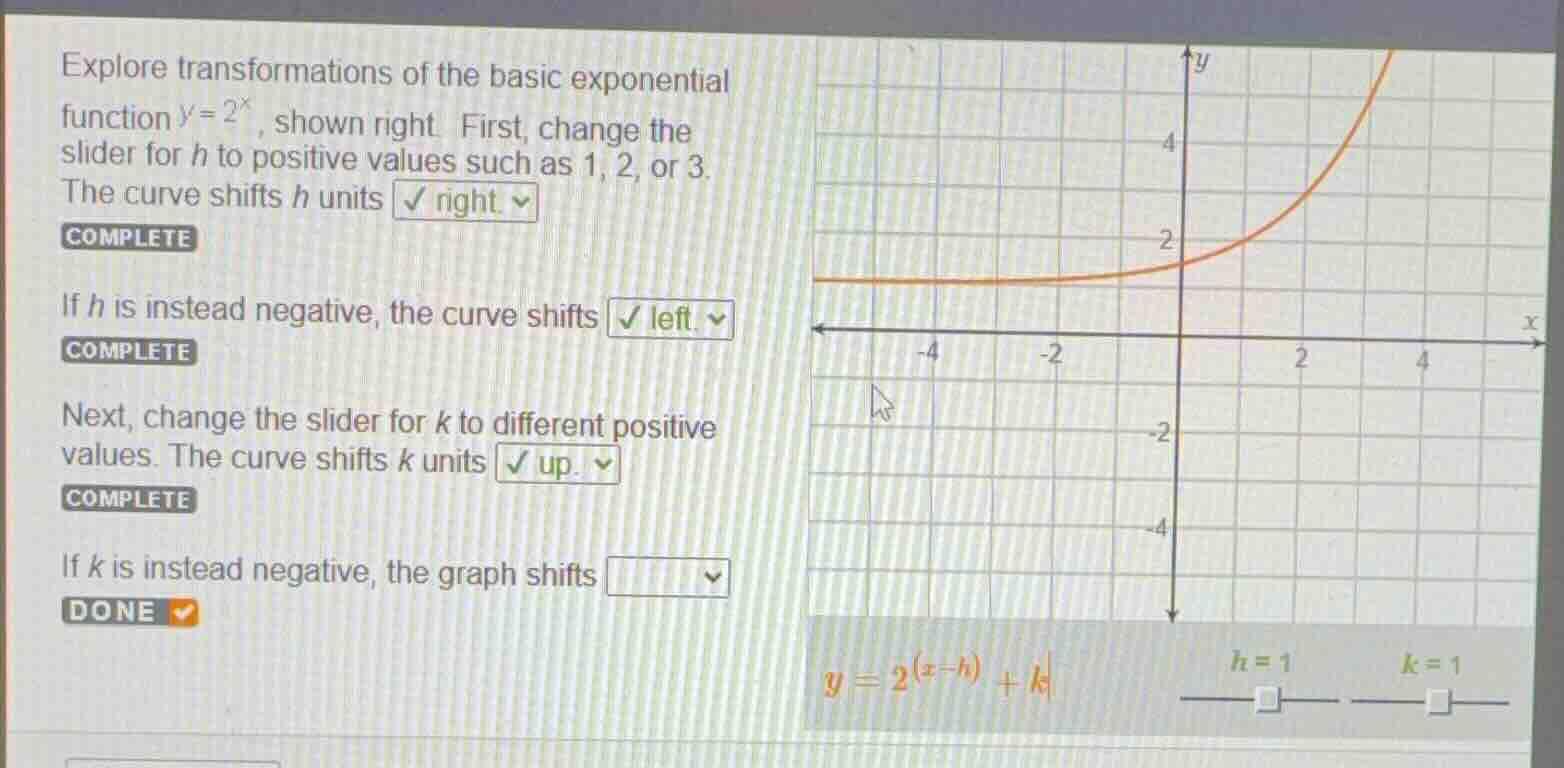
explore transformations of the basic exponential function \\(y = 2^x\\), shown right. first, change the slider for \\(h\\) to positive values such as 1, 2, or 3. the curve shifts \\(h\\) units right.

if \\(h\\) is instead negative, the curve shifts left.

next, change the slider for \\(k\\) to different positive values. the curve shifts \\(k\\) units up.

if \\(k\\) is instead negative, the graph shifts dropdown

Explanation:

Response

<pre_analysis>
{
"quality": "clear",
"question_count": 1,
"skills_matched": [
"direct_cot",
"blank_filling_formatter",
"explain_then_answer",
"tutor",
"mastery_adaptive_brevity"
],
"needs_drawing": false,
"concepts_used": [
"Exponential Function Transformations"
],
"new_concepts": [],
"current_concepts": [
"Exponential Function Transformations",
"Horizontal Translation",
"Vertical Translation"
]
}
</pre_analysis>

<reasoning>

Identify the transformation parameter

Using the Exponential Function Transformations knowledge point
The general transformed exponential function shown in the image is:
\[y = 2^{(x-h)} + k\]
The parameter \(k\) represents the vertical translation of the graph.

Analyze the effect of a negative parameter

Using the Exponential Function Transformations knowledge point
When \(k > 0\), the graph shifts vertically upward by \(k\) units.
When \(k < 0\) (negative), the graph shifts vertically downward by \(|k|\) units.
Therefore, if \(k\) is negative, the graph shifts down.
</reasoning>

<answer>
If \(k\) is instead negative, the graph shifts <blank>down</blank>.
</answer>

<post_analysis>
{
"subject": "Mathematics",
"question_type": "Fill-in-the-blank",
"knowledge_point": [
"Mathematics",
"Algebra",
"Exponential Function Transformations"
]
}
</post_analysis>

Answer:

<pre_analysis>
{
"quality": "clear",
"question_count": 1,
"skills_matched": [
"direct_cot",
"blank_filling_formatter",
"explain_then_answer",
"tutor",
"mastery_adaptive_brevity"
],
"needs_drawing": false,
"concepts_used": [
"Exponential Function Transformations"
],
"new_concepts": [],
"current_concepts": [
"Exponential Function Transformations",
"Horizontal Translation",
"Vertical Translation"
]
}
</pre_analysis>

<reasoning>

Identify the transformation parameter

Using the Exponential Function Transformations knowledge point
The general transformed exponential function shown in the image is:
\[y = 2^{(x-h)} + k\]
The parameter \(k\) represents the vertical translation of the graph.

Analyze the effect of a negative parameter

Using the Exponential Function Transformations knowledge point
When \(k > 0\), the graph shifts vertically upward by \(k\) units.
When \(k < 0\) (negative), the graph shifts vertically downward by \(|k|\) units.
Therefore, if \(k\) is negative, the graph shifts down.
</reasoning>

<answer>
If \(k\) is instead negative, the graph shifts <blank>down</blank>.
</answer>

<post_analysis>
{
"subject": "Mathematics",
"question_type": "Fill-in-the-blank",
"knowledge_point": [
"Mathematics",
"Algebra",
"Exponential Function Transformations"
]
}
</post_analysis>