QUESTION IMAGE
Question
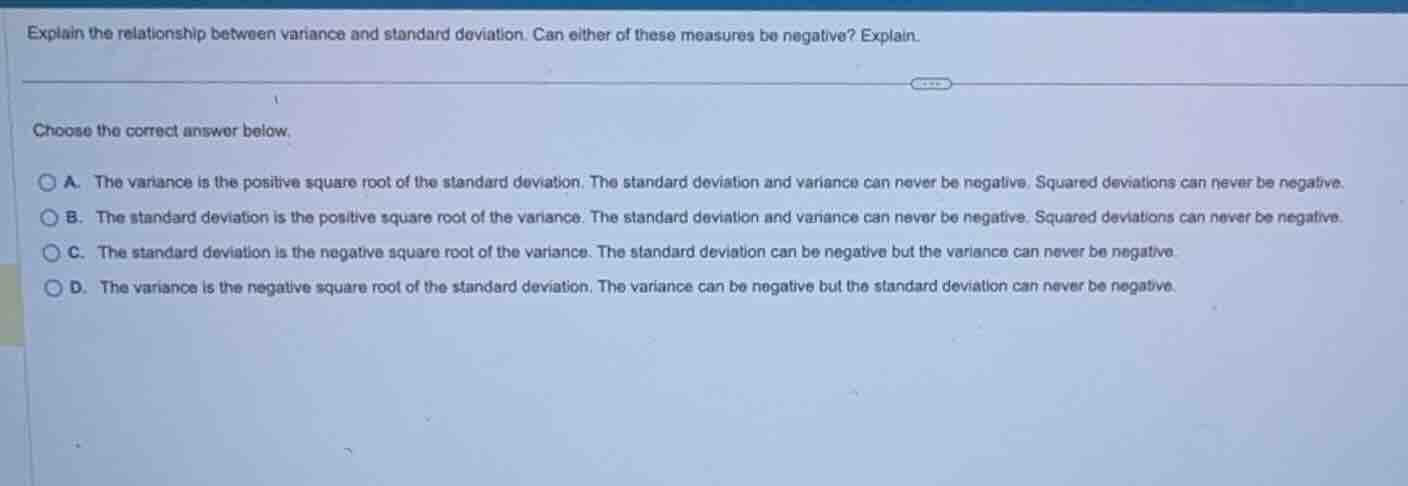
explain the relationship between variance and standard deviation. can either of these measures be negative? explain.
choose the correct answer below.
a. the variance is the positive square root of the standard deviation. the standard deviation and variance can never be negative. squared deviations can never be negative.
b. the standard deviation is the positive square root of the variance. the standard deviation and variance can never be negative. squared deviations can never be negative.
c. the standard deviation is the negative square root of the variance. the standard deviation can be negative but the variance can never be negative.
d. the variance is the negative square root of the standard deviation. the variance can be negative but the standard deviation can never be negative.
Define standard deviation and variance
Using the Population Variance and Population Standard Deviation knowledge points
Determine non-negativity
Using the Measures of Variation knowledge point
Evaluate the given options
Using the Measures of Variation knowledge point
- Option A incorrectly states variance is the square root of standard deviation.
- Option B correctly states standard deviation is the positive square root of variance, and neither can be negative because squared deviations are non-negative.
- Options C and D incorrectly allow negative values or incorrect square root relationships.

Snap & solve any problem in the app
Get step-by-step solutions on Sovi AI
Photo-based solutions with guided steps
Explore more problems and detailed explanations
- (A) The variance is the positive square root of the standard deviation. The standard deviation and variance can never be negative. Squared deviations can never be negative.
- (B) The standard deviation is the positive square root of the variance. The standard deviation and variance can never be negative. Squared deviations can never be negative. (Correct answer)
- (C) The standard deviation is the negative square root of the variance. The standard deviation can be negative but the variance can never be negative.
- (D) The variance is the negative square root of the standard deviation. The variance can be negative but the standard deviation can never be negative.