QUESTION IMAGE
Question
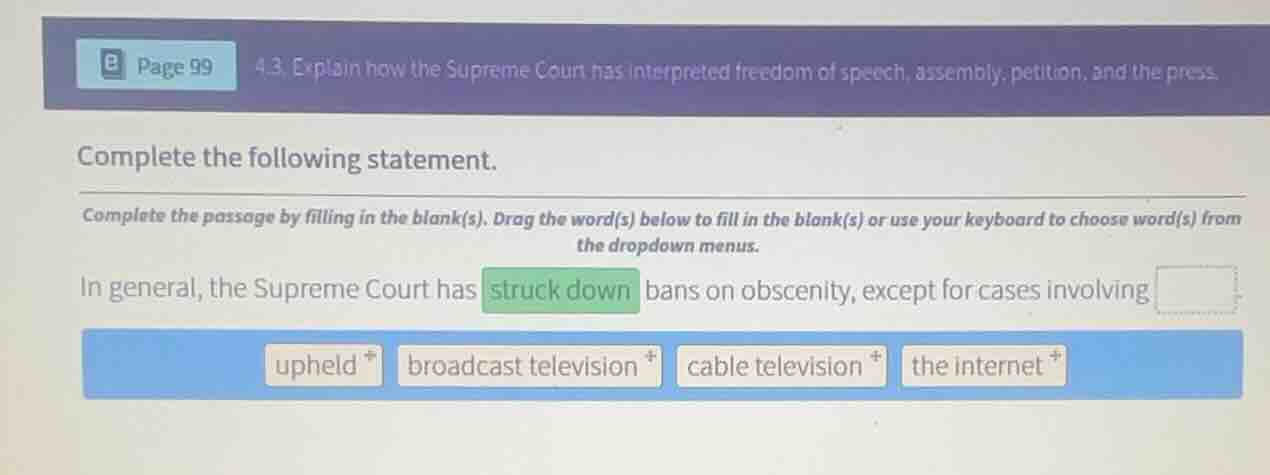
4.3. explain how the supreme court has interpreted freedom of speech, assembly, petition, and the press.
complete the following statement.
complete the passage by filling in the blank(s). drag the word(s) below to fill in the blank(s) or use your keyboard to choose word(s) from the dropdown menus.
in general, the supreme court has struck down bans on obscenity, except for cases involving .
options: upheld, broadcast television, cable television, the internet
Analyze Supreme Court obscenity standards
The Supreme Court generally protects speech under the First Amendment, but obscenity is an unprotected category. However, the Court has historically upheld restrictions on broadcast television due to its pervasive nature and accessibility to children (e.g., FCC v. Pacifica Foundation), while striking down similar bans on the internet (Reno v. ACLU) and cable television (United States v. Playboy Entertainment Group).
Determine the correct dropdown selections
The first blank is already filled with "struck down" in the image. The sentence reads: "In general, the Supreme Court has struck down bans on obscenity, except for cases involving [blank]." Among the options ("upheld", "broadcast television", "cable television", "the internet"), the Court has historically upheld regulations and bans on broadcast television.

Snap & solve any problem in the app
Get step-by-step solutions on Sovi AI
Photo-based solutions with guided steps
Explore more problems and detailed explanations
Complete the passage by filling in the blank(s). Drag the word(s) below to fill in the blank(s) or use your keyboard to choose word(s) from the dropdown menus.
In general, the Supreme Court has struck down bans on obscenity, except for cases involving <blank>broadcast television</blank>.