QUESTION IMAGE
Question
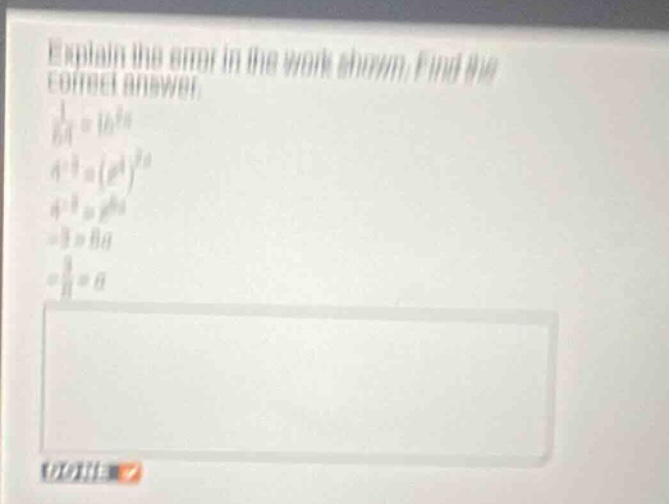
explain the error in the work shown. find the correct answer.
\\\frac{1}{64} = 16^{2a}\\
\\4^{-3} = (2^4)^{2a}\\
\\4^{-3} = 2^{8a}\\
\\-3 = 8a\\
\\-\frac{3}{8} = a\\
⚡ Using what you learned: Solving Exponential Equations
Step 1: Identify the error in the work
The original problem is:
In the second line of the shown work, the student wrote:
While \( \frac{1}{64} = 4^{-3} \) is correct, the bases on both sides must be the same to equate the exponents. The student expressed the left side with a base of \( 4 \) and the right side with a base of \( 2 \) (since \( 16 = 2^4 \)).
To solve correctly, both sides should be written with the same base, such as base \( 4 \) or base \( 2 \).
Step 2: Solve using a common base of 4
Express both sides with base \( 4 \):
Substitute these into the equation:
Step 3: Solve for x
Equate the exponents:

Snap & solve any problem in the app
Get step-by-step solutions on Sovi AI
Photo-based solutions with guided steps
Explore more problems and detailed explanations
Error: The student did not use the same base for both sides of the equation. They wrote the left side with a base of \( 4 \) (\( 4^{-3} \)) and the right side with a base of \( 2 \) (\( 2^4 \)).
Correct Answer: