QUESTION IMAGE
Question
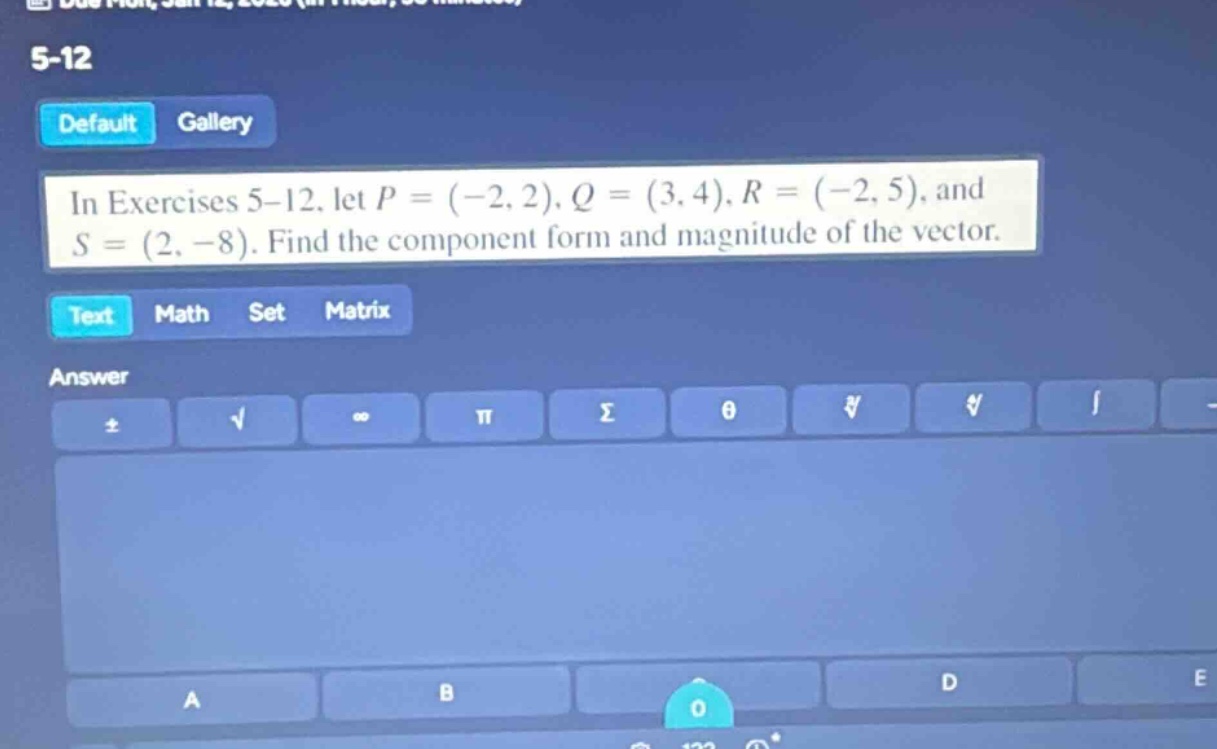
in exercises 5–12, let p = (-2, 2), q = (3, 4), r = (-2, 5), and s = (2, -8). find the component form and magnitude of the vector.
To solve the problem, we need to know which vector we are dealing with (e.g., \(\overrightarrow{PQ}\), \(\overrightarrow{PR}\), \(\overrightarrow{PS}\), etc.). Since the problem statement in the image is cut off, I'll assume we are finding the component form and magnitude of a common vector, say \(\overrightarrow{PQ}\) (but the process is similar for any vector between two of these points).
Step 1: Recall the formula for the component form of a vector
If we have two points \( A = (x_1, y_1) \) and \( B = (x_2, y_2) \), the component form of the vector \(\overrightarrow{AB}\) is given by:
Step 2: Recall the formula for the magnitude of a vector
For a vector \(\mathbf{v} = \langle a, b
angle\), the magnitude (or length) is given by:
Example: Finding \(\overrightarrow{PQ}\) (where \( P = (-2, 2) \) and \( Q = (3, 4) \))
Step 1: Component form of \(\overrightarrow{PQ}\)
Using the formula for the component form:
Step 2: Magnitude of \(\overrightarrow{PQ}\)
Using the magnitude formula:
If we instead consider \(\overrightarrow{PS}\) (where \( P = (-2, 2) \) and \( S = (2, -8) \))
Step 1: Component form of \(\overrightarrow{PS}\)
Step 2: Magnitude of \(\overrightarrow{PS}\)
Since the problem statement in the image is incomplete (it does not specify which vector to find), please clarify which vector (e.g., \(\overrightarrow{PQ}\), \(\overrightarrow{PR}\), \(\overrightarrow{PS}\), etc.) you need to compute, and I will provide the exact solution.

Snap & solve any problem in the app
Get step-by-step solutions on Sovi AI
Photo-based solutions with guided steps
Explore more problems and detailed explanations
To solve the problem, we need to know which vector we are dealing with (e.g., \(\overrightarrow{PQ}\), \(\overrightarrow{PR}\), \(\overrightarrow{PS}\), etc.). Since the problem statement in the image is cut off, I'll assume we are finding the component form and magnitude of a common vector, say \(\overrightarrow{PQ}\) (but the process is similar for any vector between two of these points).
Step 1: Recall the formula for the component form of a vector
If we have two points \( A = (x_1, y_1) \) and \( B = (x_2, y_2) \), the component form of the vector \(\overrightarrow{AB}\) is given by:
Step 2: Recall the formula for the magnitude of a vector
For a vector \(\mathbf{v} = \langle a, b
angle\), the magnitude (or length) is given by:
Example: Finding \(\overrightarrow{PQ}\) (where \( P = (-2, 2) \) and \( Q = (3, 4) \))
Step 1: Component form of \(\overrightarrow{PQ}\)
Using the formula for the component form:
Step 2: Magnitude of \(\overrightarrow{PQ}\)
Using the magnitude formula:
If we instead consider \(\overrightarrow{PS}\) (where \( P = (-2, 2) \) and \( S = (2, -8) \))
Step 1: Component form of \(\overrightarrow{PS}\)
Step 2: Magnitude of \(\overrightarrow{PS}\)
Since the problem statement in the image is incomplete (it does not specify which vector to find), please clarify which vector (e.g., \(\overrightarrow{PQ}\), \(\overrightarrow{PR}\), \(\overrightarrow{PS}\), etc.) you need to compute, and I will provide the exact solution.