QUESTION IMAGE
Question
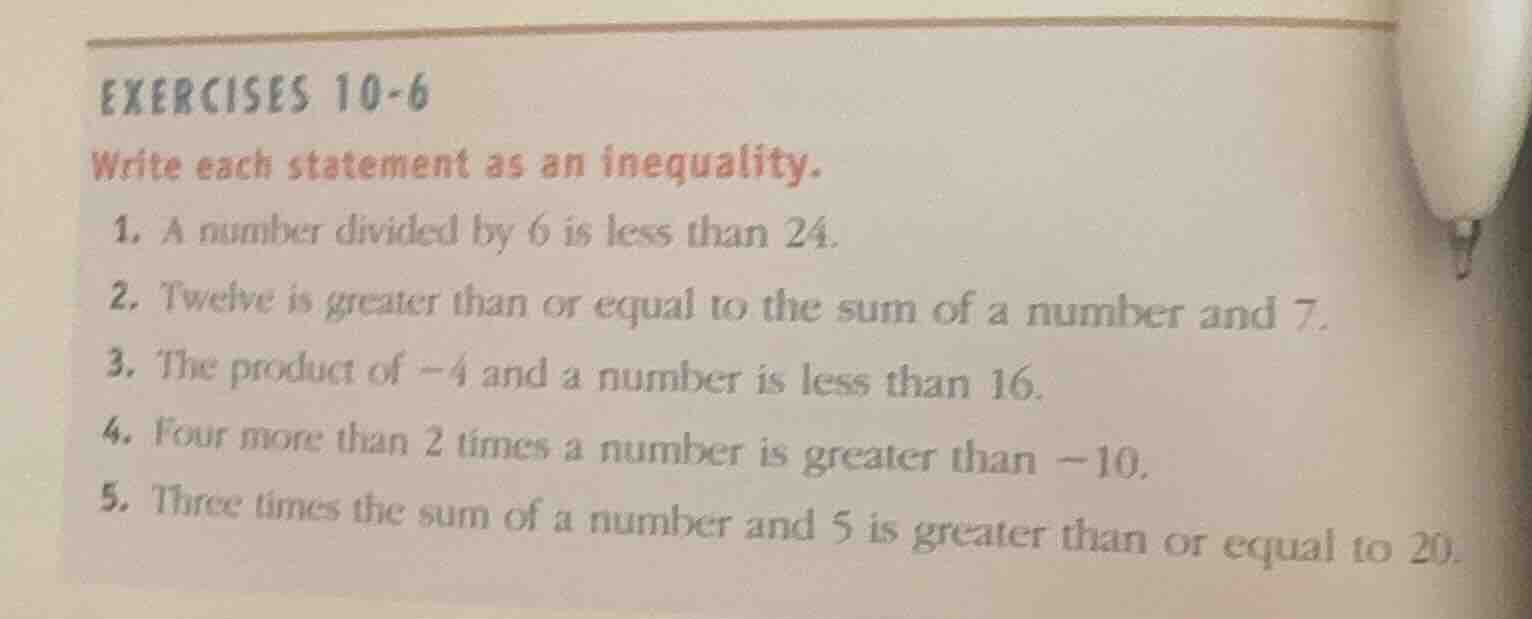
exercises 10-6
write each statement as an inequality.
- a number divided by 6 is less than 24.
- twelve is greater than or equal to the sum of a number and 7.
- the product of -4 and a number is less than 16.
- four more than 2 times a number is greater than -10.
- three times the sum of a number and 5 is greater than or equal to 20.
Translate Statement 1
Using the Translating Word Problems and Algebraic Modeling knowledge points
Let \(n\) represent the unknown number.
"A number divided by 6" translates to \(\frac{n}{6}\).
"is less than 24" translates to \(< 24\).
The complete inequality is:
Translate Statement 2
Using the Translating Word Problems and Algebraic Modeling knowledge points
Let \(n\) represent the unknown number.
"Twelve" is \(12\).
"is greater than or equal to" translates to \(\ge\).
"the sum of a number and 7" translates to \(n + 7\).
The complete inequality is:
Translate Statement 3
Using the Translating Word Problems and Algebraic Modeling knowledge points
Let \(n\) represent the unknown number.
"The product of -4 and a number" translates to \(-4n\).
"is less than 16" translates to \(< 16\).
The complete inequality is:
Translate Statement 4
Using the Translating Word Problems and Algebraic Modeling knowledge points
Let \(n\) represent the unknown number.
"2 times a number" translates to \(2n\).
"Four more than" means we add 4 to that expression, giving \(2n + 4\).
"is greater than -10" translates to \(> -10\).
The complete inequality is:
Translate Statement 5
Using the Translating Word Problems and Algebraic Modeling knowledge points
Let \(n\) represent the unknown number.
"the sum of a number and 5" translates to \((n + 5)\).
"Three times the sum" means we multiply the entire sum by 3, giving \(3(n + 5)\).
"is greater than or equal to 20" translates to \(\ge 20\).
The complete inequality is:

Snap & solve any problem in the app
Get step-by-step solutions on Sovi AI
Photo-based solutions with guided steps
Explore more problems and detailed explanations
| No. | Answer |
|---|---|
| 2 | \(12 \ge n + 7\) |
| 3 | \(-4n < 16\) |
| 4 | \(2n + 4 > -10\) |
| 5 | \(3(n + 5) \ge 20\) |